site.btaExperts Call for Clear Fiscal Direction, Stronger Business Role at Sofia Forum
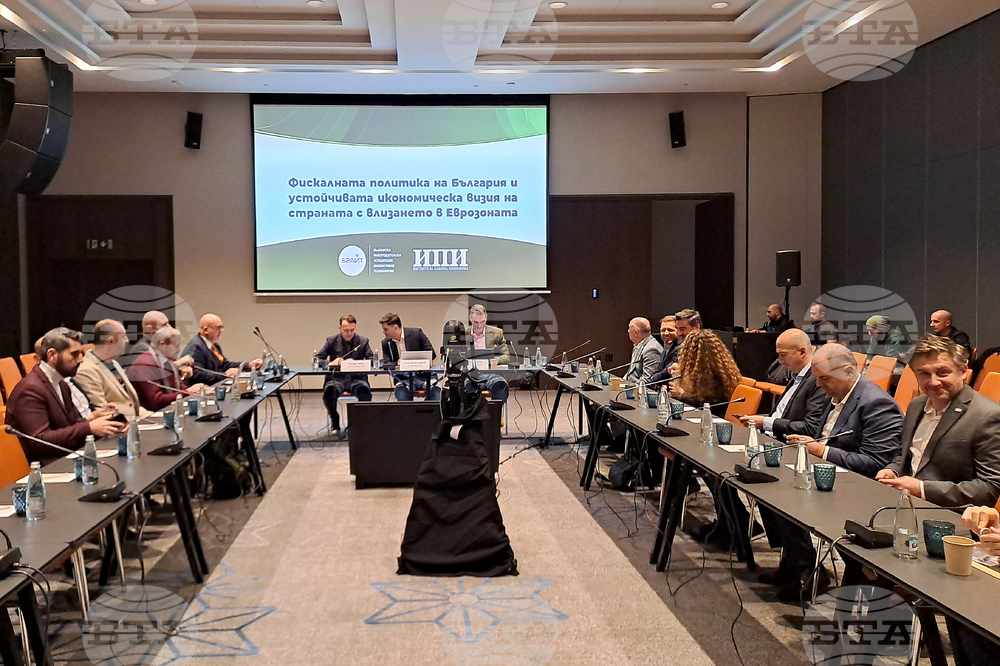
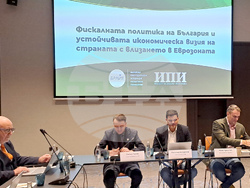
A roundtable on the fiscal policy and economic vision of Bulgaria as a future eurozone member brought together representatives of the business community, economists and financial experts on Friday. The event, held at the Hyatt Regency Sofia, was organized by the Bulgarian Employers' Association Innovative Technologies (BRAIT) and the Institute for Market Economics (IME).
Speakers outlined the need for a stronger business voice in policy-making, a reassessment of the country’s budget trajectory, and adherence to clear fiscal principles as Bulgaria prepares to adopt the euro on January 1.
Opening the forum, BRAIT Chair Ilia Krastev said business must exert more pressure, be proactive and maintain a constructive approach in the budgetary process. He argued that Bulgaria lacks consistent and in-depth debate on the budget and long-term development strategy. “We believe this does not happen often enough, nor in a constructive and coherent manner,” he said, adding that the private sector should both propose and criticize policies and explain their implications to society.
Krastev noted that Friday’s discussion would not be a one-off event. BRAIT plans a series of debates in early 2026 on reforms in the pension system, public-private partnerships and concessions, and healthcare.
IME Senior Research Fellow Petar Ganev highlighted the need to reverse Bulgaria’s budget trajectory to ensure success as a eurozone member. He said the debate concerns not only the 2026 draft budget but the broader medium-term direction of the country.
Ganev recalled that after a decade of unsuccessful transition policies before the 1997 currency board arrangement and nearly 28 years of stability marked by low taxes and declining debt, Bulgaria is entering a new period with euro adoption, which makes the current trajectory decisive.
He expressed concern that the shift toward higher taxes appears merely postponed to 2027-2028, citing debates on increasing health insurance contributions and the dividend tax. Ganev also pointed to political instability, repeated election cycles, and a record number of unadopted budgets as factors complicating fiscal policy. He said the dividing lines in society are reflected most clearly in the budget and that Bulgaria is once again confronted with a fundamental question of the past three decades: its economic and fiscal direction and the need for shared standards of integrity and anti-corruption.
IME chief economist Lachezar Bogdanov said the fundamental problem of Bulgaria’s fiscal policy is the political choice to significantly expand state redistribution and public expenditure. He explained that for most of the past 25 years, public spending averaged around 37% of GDP and rarely exceeded 40%, while in 2025 it is projected to reach 42.5%. The initial draft 2026 budget projected spending close to 46%, later revised to 45%.
Bogdanov warned that expenditure growth is driving the widening deficit, officially projected at 3%, but potentially higher. He said that without political will and broad consensus to curb the expansion of the state, tax increases will be unavoidable. He argued that recent decisions to avoid raising the dividend tax and to increase the pension contribution by only 2 percentage points delay the inevitable and cannot sustain an expanding public sector. Structural reforms, faster economic growth, better investment conditions and a more efficient public sector are essential, he said.
Lyubomir Karimanski, member of the Governing Council of the Bulgarian National Bank (BNB), outlined the key principles every government should follow when drafting the budget and updating the medium-term fiscal framework. He stressed the importance of effective allocation of public resources and strict adherence to fiscal rules.
Karimanski criticized arbitrary interpretations of expenditure levels, noting that even after excluding EU-funded spending, consolidated public expenditure remains close to 42% of GDP. He said tax and social-security revenues are already near their historical peak, leaving little room for increases, which makes expenditure the core issue. Optimization, he argued, should come through transforming public-sector activities rather than direct staff cuts, supported by detailed institutional assessments and better data.
/MR/
Additional
news.modal.image.header
news.modal.image.text
news.modal.download.header
news.modal.download.text
news.modal.header
news.modal.text