site.btaMedia Review: October 7
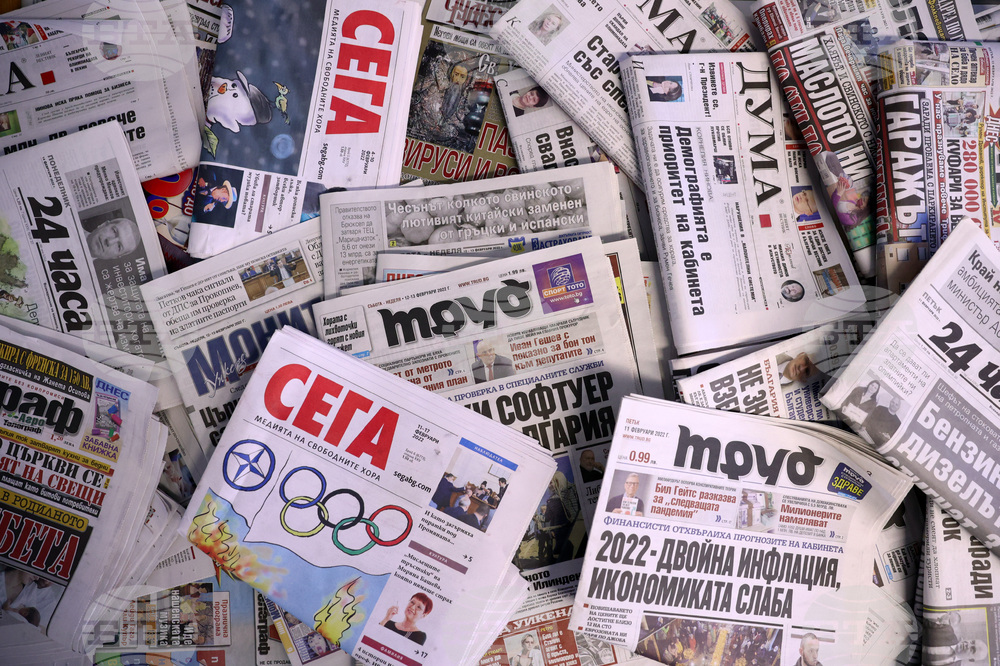
OVERVIEW
All media report on the two merchant vessels that were attacked with drones while sailing in the Bulgarian exclusive economic zone in the Black Sea in the early hours on Tuesday.
The daily 24 Chasa quotes a crew member of the ABLE, one of the vessels that was attacked, as saying: "I think the Russians dropped an underwater bomb on us." According to the sailor, an explosion came from the underwater section of the ship, and then a fire broke out.
In an interview for bTV cited by 24 Chasa, former foreign minister Nadezhda Neynsky noted that the war between Russia and Ukraine is no longer "just some foreign war, as was previously claimed – one being fought somewhere far away from us, in which we should not interfere". She warned that the war now poses an extreme threat to Bulgaria's national security.
The former minister noted that security in the Black Sea is not just a political and military issue but also an economic one. "If the Black Sea becomes a sea where commercial shipping is under threat, this has a direct impact on Bulgarians' pockets, as transport costs and insurance premiums rise," she added.
Commenting on the cabinet's position that debris from the drones are needed to officially confirm the drones' origin, Neynsky said: "If you do not want to, you might not even find any debris."
Neynsky stated that the security measures the state is taking should be revealed. She expects those in power to explain what will be done to prevent a similar incident from happening again. The former diplomat said: "NATO has a security strategy for the Black Sea. How Bulgaria will respond, and what it will ask of its allies, is of the utmost importance. This is one of the key questions facing the state at this moment."
Neynsky said that the statements made so far by President Iliana Iotova and Prime Minister Rumen Radev reflect a party-political stance rather than a national one. She added: "The Consultative Council is an important body. The National Assembly must now be convened to hold a debate and formulate a common national position on security. It is their responsibility to reach a consensus. So far, we have heard the position of the leader of Progressive Bulgaria [Radev] and that of the President, but we have not heard the state's national position." Neynsky concluded that the Consultative Council is the tool to be used to assess the potential threats. She shared her expectations to have the Russin Ambassador Eleonora Mitrofanova summoned and the issue of security in the Black Sea raised.
* * *
Prime Minister Rumen Radev reported that Bulgaria will purchase another five anti-aircraft missile systems on Wednesday. Dnevnik.bg notes that the German IRIS-T systems that Radev is referring to can be delivered to Bulgaria no sooner than five years from now. The article reads:
"The deal with Diehl Defence, which [Radev] referred to, dates back two years. It concerns an air defence system, with the option to order a further five by 2032. The price of a single system is EUR 182 million. The German company's website highlights that [...] for EUR 1.4 billion, Bulgaria could acquire seven IRIS-T SLM systems for the price of a single American Patriot. There are at least three important features associated with this system.
"First, it is designed to engage aircraft and cruise missiles, with a range of up to 40 km and an altitude of up to 20 km. The SLX model is intended for intercepting ballistic missiles, and Bulgaria has included this as an option in the contract. However, the first SLX system was demonstrated for the first time in February 2026 and is still undergoing further development.
"The second point is how many missiles Bulgaria would purchase. The price of a single missile can range from EUR 400,000 to 1 million. Each system is loaded with eight missiles. The problem lies not only in the price but also in the fact that currently around 75% of the production of this ammunition is destined for Ukraine, and even Germany is taking this into account in its readiness and schedule for replenishing stocks.
"The third factor is the delivery timeframe. Diehl Defence has officially stated a production capacity of ten IRIS-T missiles per year. The company's goal is to increase this to 16 by 2028. Its partner, Hensoldt, which manufactures the TRML-4D radar for the IRIS-T, announced last August that it would increase its capacity to 30 per year (between 40 and 60 are needed just to cover the entire German airspace). Production and supply contracts have already been signed not only by Germany, but also by Estonia, Latvia, Slovenia, Sweden, and Switzerland. A new Bulgarian order will have to join this queue, and it is known that the contract with Sweden alone will be fulfilled between 2028 and 2030.
"In addition, time is needed to train Bulgarian crews on these air defence systems and to introduce them into service in Bulgaria. The financing of the deal is a problem for the National Assembly and the state budget. Even when utilizing the European SAFE programme, Bulgaria is a participant, and this must be factored into budgetary plans, as in practice it amounts to incurring public debt. The funds under SAFE consist of bank loans guaranteed by the EU on favourable terms, with a 10-year grace period for principal repayment and a 45-year repayment term. However, this does not alter the fact that they constitute a loan."
* * *
Dnevnik.bg cites an interview for Vesselin Dremdjiev's YouTube channel, in which former defence minister Todor Tagarev reported that the government knows far more than it tells the public. Tagarev stated: "At the very least, the information on the ships in the area is detailed. The armed forces and our allies have surveillance systems in place. We can request information from the Ukrainian authorities regarding the ships and their cargoes. They do not share all the information, just as was the case with the drone near Kardam." The Kardam incident took place near the border with Romania on August 8.
The former minister said that by keeping the public in the dark, Prime Minister Radev is undermining confidence in the Bulgarian institutions. Tagarev stated that Bulgarian authorities have once again kept a low profile in the hope that the storm will blow over. He added: "This is not an escalation of the conflict. Russia has been doing this since 2023. For us, this is the most serious security-related incident. Right on our border, someone is attacking ships and killing their crews."
Tagarev said that Radev could ask NATO for help but does not wish to do so, because doing so would mean complete transparency and exchange of information.
ECONOMY
An article in Trud entitled "The new steel import regime and 50% higher tariffs will delay key energy and infrastructure projects" warns that under the European Union's new regulations on the supply of steel and iron, a new import regime for these materials has been introduced, involving a significant reduction in import quotas – by an average of around 47% – and a 50% increase in duties on quantities exceeding these quotas. According to the author, the EU's decision jeopardizes the implementation of strategic energy and infrastructure projects in Bulgaria and Europe, creating pressure in the form of higher costs, delays and difficulties in ensuring security of supply.
The text reads: "The regulations have a significant impact on the construction sector, for which steel and iron are a key component of every construction project. Strictly defined technical specifications apply to these materials, as well as pre-agreed parameters, quantities and delivery times. [...]
"The new regulations have an even greater impact on the implementation of public projects relating to the construction of strategic infrastructure, particularly in the case of contracts that have already been concluded, where a change of supplier or product at short notice would require new technical approval procedures to be followed. This, in turn, will have a negative impact on the project's fixed completion deadlines, as well as on the budgetary framework under the contracts. Any amendment to the latter will necessitate additional public funding.
"The construction sector and industry associations in Bulgaria place special emphasis on projects of national and European significance, such as the construction of gas transmission and energy infrastructure, where the steel products used must often comply with specific technical parameters, standards and requirements specified by the contracting authority. Any change relating to a manufacturer or product would require a new technical assessment, changes to the project documentation and further coordination, which would inevitably affect completion deadlines and, consequently, would impact the security of supply, the reliability of the energy system and the development of cross-border energy interconnections."
* * *
The World Bank has lowered its forecast for Bulgaria's economic growth next year, Dnevnik.bg reports. The institution now expects a tightening of fiscal spending as well as weaker income growth in 2027, which is likely to lead to a decline in consumption. Consumption has been one of the main drivers of growth in recent years. The World Bank has maintained its forecast of 2.6% growth this year and, instead of 2.9% for next year, it now expects 2.6% again. For 2028, the outlook is for a slight acceleration to 2.7%.
INFRASTRUCTURE
Mediapool.bg reports that hundreds of residents of Sofia in the boroughs of Iztok, Mladost, and Druzhba have been left with no hot water for more than a month due to widespread faults that occurred following two weeks of scheduled maintenance. The annual maintenance work took place from August 28 to September 13, during which there was no hot water in 14 Sofia boroughs.
The problem today affects large parts of eastern Sofia. It is not clear exactly when hot water will be restored to those affected. The deadlines currently given may well be extended, as has happened on more than one occasion so far.
The article reads: "In a response to Mediapool, Toplofikacia Sofia stated that work is being carried out systematically to rectify the faults, with priority given to those affecting the most people. They did not specify exactly how many people were involved in the repairs to the network. [...] Residents of the affected buildings say they have not noticed any work being carried out on the leaks, or that Toplofikacia teams arrived, dug up the area and then did not return."
Toplofikacia reported: "Following the completion of the annual maintenance work on the Sofia Iztok area and the restoration of the heat supply, numerous faults occurred in heavily worn sections of the heat distribution network. This was due to the technical condition and the high degree of wear and tear on certain sections of the network." When faults are rectified and the network is subsequently repaired and restored to operational status, new faults arise in other compromised sections, necessitating a further shutdown, localization and rectification of the next fault.
The article continues: "The constant breakdowns on Toplofikacia's network are the result of a long-standing lack of investment in replacing worn-out pipes. This has led to an increase in breakdowns and water losses. In 2025, losses due to leaks accounted for over 10% of the heat energy produced, according to the company's financial report. Water consumption is also rising, which is likewise due to the ever-increasing volumes leaking through the damaged network.
"The largest municipal company continues to accumulate losses. For 2025, it recorded a loss of BGN 426 million, or around EUR 215 million. A year earlier, the loss stood at BGN 143 million. Toplofikacia Sofia's total liabilities at the end of 2025 stood at BGN 2.7 billion, or around EUR 1.4 billion. These relate mainly to gas supplies to the state-owned company Bulgargaz as well as to old gas-related liabilities transferred to Bulgarian Energy Holding.
"According to the Mayor of Sofia, Vassil Terziev, stabilizing the district heating system requires putting it out to concession. To this end, however, the mayor is insisting on obtaining authorization from the municipal council to carry out an analysis of Toplofikacia's current state and potential development. The decision never reached a vote. In fact, a similar analysis was carried out years ago, and during the previous term of office a decision was taken to launch a procedure to attract an external investor for the capital's district heating system. This procedure never actually got off the ground."
CRIME
Bulgarian National Television reports that Wednesday is the third consecutive day of bomb threats against public institutions. Yet another report was received that an explosive device had been planted at the Palace of Justice in Burgas, on the Black Sea, the third such incident since the start of the week.
On Tuesday, six telephone reports were received regarding explosive devices in schools in Smolyan, Chepelare, and Madan, all three in Southern Bulgaria. On Wednesday, a new report was received concerning the nursery in the village of Srednogortsi, near Madan.
All reports were investigated, and no explosive devices were found.
A bomb threat was also received in Kazanlak, South Central Bulgaria. The message was sent to the municipal administration's email address shortly after 11:30 a.m. Staff have been evacuated from the building, and an investigation is underway at the scene. At present, there is no information regarding an explosive device having been found.
/NZ/
news.modal.header
news.modal.text