site.btaMedia Review: July 20
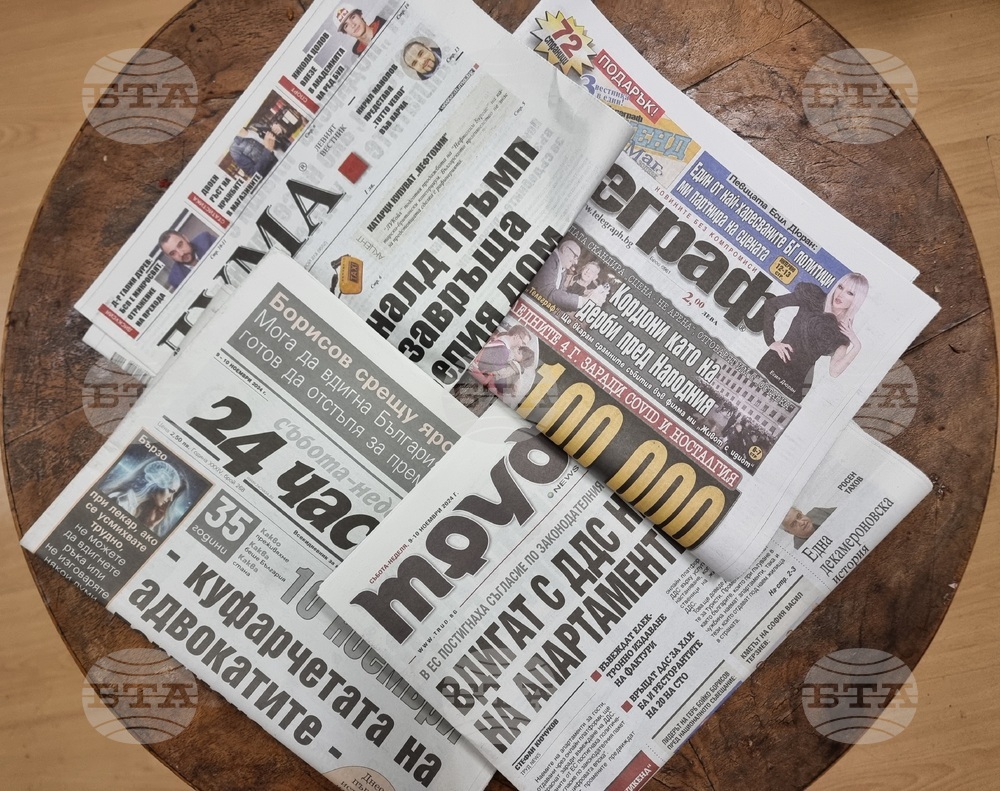
All media outlets have covered Spain's 1–0 victory over Argentina in Sunday's FIFA World Cup final. Mediapool.bg reports that France's Kylian Mbappé finished as the tournament's top scorer, ending the event with ten goals. Dnevnik.bg carries an article titled "How the World Cup Became a USD 10 Billion Event," describing the 2026 tournament as the sport's largest revenue-generating machine.
POLITICS
In a discussion on Nova TV's morning show, journalists broadly agreed that the Radev government is sending mixed foreign policy signals. They pointed to the contrast between Foreign Minister Velislava Petrova's participation in the Ukraine–Southeast Europe Summit in Kyiv, where her name appeared in the preamble to the Kyiv Declaration, and the government's simultaneous insistence that Bulgaria has no place in the Coalition of the Willing. Ruzha Raycheva of OFFNews believes Bulgaria appears hesitant rather than strong in foreign affairs because of these contradictory messages. Bozhidar Rusev of Darik Radio said that the government's current strategy allows different audiences to hear what they want: pro-Russian voters see that Bulgaria refuses to be part of the Coalition of the Willing, while pro-European voters see the foreign minister attending the Kyiv summit and supporting the Kyiv Declaration.
A similar view is expressed in an interview with 24 Chasa by historian Ivan Ilchev. He criticizes the idea that Bulgaria should remain neutral in the current geopolitical environment. In his view, "Europe must remain united, because a divided Europe is weaker and more vulnerable to the United States, Russia, or China, as well as to emerging BRICS powers such as India and Brazil." Ilchev also argues that North Macedonia is deliberately delaying implementation of its commitments in the expectation that political fatigue in the EU will eventually shift pressure from Skopje onto Sofia.
*
24 Chasa reports that the Defence Ministry is considering introducing mandatory military training for people seeking careers as police officers, private security guards, special services employees, or even civil servants. The proposal is outlined in the 2025 Defence Report, which Rumen Radev's Cabinet has submitted to Parliament, the daily says, noting that the debate over compulsory military service has gained renewed prominence since Russia's invasion of Ukraine in 2022.
*
In an interview with Bulgarian National Radio, sociologist Elena Darieva discussed proposed amendments to the Election Code concerning the publication of sociological polling on election day. Darieva said there is strong interest in polling data both during election campaigns and on election day because such information can influence undecided voters. She notes that 15–21% of voters decide how to vote during the final week before the election and 3–8% make their choice on election day itself. Last-minute voters often benefit either new political entrants or whichever party appears strongest, reflecting what is referred to as the bandwagon effect. Darieva noted that rather than introducing new restrictions on election-day polling, policymakers should ensure that the existing rules are properly enforced.
ECONOMY
Speaking on Bulgarian National Television, parliamentary Committee on Budget and Finance Chair Konstantin Prodanov said that frozen social benefits, including maternity benefits, will be restored in the 2027 budget. "Work on the new fiscal plan will begin in two months," he noted, saying that "the 2027 budget will reflect Progressive Bulgaria's policies in full: eliminating financial leakages in the healthcare system, actively attracting foreign investment, and implementing administrative reform." On the government's position regarding the war in Ukraine, Prodanov said Bulgaria was providing assistance "within its means," which currently do not include financial or military support. "We are helping in the economic and energy sectors. We are not preventing others from providing assistance, nor are we blocking anything," he said. Prodanov added that the conflict should be resolved peacefully through negotiations involving Russia, Europe, Ukraine, and the United States.
*
Interviewed on bTV's morning show, National Tourism Board Executive Director Polina Karastoyanova said that the withdrawal of Qatar Airways from the Bulgarian market is not a sign of declining interest in the country but rather a consequence of the changing geopolitical environment and the airline's route network restructuring. Karastoyanova said the decision should be viewed in the context of the conflict in the Middle East, which has affected the aviation sector and tourism flows across the region. "The route was used primarily as a convenient connection through Doha to destinations in Asia, Africa and Australia, rather than for direct tourism between Qatar and Bulgaria," she said. The Tourism Ministry has launching talks aimed at offsetting the loss of air connectivity through alternative airlines and routes via the United Arab Emirates, Karastoyanova said. She also commented on the expected decline in the number of German tourists this summer, attributing it to problems in the air transport sector. She recalled that a commercial dispute between airlines had led to the cancellation of a charter programme, which is expected to reduce arrivals from Germany by more than 100,000 tourists this season. Despite these challenges, Bulgaria remains well positioned in the international tourism market, she said.
*
"The situation on Bulgaria's fuel market is calm for the time being. We have no problems with supplies or refining, and there are no issues with prices either. Our prices remain among the lowest in the EU," Bulgarian Petroleum and Gas Association Chair Svetoslav Benchev told BNR after US Secretary of State Marco Rubio announced that American strikes would continue as long as Iran attacks vessels in the Strait of Hormuz.
HEALTH
Citing data from Bulgaria's National Center for Public Health and Analyses, Trud reports that more than 50% of Bulgarians are overweight, while around 20% are obese on average. According to data from the World Health Organization, Bulgaria ranks sixth in Europe for adult obesity and fifth for childhood obesity. Experts estimate that obesity now costs the country more than 9.4% of its gross domestic product.
In another article, the daily warns against the growing trend of self-administering injectable weight-loss peptides obtained through social media and unregulated online sellers.
SOFIA METRO
Capital.bg reports that in late June, Metropolitan JSC signed two contracts worth nearly EUR 140 million (excluding VAT) for the construction of approximately 1.8 kilometres of new metro line and two stations. The combined value of the contracts is nearly double the initial estimate published in spring 2024. The contracts were awarded to two consortiums, including Bulgaria's major construction firms GP Group and Trace Group Hold, as well as a company co-owned by the mother of businessman Krasimir Georgiev. Georgiev came to public attention in 2009 amid a scandal involving alleged influence peddling in appointments to the Supreme Judicial Council and the wider judiciary, the media outlet notes. According to Metropolitan, the two new stations are expected to serve nearly 28,000 passengers daily in each direction. Both contracts have a 36-month implementation period. If construction begins as scheduled and no major delays occur, the stations could become operational as early as 2029.
ROAD SAFETY
A series of serious crashes in which trucks have torn through motorway guardrails and crossed into oncoming traffic has once again raised concerns about road safety in Bulgaria. Speaking on Nova TV's morning show, road safety expert Vladimir Zhiyanski said that the widely used metal guardrails are incapable of stopping trucks, despite costing several times more than reinforced concrete alternatives. According to the manufacturers and representatives of the investors, their capacity is up to 1,500 kilograms, Zhiyanski said. This means that they cannot stop a large truck, a smaller truck, or even some of the heavier passenger vehicles.
Trud has an interview with Institute of Transportation Engineering General Manager Hristo Grozdanov who also argues that Bulgaria should replace conventional metal guardrails with concrete median barriers on motorways because they provide significantly better protection against cross-median crashes. "A concrete safety barrier on a motorway saves human lives," he says. One of his strongest criticisms is that road infrastructure decisions are driven by price rather than long-term safety outcomes. Grozdanov notes that many European countries and the United States already use concrete median barriers extensively on high-speed roads.
/IV/
news.modal.header
news.modal.text