site.btaUPDATED Cabinet Approves Draft 2026 Budget Package
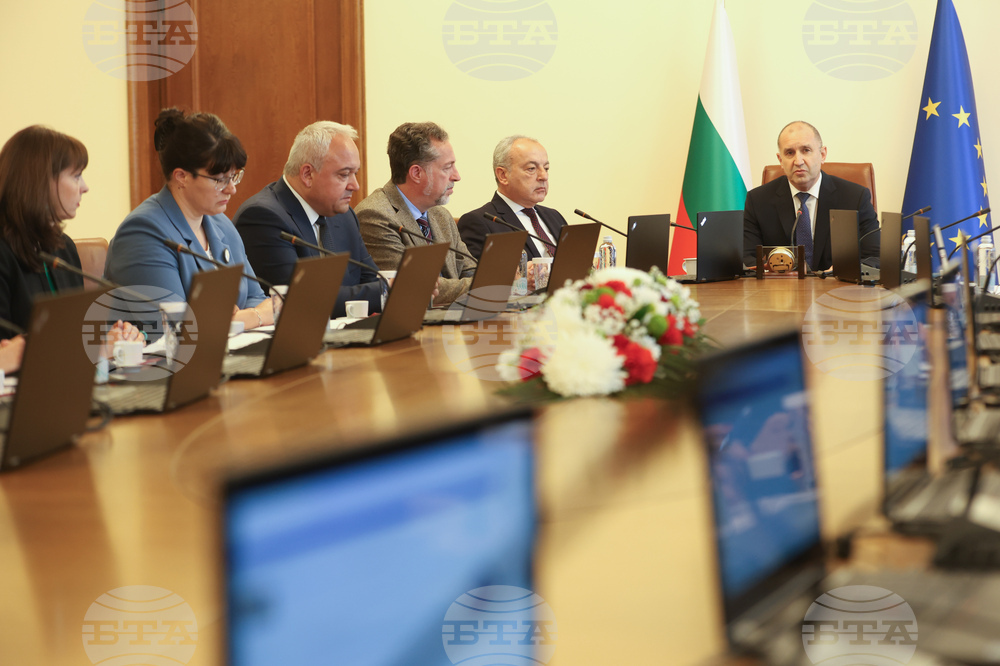
Deputy Prime Minister and Minister of Finance Galab Donev said at a briefing on Wednesday that the Government has approved a draft State Budget, and that he expects "serious, responsible, and meaningful work and debate on it in the National Assembly.” Later in the day, the Council of Ministers' press centre said that the Cabinet has also approved the draft Public Social Insurance and National Health Insurance Fund budgets for 2026.
State Budget
Donev also said that operating expenditures are increasing by more than EUR 1.34 billion compared to 2025. Under the draft State Budget, expenditures increase by EUR 779.5 million, covering EUR 142.2 million for the snap parliamentary elections and the upcoming presidential election; EUR 48.5 million for Bulgaria's hosting of the Giro d'Italia; EUR 20 million for preparations to host the Eurovision Song Contest.
Outstanding liabilities from previous years for current road maintenance and repair under the budget of the Ministry of Regional Development amount to EUR 139.5 million. According to Donev, this increase covers only part of the costs arising from out-of-court settlement agreements concluded in 2024–2025 to resolve litigation related to delayed payments under contracts signed after 2021, including interest and legal expenses, which are expected to total approximately EUR 160 million in 2026.
Expenditure under municipal budgets financed from municipalities' own revenues and carried-over budget surpluses is increasing by EUR 96.9 million. An additional EUR 2.5 million is allocated to municipalities to compensate transport operators providing school transport because of higher fuel prices; EUR 8.1 million is earmarked to compensate parents whose children were not admitted to kindergartens and nurseries; and EUR 30 million is allocated for the Christmas bonus payment.
Increased defence spending amounts to EUR 80.9 million. A further EUR 170 million has been allocated to support agricultural producers in response to higher fuel prices resulting from the war in Iran. Another EUR 55 million is earmarked for de minimis aid to the transport sector to offset the increase in road toll charges. Donev said that the previous two governments had failed to take action to increase toll charges, leaving Bulgaria at risk of infringement proceedings by the European Commission.
Capital expenditure for 2026 is set to increase by EUR 2.5 billion compared with the previous year, of which EUR 1.8 billion will come from European Union funds and EUR 681 million from the national budget. Capital funding for municipalities will total EUR 2.13 billion, representing an increase of more than EUR 1 billion, Finance Minister Galab Donev said.
He noted that no funding for the municipal investment programme had been included in the budget estimates prepared in December 2025. By contrast, the current draft budget, for the first time, allocates a realistic EUR 1.1 billion for the programme. The Finance Minister also stressed that the largest increase in capital expenditure is for defence, amounting to EUR 158 million, in line with the target level of defence spending as a percentage of GDP. Under the central government budget, planned capital expenditure has also been reduced to EUR 227.6 million, with almost all of the funds earmarked for the settlement of outstanding liabilities from 2025, Galab Donev said.
Overall, capital expenditure financed by European Union funds is planned to total EUR 5.3 billion. The Deputy Prime Minister also stated that additional spending amounting to EUR 1.1 billion in 2026, approved by the governments of Rosen Zhelyazkov and Andrey Gurov while operating under an extended budget law, has been incorporated into the budget framework.
Public Social Insurance Budget
The Council of Ministers approved the Public Social Insurance Budget bill.
The average pension in 2026 is expected to reach EUR 543.46. Pensions are projected to record real growth of 4.5%, against forecast average annual inflation of 4.3% based on the Harmonised Index of Consumer Prices for 2026.
As of July 1, 2026, all pensions granted by the end of 2025 are to be adjusted under the so-called Swiss rule, provided for in Article 100 of the Social Insurance Code, by 7.8%. From the same date, the minimum old-age pension for insured service and age with a full contribution record will increase from EUR 322.37 to EUR 347.51. The social old-age pension and related pensions and supplements will also be increased from July 1 by the percentage determined under the Swiss rule. The maximum monthly amount payable from one or more pensions will remain unchanged from its 2025 level of EUR 1,738.40.
In 2026, women working under third-category labour conditions will be eligible for retirement upon reaching 62 years and six months of age and having 36 years and 10 months of insured service. For men, the requirements will be 64 years and nine months of age and 39 years and 10 months of insured service.
A total of EUR 13.5039 billion has been earmarked in 2026 for the payment of all types of pensions and related supplements, representing 10.8% of the country's projected gross domestic product. This is EUR 1.1799 billion, or 9.6%, more than the amount allocated for pensions under the 2025 Public Social Insurance Budget.
The minimum insurable income for self-insured persons will be EUR 620.20 as of August 1, 2026. From the same date, the maximum insurable income for all insured persons will increase to EUR 2,300.
The benefit for raising a child up to the age of two, as well as the benefit paid to fathers (or adoptive parents) for raising a child up to the age of eight, will remain unchanged at EUR 398.81. The minimum daily unemployment benefit of EUR 9.21 and the maximum daily unemployment benefit of EUR 54.78 will also remain unchanged.
As of August 1, 2026, civil servants covered by the Civil Servants Act and employees under the Judicial System Act will begin paying personal social security contributions. From that date, social security contributions will be shared between the employer and the insured person at a ratio of 80:20. As of January 1, 2027, the ratio will change to 60:40, in line with the arrangement applicable to other employees.
National Health Insurance Fund Budget
The Council of Ministers approved the draft 2026 Budget of the National Health Insurance Fund (NHIF).
The draft provides for revenues and transfers totalling EUR 5,256,677,200. Health insurance revenues are projected at EUR 5,138,270,600, including EUR 3,187,527,600 from health insurance contributions and EUR 1,950,743,000 in health insurance transfers.
Total expenditure under the draft NHIF Budget Act for 2026 amounts to EUR 5,256,677,200.
The projected revenues and expenditures are EUR 412,331,700 higher than those provided for in the 2025 National Health Insurance Fund Budget Act, representing an increase of 8.5%.
Funds allocated for health insurance payments amount to EUR 4,933,102,800, which is EUR 395,960,600 more than under the 2025 NHIF Budget Act, or an increase of 8.7%.
In 2026, the Ministry of Health is expected to provide monthly transfers to the NHIF budget, amounting to a total of EUR 101,490,700 for the year, to cover activities outside the scope of compulsory health insurance.
The draft 2026 National Health Insurance Fund Budget Act has been prepared in line with the budgetary framework while maintaining the health insurance contribution rate at 8%. The draft budget envisages that public funds will be spent lawfully, transparently and efficiently.
The parameters set out in the draft 2026 NHIF budget establish a stable financial framework for the functioning of Bulgaria's health insurance system.
/KK/MR/
news.modal.header
news.modal.text