site.btaMedia Review: June 5
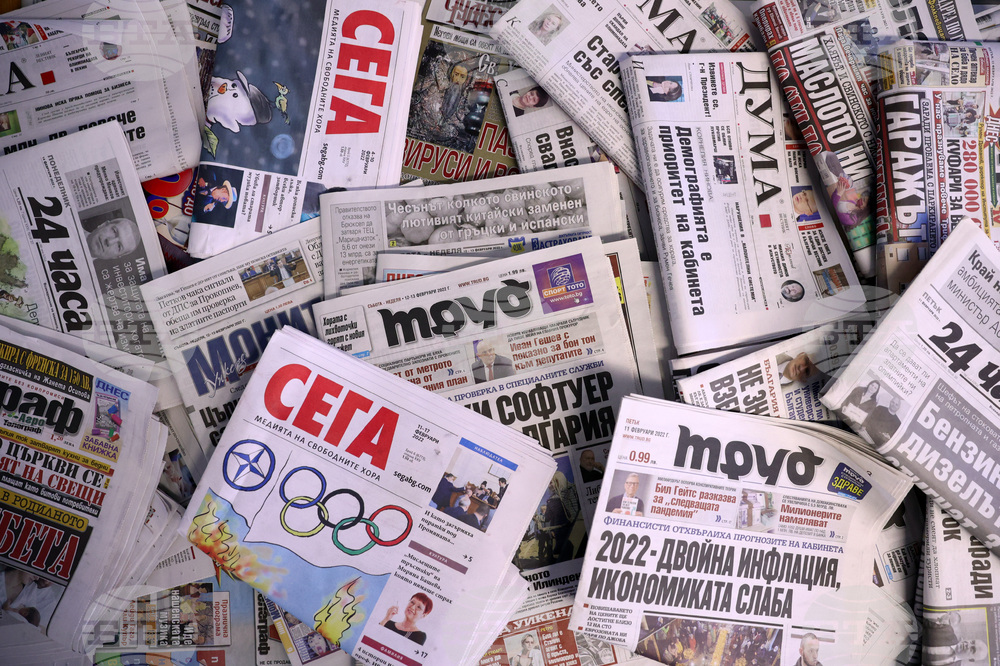
POLITICS
24 Chasa reports that the ruling Progressive Bulgaria (PB) has taken control of 15 of the National Assembly’s 24 standing committees, while also securing deputy chair positions in all committees. GERB received three committee chairmanships, the Movement for Rights and Freedoms (MRF) and Democratic Bulgaria got two each, while Continue the Change and Vazrazhdane - one.
PB floor leader Petar Vitanov was elected head of the Foreign Policy Committee. Progressive Bulgaria also secured leadership of the Legal Affairs, Budget, Economy, European Affairs and Anti-Corruption committees. The Anti-Corruption Committee will be chaired by former Plovdiv police chief Dimitar Balev.
The Committee overseeing the special services and the use of special surveillance means will operate under a rotating chairmanship, with veteran politician Rumen Milanov serving first. Anton Kutev will chair the Culture and Media Committee, while Dimitar Zdravkov will head the Education Committee.
The newspaper notes that GERB leader Boyko Borissov and MRF leader Delyan Peevski will not participate in any parliamentary committees. The MRF returns to committee leadership positions after being excluded during the previous parliament because of the so-called sanitary cordon around Peevski.
An unexpected development was the election of Continue the Change lawmaker Venko Sabrutev as chair of the Social Policy Committee, while former Labour Minister Denitsa Sacheva was not nominated by GERB for the Committee despite her extensive experience in the field.
The topic is covered by other major Bulgarian media outlets.
***
Sega carries an interview with journalist Petko Georgiev, who argues that the new Government has yet to demonstrate a genuine campaign against oligarchic influence.
According to Georgiev, current developments suggest a replacement of one power model with another rather than meaningful reform. He said concerns are justified that the “Borissov-Peevski model” could be replaced by a “Radev model” characterised by concentrated executive power.
He also criticised what he described as inconsistent policy the messages from the governing majority, citing conflicting statements over possible reductions in spending on culture, pensions and maternity benefits. Georgiev concluded that the government's early performance has been unconvincing and that enthusiasm surrounding its electoral victory is beginning to fade.
***
Duma reports that Parliament adopted amendments to the Investment Promotion Act creating an Investment Coordination Council under the Council of Ministers.
According to the bill's sponsors from Progressive Bulgaria, led by Petar Vitanov, the new body will coordinate efforts to attract investment and improve cooperation among state institutions involved in the process. Following a proposal by Continue the Change MP Stoyu Stoev, the Justice Minister will also sit on the council.
Vazrazhdane criticised the initiative, arguing that its functions overlap with those of the InvestBulgaria Agency. The party said it would seek six-monthly reports to Parliament on the council’s activities and effectiveness.
***
Nova TV examines the performance of Prime Minister Rumen Radev's Government during its first month in office, asking whether the Cabinet's early record reflects a lack of governing experience or the fulfilment of campaign promises. The report notes that the government came to power after Progressive Bulgaria secured an outright parliamentary majority in the April 19 elections and formed Bulgaria's first single-party majority government in nearly three decades.
Journalist Ruzha Raycheva said the biggest surprise for the public has been the Government's more assertive approach to foreign policy. She pointed to the deadlines set for the US over the issue of the American aircraft stationed at Sofia Airport. "We are seeing the first steps towards fulfilling the campaign promises to limit behind-the-scenes dependencies, but the most important part is still ahead - the audits of contracts and spending in state institutions. This review will show to what extent the old system has been disrupted," Raycheva
said on Nova TV's morning programme. The report adds that the Government's success will ultimately depend on whether it can translate its anti-corruption pledges into concrete institutional reforms and deliver visible results in the coming months.
The assessments of political analysts Veselin Stoynev and Lyubomir Stefanov were more critical. Stoynev said the cabinet's first mistakes were not merely communication failures but reflected a "structural mismatch between public expectations and the ability of a new political formation to shoulder the burden of governing". He argued that many more "growing pains" lie ahead and that public patience is likely to diminish over time. Stefanov said he has yet to see concrete policies behind many of the government's campaign pledges.
JUSTICE
Capital, Trud and other media report that former Bulgarian Development Bank chief executive Stoyan Mavrodiev has been detained in Belgrade following a Bulgarian extradition request.
Mavrodiev has been wanted since 2024 in connection with a BGN 150 million loan granted by the state-owned bank to the Roadway Construction company. Prosecutors accuse him of misconduct related to the loan, which was linked to businessman Rumen Gaytanski.
Capital recalls that the loan was issued in 2019 and was later criticised because the pledged collateral proved largely worthless. The bank eventually recovered an asset sold for only a fraction of the original loan value.
Trud writes that Serbian authorities have placed Mavrodiev in detention for 18 days pending receipt of extradition documents from Bulgaria. The newspaper notes speculation that he may have sought to replicate the situation of fugitive banker Tsvetan Vassilev, who has remained in Serbia for years despite Bulgarian extradition efforts.
Capital also highlights testimony published by BIRD.bg in which Gaytanski allegedly claimed that part of the BGN 150 million loan was intended to benefit former MRF honorary chairman Ahmed Dogan. According to the testimony, approximately BGN 30 million was used to cover liabilities linked to TPP Varna. The allegations have not been tested in court.
***
Mediapool publishes the full transcript of a 9 October 2024 interrogation of businessman Rumen Gaytanski conducted by investigators from the Anti-Corruption Commission.
According to the transcript, Gaytanski alleged that for years he operated as a proxy for Ahmed Dogan in public procurement schemes involving waste management, construction and infrastructure projects. He claimed he was required to transfer money, luxury goods and other benefits to Dogan and that approximately BGN 30 million from the controversial BDB loan ultimately went to settle obligations linked to Dogan.
The testimony also names several current and former MRF figures and local officials whom Gaytanski claims facilitated procurement contracts in municipalities with strong MRF influence. Mediapool notes that the interrogation occurred while Gaytanski remained in detention. He was released on bail one week later.
The publication stresses that the transcript originates from a leaked investigative file and contains allegations by Gaytanski that have not been adjudicated by a court.
***
Duma reports that prosecutors in the southern city of Plovdiv have uncovered an organised criminal group accused of defrauding the National Health Insurance Fund through fictitious rehabilitation treatments.
According to prosecutors, two sisters working as a rheumatologist and rehabilitation specialist, together with the director of a rehabilitation facility in Banya, were at the centre of the scheme.
Investigators allege that around 4,000 people were registered as patients over a one-year period after being recruited through Viber and Instagram groups. Although many allegedly received only inexpensive holidays rather than medical treatment, the NHIF reportedly paid approximately EUR 500,000 for the services.
Prosecutors also said some individuals paid EUR 100 for improperly issued sick leave certificates. The five defendants face penalties ranging from three to 15 years in prison and confiscation of assets if convicted.
***
Dnevnik and bTV report that the European Public Prosecutor's Office (EPPO) in Sofia has filed an indictment with the Sofia City Court against the representative of a Bulgarian company suspected of fraud involving EU and
national funding under two projects financed by the European Regional Development Fund (ERDF). The projects were approved under the Innovation and Competitiveness Operational Programme and were intended to support innovation and expand the production capacity of small and medium-sized enterprises.
The outlets note that, according to the investigation, the defendant submitted false information and documents in connection with the projects. Prosecutors allege that the company falsely declared it had no outstanding tax or social security liabilities, provided misleading information regarding procurement procedures and technical implementation, and claimed that certain machinery and production capacities existed or had been put into operation when this was not the case.
Dnevnik adds that the first project concerned the production of an innovative reservoir with a seamless hydro-insulated coating, while the second focused on increasing production capacity through the acquisition of industrial equipment. As a result of the alleged fraud, the company obtained more than EUR 693,000 in grant funding, including approximately EUR 589,000 from the ERDF and the remainder through national co-financing from the Bulgarian state budget.
ECONOMY AND DEFENCE
In the context of the National Assembly's Budget and Finance Committee approving fines for monopolistic companies found to be charging excessively high prices, BNR interviewed economist Dimitar Chobanov, who argued that the supply chain should become more transparent to address public concerns over rising prices. He said greater visibility of pricing at every stage, from producer to retailer, would help identify where markups are being generated and whether market distortions are contributing to inflationary pressures. He added that public debate has largely been shaped by representatives and lobbyists of large retail chains, which are mobilizing against the proposed measures because they threaten profit margins that retailers have come to regard as normal. Chobanov said that the role of regulators and lawmakers is to ensure that market conditions are brought closer to those in other European countries.
The economist also cautioned against relying exclusively on punitive measures and argued that sustainable price control requires stronger competition and better market oversight. He said the Government's approach to public finances has so far demonstrated good intentions but lacks a comprehensive package of measures. Chobanov noted that public spending has reached record levels because of policies pursued by successive governments since 2020 and pointed to the European Commission's ongoing excessive deficit procedures, including the one against Bulgaria. He concluded that it will be impossible to adopt a realistic and fully executable budget that meets the relevant fiscal criterion this year.
***
Capital reports that Bulgaria’s largest state-owned arms producer, VMZ Sopot, recorded a sharp decline in revenue during the first quarter of 2026.
Revenue fell by roughly one-third year-on-year to slightly above EUR 100 million, while profit declined by nearly two-thirds. The company nevertheless expects to fulfil contracts worth around EUR 350 million by the end of the year.
The newspaper also notes a 40% decline in revenue at the smaller state-owned company NITI Kazanlak. Management attributes the weaker performance to a reduced volume of orders and changing military demand patterns, including greater reliance on drones and longer-range missile systems.
By contrast, state arms trader Kintex reported stronger revenue growth and a significant increase in profit.
***
Dnevnik writes that Bulgaria has supplied Soviet-era T-72 tanks to Ukraine, as quoted by the Defence Express Media, the Military & Defence Portal of Ukraine. The outlet reports that the deliveries were not made directly by the Bulgarian state but through intermediary transactions involving other NATO countries, primarily Czechia, which subsequently transferred the equipment to Kyiv. The report says the transfers included 22 T-72 tanks, artillery systems, armoured vehicles and other military equipment.
The outlet also provides specific data on Soviet-era weapons transferred through these intermediaries. According to UN records cited in the publication, Bulgaria exported 65 pieces of military equipment to Czechia, including: 40 MT-LB tracked armoured personnel carriers, 22 T-72 tanks, 2 Humvee armoured vehicles, 1 BMP-1 infantry fighting vehicle, 38 artillery systems of 122 mm calibre. A further 24 units were exported via the UK. There is also data of direct contracts with Ukraine, mainly involving light weapons and small arms.
TRANSPORT
24 Chasa reports that Transport Minister Georgi Peev has called for closer coordination among institutions to accelerate certification and deployment of new trains supplied by Alstom.
Two electric trainsets have already arrived in Bulgaria. According to company representatives, an audit of testing results is scheduled for 17 June, followed by vehicle-type approval procedures in July and subsequent certification.
The Ministry expects one fully registered train to be operational by the end of August, with additional units entering service gradually. Maintenance facilities are being developed near Svetovrachane (West Bulgaria) and in the Plovdiv region.
Peev said the arrival of the trains marks the beginning of a long-awaited renewal of Bulgaria’s ageing railway rolling stock and stressed the need to prevent vandalism targeting the new equipment.
LUBEN DILOV JR – FUNERAL
Nova TV, bTV and BNR report that family members, friends, colleagues, politicians and public figures are expected to gather on Friday at the St. Sophia Church in Sofia to bid a final farewell to Luben Dilov Jr., who died earlier this week at the age of 61. The funeral service is scheduled to begin at 1 p.m. at the church.
All broadcasters recall Dilov's prominent role in Bulgarian public life, noting that he was among the creators and ideologists of influential television programmes such as Ku-Ku, Kanaleto, Hashove and Slavi's Show. They also
highlight his work as a writer, journalist and politician, including his parliamentary career as a MP of GERB-UDF.
Nova TV notes that tributes continue to arrive from across the political and media spectrum, while bTV adds that colleagues and friends remember Dilov as one of the most recognizable voices in Bulgarian journalism, television and public life.
/MY/
news.modal.header
news.modal.text