site.btaMedia Review: April 22
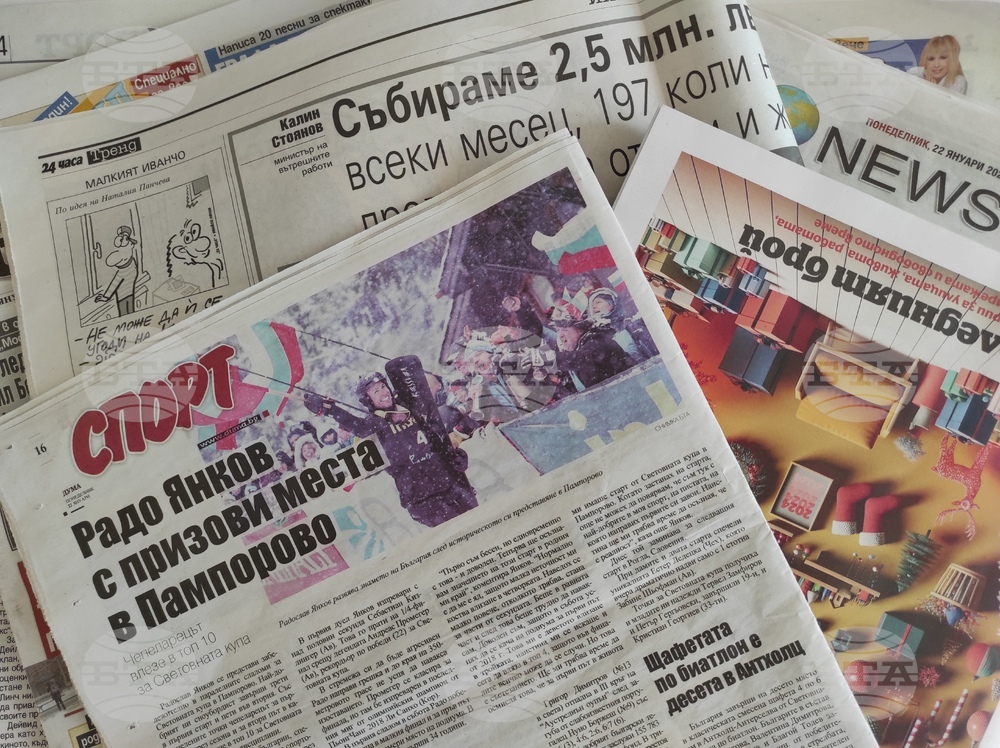
The topic of how the new parliament will look like after the elections dominates Wednesday’s news media.
POLITICS
24 Chasa’s front-page article presents the governance programme of Rumen Radev’s Progressive Bulgaria, which won the April 19 elections under the headline, “Life according to Radev: Standard Like That of Europe’s Strong and Low Taxes”. The daily writes that only five of the 131 MPs in Radev’s formation in the 52nd National Assembly will have prior parliamentary experience. However, they gained that experience in other political parties, namely the Bulgarian Socialist Party and Continue the Change. A significant portion of the new ruling MPs, however, have experience in the executive branch. Some have served as regional governors, while others were part of the seven caretaker governments appointed or nominated by President Rumen Radev during these five years of political crisis. One of them is former caretaker prime minister Galab Donev, whose name was even been circulating in the media as a potential parliament chair.
An analysis in Trud reads that Radev now has full majority in Parliament, but that means full responsibility and an end to excuses. The euphoria from the election victory will last for a few more days but then the well-known feeling of déjà vu will remain. "The objective assessment - of both the election campaign and Radev’s statements, and above all of the current reality - is clear: Bulgaria will neither leave the European Union nor NATO (how on earth does anyone even come up with such apocalyptic scenarios?), nor will the lev return (what a pipe dream), nor will prices drop, nor will fuel become cheaper, nor will corruption disappear. Nothing substantial will change," the analysis reads. In reality, the likelihood that the former president will become the next Viktor Orban and Russia’s Trojan horse in the EU is very slim, the author believes. “Setting aside the populist rhetoric, the former president and likely prime minister is fully aware that a vast majority of his voters placed their trust in him not because they expect a drastic change in the country’s foreign policy course, but because they are once again hoping that someone will save them - whether from the mafia, from the endless elections of recent years, or from the apathy to which they have voluntarily surrendered,” the analysis concludes.
In an analysis of the elections for Dnevnik.bg, Antoniy Todorov writes that the results show Bulgaria faces a significant shift in political life, something like a "political tsunami" that is about to radically shake up the existing political structures. The shift is clear: Progressive Bulgaria and Continue the Change - Democratic Bulgaria gained MP seats, while GERB, the MRF (MRF - New Beginning and the Alliance for Rights and Freedoms as a whole), as well as There Is Such a People and Vazrazhdane lost the most. Still, one should not get carried away by a change that has not quite happened yet. First and foremost, the most pressing issue is the state budget, which will have to meet several conflicting expectations: maintaining and increasing incomes, keeping tax rates steady, reducing public debt, and providing better funding for sectors such as healthcare, education, culture, and defence. The new budget will have to be careful not to provoke mass protests in certain sufficiently active and well-organized sectors of society, the analysis reads. Bulgarians will need to be patient, as always, for the many of the issues currently up in the air to be clarified once the new government is formed.
On Nova TV’s morning show, journalist Bozhidar Russev commented that the elections' main goal was to establish a legitimate government. “Radev’s victory is monumental and marks the end of the Peevski-Borissov [MRF-GERB] model. From here on out, Radev faces difficult tasks, the first of which are the election of new members of the Supreme Judicial Council and a prosecutor general," Russev noted. Communications and social media expert Nadezhda Ganeva said that Radev’s campaign promise was to tackle rising prices, but it remains to be seen how that will be achieved. Journalist Vladislav Apostolov believes that even Progressive Bulgaria likely did not expect such a high result, despite their claims. According to him, there is no way they can tackle the rising prices overnight. Apostolov believes that the claim that Radev is pro-Russian is propaganda. Russev emphasized that Radev knows that if he takes an overtly pro-Russian stance, it will bring people out into the streets, and that is not his intention. Political scientist Svetlin Tachev of the Myara polling agency noted that if Radev had not run in the elections, Continue the Change – Democratic Bulgaria would have received more votes. “This political cycle has come to an end. Bulgarians are seeking stability, and that is why Radev faces the difficult task of meeting the public’s expectations,” Tachev said, recalling that a single party has not had parliamentary majority since 2000.
On Bulgarian National Television’s morning show, the future parliament’s composition is discussed by journalist Ruzha Raycheva and political scientists Stoycho Stoychev and Daniel Smilov. According to Raycheva, the biggest change will be in the MPs of Continue the Change – Democratic Bulgaria (CC-DB), because the coalition includes many parties which will each want a seat. Smilov agreed that there is visible internal tension in the CC-DB, but if they allow division, that will be to their detriment when they have the potential to become the biggest opposition in the 52nd National Assembly. GERB might fall apart since they have limited experience as an opposition party. Stoychev said that CC-DB are the most affected by preferential votes but that is not new. He sees a single party having full majority as a distortion of the parliamentary republic model, because its normal state is coalition governments.
***
Duma quotes Bulgarian Socialist Party (BSP) leader Krum Zarkov as saying on Tuesday that the party’s result in the April 19 elections – 3.07% of the votes - was poor as expected, because all the parties that were part of the last regular government were punished, leaving the BSP out of the new parliament. However, this is not the end of either the BSP or the left in Bulgaria, he underscored. He will take full responsibility before the party’s National Council on April 25 by requesting a vote of confidence. Without it, he will tender his resignation immediately, but if he receives it, Zarkov will begin a process of renewal and reorganization of the socialist movement in Bulgaria, focused on the protection of democracy, rule of law, and the social State. The party will be open to discussion, joint action, and new people with fresh left-wing ideas.
On bTV’s morning show, BSP Executive Bureau member Valery Zhablyanov commented on the reasons for the party’s poor result in the elections. Some of the BSP’s traditional voters have shifted their support to Rumen Radev’s new political project, Progressive Bulgaria, as a viable choice that offers sufficient hope that it will change the course of Bulgaria’s development over the past 15 years. In that situation, no one knew what the best possible result for the BSP might be, Zhablyanov noted. Also, the BSP is in crisis due to mistakes accumulated over the years, not recently. He highlighted the 2020-2021 period as a pivotal moment, when the BSP leadership was unable to find its bearings and position the party in a way that would allow it to win public trust. Zhablyanov also acknowledged political compromises made in recent years that socialist voters have not forgiven, especially the participation in Zhelyazkov’s government. He does not believe that resignations are the solution at this point and praised BSP leader Zarkov for the energy put into the election campaign. Zhablyanov listed organizational reform, a clearer ideological profile, and a stronger presence among young people and in major cities as key priorities now.
On Bulgarian National Television, Movement 21 leader and BSP - United Left candidate for MP Tatyana Docheva commented on the reason for the Socialists' poor result in the elections and the formation's future. According to her, two major factors explain why the BSP failed to enter the new parliament: BSP’s participation in the previous government and the enormous public expectations that Rumen Radev would clear GERB leader Boyko Borissov and MRF leader Delyan Peevski from the political arena. Faced with this situation, the BSP will tackle issues that have been neglected and left unresolved for years; it will clean up its ranks in terms of ideology, profile, values, and the people who are truly loyal to the party and would work for it. And in the near future, the BSP will be a winner again, Doncheva believes. She disagrees with the calls for BSP leader Zarkov's resignation, which she believes come from the party's former leadership, because he had only a month and a half at the helm.
***
Mediapool.bg presents from which electoral district each party will send MPs in the 52nd National Assembly, as well as who has won a seat thanks to preferential votes. According to currently available data of the Central Election Commission, Progressive Bulgaria will have 131 MPs, GERB-UDF will have 39 MPs, Continue the Change - Democratic Bulgaria will have 37, MRF - New Beginning" will have 21, and Vazrazhdane will have 13 MPs. There are electoral districts in which none of the political parties that enter parliament reshuffle their candidate lists: Veliko Tarnovo, Gabrovo, Kardzhali, Sliven, Smolyan, and Targovishte. Significant changes are observed in Sofia, Plovdiv, Blagoevgrad, Burgas, Varna, Montana, Pleven, Stara Zagora, Haskovo, and Yambol.
***
24 Chasa has an interview with world-known cognitive psychologist and psycholinguist Prof. Steven Pinker from Harvard University. According to him, the greatest threat to democracy today is a combination of censorship, propaganda, and the breakdown of a shared reality. There is rarely a single explanation for a large-scale political phenomenon; often, all the causes reinforce one another. Dictatorships have managed to learn from one another, he added. In his words, it is dangerous when one believes one’s political party is honest, good, and wise while the other party is stupid, ignorant, and evil. Corruption is part of human nature, and all the rules and institutions against it have been artificially created, he argues.
ECONOMY
On bTV’s morning show, economists Stoyan Panchev and Lachezar Bogdanov commented that the new government will have to face some of the most serious economic challenges in recent years - high prices, a growing deficit, and the need for urgent reforms. According to them, administrative measures alone will not be enough to bring inflation under control. “There are processes over which the government has no influence - the global market for energy resources and raw materials,” said Bogdanov, adding that regular government’s greatest influence lies in its own fiscal policy. He argued that reducing the deficit and moderating spending growth will have a cooling effect on the economy and prices. Panchev expressed doubt over the inflation statistics, arguing that households’ expenses and the budget deficit are much higher than reported officially. The experts both agreed that the new government will have to implement structural reforms, particularly in systems characterized by high costs and low efficiency, such as the judicial system and the public administration.
On Bulgarian National Television's morning show, economist Adrian Nikolov commented that the first drafts of the 2026 state budget might be ready by the end of May, which is an optimistic forecast. However, he urged Bulgarians not to have sky-high expectations because, in his words, completely overhauling the fiscal framework in just a few months is practically impossible. "The new finance minister, whoever that may be, will have a very limited set of tools to work with within the 2026 budget. We may see major reforms and the direction that will be set in the fall," the economist said. "Progressive Bulgaria has a very clear stance on avoiding tax hikes, fiscal discipline, and deficit reduction. The question is to what extent this will translate into a real fiscal philosophy, and we will see it in the actual budget," Nikolov noted. For him, an important reform is reducing the number of municipalities, as they have bloated staff. Public administration could be reduced by up to 10,000 people, but only if the municipal map is streamlined.
On Bulgarian National Radio, analyst Boyan Rashev, an expert on the environment, natural resources, and energy, commented on the effects of the war in the Middle East and the fuel crises. "We are no longer looking at the best-case scenario; we are heading toward the worst-case scenario, which involves facing a shortage of certain fuels at some point this summer - not just high prices," he warned. According to him, kerosene is the biggest problem in Europe, followed by Diesel. The global economy is already feeling this crisis, with Asia being the hardest hit at the moment. Europe is affected by high prices, and even if the situation around the Strait of Hormuz normalizes, prices for petroleum products will remain high for a long time because the depleted resources will have to be replenished. Bulgaria is one of the well-positioned countries in the EU because it still has a relatively well-functioning refinery, but enough crude oil has to be found for it. There should be no fuel price caps, he commented on Bulgaria’s response to the issue. In his view, reducing excise taxes and VAT is a viable option.
***
Capital.bg presents a survey on burnout by the Bulgarian Chamber of Commerce and Industry conducted in early 2026, according to which nearly three-quarters of workers in six professions are working under chronic stress. The survey included more than 300 employees in fields with a high risk of burnout - 62% of respondents reported a moderate level of burnout, and another 11% reported a high level. The study covers managers in the manufacturing industry, HR specialists, marketing and sales experts, hotel and restaurant managers, IT specialists, and financial experts. One of the key findings of the study is that the risk of burnout is strongly linked to the personality traits of the employees themselves. Three traits are predominant among people who are prone to burnout: excessive ambition and expectations, excessive self-criticism, and pronounced workaholism. These characteristics are most pronounced in marketing and sales, among managers in the hospitality and restaurant industries, as well as among IT professionals.
***
Both Trud and 24 Chasa report on their front pages that household appliances might become cheaper as a result of lower ecological fees, with the price of a 70 kg refrigerator potentially dropping by EUR 16. The caretaker Government has put to public discussion draft amendments to the Regulation on the procedure and amount of the product fee. Product fees were increased eight- to ten-fold as of July 1, 2025, the daily recalls. Back then, manufacturers and retailers warned that this would affect the retail prices of household appliances. Currently, Bulgarians pay eco-fees that are several times higher than those paid in other EU countries. Business representatives have called for the fees to be reduced ten-fold until an analysis is conducted of the costs incurred by the recycling organizations to which manufacturers and importers pay these fees. The goal is to determine whether the collected fees are necessary. No such analysis has been included in the caretaker Government’s reasoning behind the proposed fee reduction.
/DS/
news.modal.header
news.modal.text