site.btaMedia Review: March 11
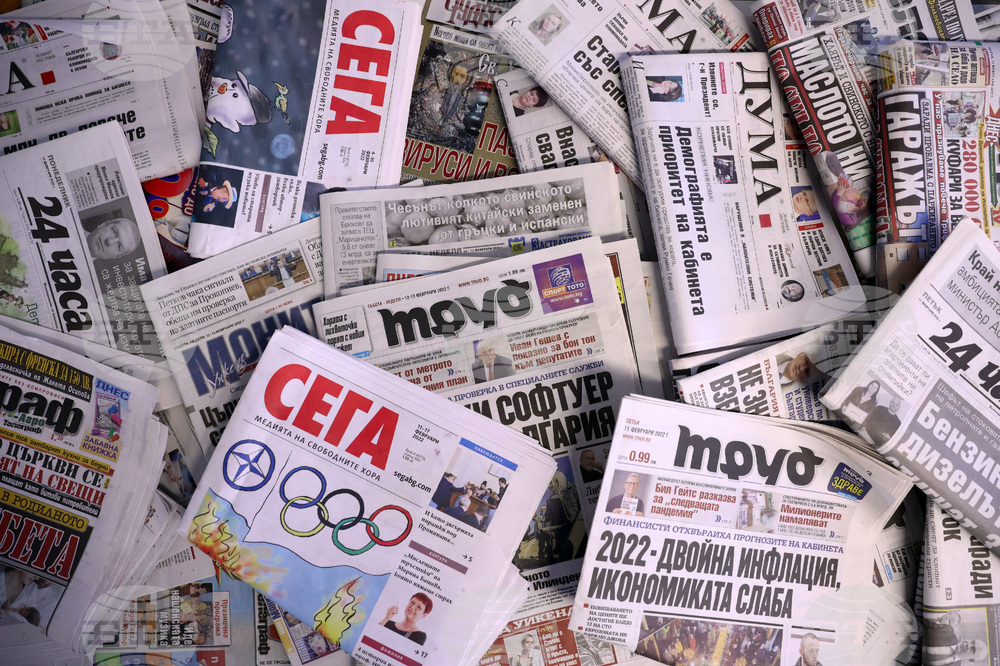
JUSTICE
Capital: A major controversy has erupted in Bulgaria after the prosecution office revealed details of an investigation into European Prosecutor Teodora Georgieva, following her announcement that she was willing to testify about alleged ties between judicial lobbyist Petyo [Pepi the Euro] Petrov, acting Prosecutor General Borislav Sarafov, and politician Delyan Peevski.
According to a statement by the Bulgarian prosecution service, a pre-trial investigation was opened in 2025 into allegations that Georgieva abused her official position between 2020 and March 2025 to obtain unlawful financial benefits. The case reportedly stems from claims by the now-missing Petyo Petrov, who in 2023 told the European Public Prosecutor’s Office (EPPO) he had made monthly payments intended to influence judicial proceedings, though without naming specific cases.
The EPPO forwarded the signal to Bulgarian authorities in 2023 but reportedly received no updates for more than a year. After a video surfaced in 2025 showing a meeting between Petrov and Georgieva, European Chief Prosecutor Laura Kövesi again requested information, prompting the Bulgarian prosecution to confirm that proceedings had been initiated.
The disclosures have raised accusations of institutional contradictions. Critics note that Bulgarian prosecutors previously closed the main investigation into the “Eight Dwarfs” corruption scandal, linked to Petrov, citing lack of evidence that magistrates were bribed, while witness statements now claim that money had in fact been prepared and distributed to magistrates, including Georgieva.
According to witness testimony cited by prosecutors, Georgieva allegedly met Petrov regularly at the “Eight Dwarfs” restaurant, where envelopes containing BGN 10,000 [EUR 5,000] were supposedly prepared for her. Witnesses include two security guards and a woman described as close to Petrov, believed to be his former wife. Georgieva firmly denies the allegations, calling the testimony fabricated and politically motivated.
Justice Minister Andrey Yankulov said the published materials contain “extremely troubling facts” and called for greater transparency regarding all investigations connected to the “Eight Dwarfs” network, questioning why Georgieva has not been formally charged despite claims that evidence exists.
Legal experts also point out that the criminal provision cited by prosecutors concerns abuse of office rather than corruption and typically carries relatively minor penalties.
Georgieva argues the case is retaliation linked to her work on the expansion of the Chiren gas storage project and maintains she has never received money from Petrov, insisting the accusations are part of an institutional campaign to discredit her.
***
Trud contributes by writing that Bulgarian prosecutors have published documents and correspondence with the EPPO alleging that suspended European Prosecutor Teodora Georgieva received regular cash payments from former investigator and alleged judicial lobbyist Petyo Petrov, known as “Pepi the Euro.” According to witness testimony cited by the Sofia City Prosecutor’s Office, Georgieva repeatedly visited the now-closed restaurant The Eight Dwarfs between 2019 and 2020 to collect envelopes containing BGN 10,000 each. Prosecutors say the claims are supported by witness statements and an authenticated video recording of a meeting between the two.
The prosecution service said it released the materials to counter what it described as media and political attacks against the institution. The EPPO previously found Georgieva responsible for a serious violation, leaving open the possibility of her dismissal by the Court of Justice of the EU; she is currently suspended.
Georgieva denies wrongdoing, saying she visited the restaurant only a few times and under pressure, while prosecutors argue witness testimony shows she met Petrov privately and repeatedly. The Bulgarian prosecution stated it will continue informing European institutions and insists it is acting lawfully despite criticism and allegations of political pressure.
24 Chasa also covers the topic.
***
NOVA TV: Caretaker Deputy Prime Minister and Justice Minister Andrey Yankulov criticized the Bulgarian prosecution service, saying it further discredited itself by acknowledging evidence of alleged corruption involving prosecutor Teodora Georgieva while failing to take action. He questioned why the case was sent to the European Public Prosecutor’s Office if the evidence was insufficient and said it remains unclear how the investigation has been conducted or whether the evidence was properly verified.
Yankulov noted similarities with testimony in the “Eight Dwarfs” case involving alleged bribery and influence over magistrates linked to Petyo Petrov (“Pepi the Euro”), stressing that key details, including witness identities and expert examinations of leaked recordings, remain unknown.
The justice minister said he would seek information about possible connections between magistrates and Petrov, including whether Sofia City Prosecutor Emilia Rusinova had travelled in his car, adding that disciplinary action could follow if links are proven. He argued that networks of influence based on dependency and personal benefits have long affected the judiciary and must be dismantled.
Yankulov also announced plans to create an institutional support mechanism for magistrates, including physical and psychological protection. The prosecution service, meanwhile, accused him of undermining both the Bulgarian and European prosecutor’s offices and said it would inform European institutions about his actions. The dispute follows Georgieva’s claim that she had alerted the justice minister to possible crimes by acting Prosecutor General Borislav Sarafov.
ENERGY - FUEL
Mediapool: Caretaker Energy Minister Traicho Traikov has invited his Turkish counterpart Alparslan Bayraktar to visit Sofia for talks on optimizing the parameters of Bulgaria’s agreement with the Turkish state company BOTAS for reserving annual capacity of 1.8 billion cubic meters for unloading LNG at Turkish terminals and transporting it to Bulgaria until 2036.
The two ministers met on Tuesday in Paris during the Second Nuclear Energy Summit, attended by a Bulgarian delegation led by Prime Minister Andrey Gurov, the Energy Ministry’s press office said.
The Turkish side showed understanding and readiness to discuss changes to the BOTAS contract, the statement added.
“Specific negotiations lie ahead, as the parameters are highly technical, and Türkiye also has its own interests. We are also discussing other joint projects, such as green energy corridors through Türkiye and Bulgaria for renewable energy, but the main topic is the gas agreement,” Traikov said, as quoted in the statement.
Before Bayraktar’s visit to Sofia, Bulgaria will prepare a detailed position outlining possible updates to the contract, under which Bulgaria must pay more than USD 500,000 per day for reserved capacity regardless of whether it is used. Since early 2023, however, only 2.5 million cubic meters of gas have been delivered under the agreement, part of which remains stored in Turkish facilities.
As early as summer 2024, Bulgargaz announced it would stop payments under the contract and requested renegotiation, proposing reduced quantities, a shorter contract term, and adjustments to tariffs originally set when natural gas prices were around EUR 120 per MWh - roughly double current levels, even amid elevated prices caused by tensions involving Iran, the United States, and Israel.
BOTAS previously rejected changes to the agreement, and former Energy Minister Zhecho Stankov also failed to secure revisions.
Following talks in Baku last week with a Turkish deputy energy minister during the Southern Gas Corridor annual meeting, Traikov said Türkiye’s position appears to have shifted and that there is now openness to revising the deal - a view reaffirmed after his meeting with Bayraktar.
“I believe it is a good idea for Bulgaria to benefit from Türkiye’s large LNG import capacity. We want to preserve the rational philosophy of the agreement, but we must optimize its parameters, which is why we agreed to continue discussions in Sofia,” Traikov added.
During the nuclear energy forum, Traikov also met Romanian Energy Minister Bogdan-Gruia Ivan to discuss the possibility of submitting a joint application to the European Commission for grant funding for a feasibility study on the Nikopol–Turnu Magurele hydropower project. The long-debated project was designated last autumn as being of special interest to Brussels, increasing its chances of receiving EU financing.
The forum focused on the geopolitical situation and the impact of the Middle East crisis on energy markets. Bulgaria is closely monitoring developments and their potential effects on global energy supplies and commodity prices, Traikov said, highlighting the positive role of Azerbaijan’s gas supplies, which account for about 40% of Bulgaria’s deliveries.
He emphasized the importance of strategic energy autonomy at the European level and reducing dependence on external suppliers. Electrification, he noted, is a key tool for reducing fossil fuel use, requiring reliable clean electricity generation, expanded transmission networks, and increased energy storage capacity.
“Nuclear energy plays a key role as a stable low-carbon baseload source of electricity, linked not only to power generation but also to heat production and hydrogen,” Traikov said, referring to plans to build two new nuclear units at the Kozloduy Nuclear Power Plant.
He also welcomed the European Commission’s strategy for developing and deploying small modular reactors and its clean energy investment strategy.
Traikov further raised the issue of revising technical criteria in the EU taxonomy related to nuclear energy, including access to financing, to ensure equal and technologically neutral treatment of low-carbon technologies.
***
Bulgaria has sufficient fuel supplies and no risk of shortages in the near term, as the Burgas refinery has enough crude oil to operate until late March or early April and secured deliveries for April as well, said Svetoslav Benchev, head of the Bulgarian Petroleum and Gas Association, in an interview with Bulgarian National Radio.
He noted that uncertainty remains ahead of April 29, when a U.S. sanctions derogation for the refinery expires, which could complicate payments and banking operations, since many commercial banks no longer work with the Lukoil group. Unlike before sanctions, the refinery now must pay for oil deliveries in advance, increasing financial pressure.
Benchev warned that any prolonged closure or mining of the Strait of Hormuz would significantly impact global oil markets, though prices remain relatively stable because such disruption has not occurred so far.
He explained that Bulgaria does not maintain strategic oil reserves like G7 countries but does hold wartime reserves and EU-mandated emergency stocks covering 90 days of consumption, which cannot be used to control prices.
Fuel prices are higher in Greece and Romania mainly due to higher excise taxes and production costs. Benchev argued that price caps would harm the market by reducing refinery liquidity or forcing gas stations to sell at a loss, potentially leading to closures and later price spikes. According to him, the only realistic way to ease fuel prices would be a temporary VAT reduction, though this would strain the state budget.
PENSIONS – EASTER BONUSES
24 Chasa: More than 1.6 million Bulgarian pensioners will receive Easter bonuses under a plan prepared by the caretaker government of Prime Minister Andrey Gurov. Pensioners whose total income is up to the poverty line (EUR 390.63) will receive EUR 50, while those with pensions between EUR 390.63 and EUR 620.20 - roughly up to the minimum wage level - will receive EUR 20. The payments, which include all pensions and supplements in the income calculation, will cost the state about EUR 57.8 million and will be paid together with April pensions. Over 400,000 higher-income pensioners will not receive a bonus.
The Social Policy Ministry said multiple support options were analyzed, and broader reforms are being discussed to introduce a more permanent, legally regulated holiday support scheme that could eventually cover all vulnerable groups, not only pensioners.
Meanwhile, a reform roadmap for the pension system is being prepared for completion before upcoming elections but will be left for approval by the next regular government. Planned measures include keeping the retirement age unchanged (gradually rising to 65 for both men and women by 2037), separating non-work-related pensions from the insurance system, addressing the pension ceiling, and combating the shadow economy. Talks also continue on updating the minimum wage formula and implementing EU rules on equal pay.
Separately, more than 531,000 vulnerable Bulgarians will receive food aid packages containing basic products under an EU-funded assistance programme distributed by the Bulgarian Red Cross.
***
Bulgarian National TV quotes Prime Minister Gurov as saying at a government meeting that 1.6 million pensioners will receive Easter bonuses of either EUR 20 or EUR 50. He emphasized that the measure is not a political gesture and called on politicians not to politicize it, stressing that supporting vulnerable citizens is a matter of state responsibility and humanity.
STATE BUDGET EXTENSION
Duma: BSP – United Left Floor Leader Nataliya Kiselova said Parliament is expected to adopt an extension bill for the 2026 state budget to ensure the functioning of the state until a full budget is approved. Speaking on NOVA NEWS, she stressed that Parliament should not be used for canvassing or populist purposes on the eve of the snap parliamentary elections.
According to Kiselova, this principle is being violated by a proposal in Parliament to introduce Easter bonuses, which she described as legally flawed and populist. She argued that attempts by the Movement for Rights and Freedoms to oblige the Government through a legislative decision are improper and misleading, as social support should address all low-income groups, not only pensioners.
Regarding municipal funding, she emphasized that payments and capital expenditures for local government projects must continue, echoing a position expressed by the National Association of Municipalities.
Asked about her political future, Kiselova said politics is a cause rather than a livelihood and reaffirmed her commitment to restoring previous constitutional provisions related to caretaker governments. She blamed the current political situation on poorly designed or deliberate constitutional amendments adopted by parties that no longer cooperate politically.
PUBLIC TRANSPORT WORKERS – PROTEST
bTV: Public transport employees in Sofia are staging a protest demanding higher wages and better working conditions. They are calling for dialogue with national and local authorities and for a state budget subsidy to fund a 5% salary increase. Workers warn they may escalate to stronger protest actions if their demands are not met.
The protests, organized by the Confederation of Independent Trade Unions in Bulgaria (CITUB), began earlier in the week with demonstrations by postal and public transport workers in Varna, followed by road blockades in Ruse.
According to CITUB, a total of EUR 8.38 million is needed from the state budget to raise salaries in Sofia’s public transport sector retroactively from January 1, including funding for municipal bus and electric transport companies, the metro operator, and the Center for Urban Mobility.
GAMBLING
Dnevnik: A casino next to a Sofia school continues operating despite violating legal distance requirements, highlighting broader concerns about gambling’s impact on young people in Bulgaria.
The case involves the 24th Secondary School in the Hadzhi Dimitar residential district, which previously sealed its main entrance to comply with rules requiring gambling venues to be at least 300 metres from schools. After the entrance was reopened in September 2025, the casino again fell short of the required distance but has not been relocated because its license is valid until 2033, leaving the issue unresolved.
Municipal councillors say the National Revenue Agency, which oversees gambling, has confirmed the situation but lacks clear procedures for cases where new schools or entrances bring gambling venues within restricted zones. Legal action may be the only solution.
The controversy was discussed at a public debate on gambling among students, where experts warned that advertising and promotional bonuses attract young people, often leading from early wins to addiction, financial losses and desperation. Studies suggest gamblers typically lose between BGN 20,000 [EUR 10,000] and BGN 200,000 [EUR 100,000] for every BGN 1,000 [EUR 500] won.
Although only 2–4% of Bulgarians are considered gambling-addicted, experts estimate the problem indirectly affects up to a quarter of society through families and related harms. A 2024 European study found that 22% of Bulgarian teenagers aged 15–16 had gambled in the past year - among the highest rates of online betting in Europe.
Participants debated policy responses, including banning gambling advertising, requiring disclosure of winning probabilities, or restricting gambling venues to less accessible locations. Experts cautioned that a total advertising ban could push gambling into illegal markets, while noting that widespread social anxiety and low public wellbeing contribute to high gambling participation in Bulgaria.
/MY/
news.modal.header
news.modal.text