site.btaMedia Review: March 10
HEADLINES
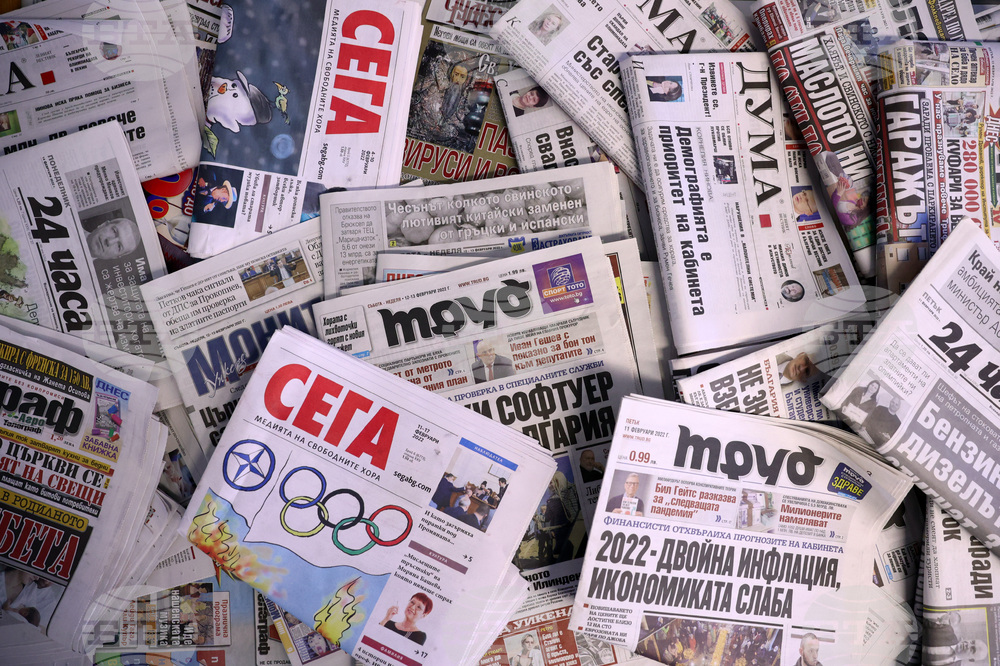
Tuesday’s print media highlight economic issues, household finances and political debates. 24 Chasa reports that pensioners may receive at least EUR 20 more for Easter and examines the growing use of quick loans for repairs, household appliances and bills, as well as the problem of unpaid waste collection fees in Sofia, where every fifth resident reportedly does not pay the charge. Trud focuses on labour and income topics, reporting that the minimum wage will rise to EUR 704 and noting that many consumers fail to read the terms of quick-loan contracts, while workers in Sofia’s public transport company are seeking a 5% retroactive pay increase. Telegraph writes about rising prices and claims that Razgrad has the country’s strongest protection against a nuclear attack, while also reporting on the testing of election commission members with a 32-question questionnaire. Duma's front page headlines feature the protests of Bulgarian Posts employees from March 9, when pensions were due to be paid, the rise in gas prices and the discussion around the Prosecutor General.
Leading interviews feature former education minister Sergey Ignatov in 24 Chasa commenting on the education system and matriculation exams, nuclear expert Georgi Kaschiev in Trud warning of financial losses related to Kozloduy NPP, and Petko Petkov in Telegraph discussing the role of President Rumen Radev. Analytical pieces examine public distrust toward the state, regional political developments in North Macedonia, and the role of panic in crisis situations.
The televised morning programmes on Tuesday focused on global security, economic pressures and domestic political developments. The Bulgarian National Television (BNT) examined geopolitical conflicts and their impact on global markets, with live commentary from the United States and Turkiye, discussions on the stance of the Bulgarian left with Rumen Petkov, and a segment on trade union protests featuring Confederation of Independent Trade Unions in Bulgaria (CITUB) President Plamen Dimitrov. The programme also marked the 83rd anniversary of the rescue of Bulgarian Jews with historian Assoc. Prof. Spas Tashev.
bTV’s morning broadcast highlighted the controversy around the Bulgarian European prosecutor, with comments by Tatyana Doncheva, and also commemorated the events of March 1943 that halted the deportation of nearly 50,000 Bulgarian Jews. Other topics included concerns about the lack of anti-drone systems at Bulgarian airports and the impact of rising fuel prices on the economy.
Nova TV focused on the surge in oil prices and its possible effect on electricity, fuel and food costs, aviation safety risks posed by drones, and an investigation into an illegal anabolic steroid factory in Sofia.
The Bulgarian National Radio (BNR) morning programmes feature interviews on road safety, urban transport, education, the economy and international developments. Ski instructor Ivaylo Tsvetkov warns that accidents on the slopes are often caused by inexperienced or intoxicated skiers driving too fast. A discussion on Sofia’s public transport criticizes municipal leadership for being disconnected from everyday commuters. Education expert Borislav Penev highlights the negative effects of excessive screen time on children. Rumen Radev of the Association of Industrial Capital in Bulgaria comments on concerns among businesses about the possible prolongation of the conflict in Iran. Tourism analyst Rumen Draganov argues that prices in the sector should be regulated to help Bulgaria converge with EU standards, while Petromir Kanchev expresses hope that the prosecution service will show results in ongoing investigations rather than remain inactive.
POLITICS
Dnevnik publishes an analysis by political scientist Daniel Smilov entitled "Do It Yourself: The Strange Experiment with Radev’s Party." The author argues that Bulgaria is undergoing an unusual political experiment in which former President (2017-2026) Rumen Radev’s political project is emerging in a fragmented party system, forcing voters to "assemble" political alternatives from existing political actors. Smilov suggests that the project relies heavily on the president's personal popularity rather than on a clear ideological platform or established party structure.
According to the analysis, the potential success of such a formation would depend on whether it can transform protest energy and public dissatisfaction with the political elite into a stable political organization. At the same time, the author warns that the experiment carries risks: a party built primarily around a single political figure may deepen polarization and institutional tensions rather than resolve the ongoing political crisis.
ECONOMY
Trud reports that the Podkrepa Labour Confederation has called on the government to urgently prepare an action plan to limit the impact of rising oil prices on the economy, workers and vulnerable households. The union urges the cabinet to discuss such measures with social partners and the public amid concerns that the recent surge in global oil prices could fuel inflation and weaken consumption.
According to Podkrepa, oil prices have risen from about USD 60 to roughly USD 110 per barrel in the past two weeks, following developments around Iran. The union estimates that a 10% increase in oil prices leads to about a 4% rise in fuel prices in Bulgaria, adding around 0.4 percentage points to inflation. With the current jump in oil prices, fuel costs could rise by as much as 24%, pushing up the prices of goods and services by roughly 2.4%.
Podkrepa warns that if oil prices climb further toward USD 130 per barrel, the resulting inflation could deepen poverty and reduce consumption, particularly in the context of delayed wage adjustments and the absence of an adopted state budget for 2026.
* * *
Duma reports that disability certificates issued by the Medical Expert Evaluation Board (referred to as TELK in Bulgarian) are increasingly being used as a source of additional income by people who live abroad or are unemployed. According to the article, some beneficiaries receive disability pensions and related social payments despite spending long periods outside Bulgaria or not actively participating in the labour market.
The publication argues that weaknesses in the control mechanisms of the TELK system allow such practices to continue, placing pressure on the social security system and raising concerns about fairness. The article calls for stricter oversight and reforms to ensure that disability benefits reach those who genuinely need them.
* * *
BNR has an interview with tourism analyst Rumen Draganov, who called for measures to regulate prices in Bulgaria’s tourism sector in order to help the country catch up with EU standards. He said that better price policies and coordination in the sector are needed to improve competitiveness and ensure sustainable growth.
Draganov noted that tourism remains an important part of Bulgaria’s economy, but warned that inconsistent pricing and insufficient regulation could affect the country’s attractiveness as a destination. He stressed that the sector should aim to gradually align its standards and pricing practices with those in other EU member states.
JUSTICE
bTV reports that lawyer and politician Tatyana Doncheva commented on the controversy surrounding the Bulgarian European prosecutor Teodora Georgieva, saying that Georgieva’s public statements suggest she believes responsibility for the situation should not fall on her alone. Speaking on the morning programme, Doncheva argued that the case reflects deeper institutional and political problems within the prosecution system and relations with European institutions.
According to Doncheva, the situation has broader implications for the credibility of Bulgaria’s judicial system and raises questions about political influence, accountability and the functioning of the European Public Prosecutor’s Office in the country. She suggested that the dispute could expose internal conflicts within the prosecution and called for greater clarity about the facts and responsibilities in the case.
* * *
BNR reports that civic activist Petromir Kanchev expressed hope that the prosecution service will take action and that someone involved in ongoing investigations will eventually speak out. In an interview with the Bulgarian National Radio, he said there are expectations for accountability and transparency in cases that have attracted public attention.
Kanchev warned that if the prosecution fails to produce results, public trust in the institution could erode further. He stressed the importance of clarifying the facts and ensuring that investigations lead to concrete outcomes rather than remaining indefinitely delayed and unresolved.
CRIME
Nova TV reports on an investigation into an illegal factory producing anabolic steroids in Sofia, uncovered during a police operation. Authorities found equipment and substances used to manufacture performance-enhancing drugs that were allegedly distributed through online channels and fitness networks. According to the report, the operation targeted a clandestine production site where steroids were prepared, packaged and marketed, including for sale abroad.
Law enforcement authorities are working to identify those behind the operation and the full scale of the distribution network. The case has raised concerns about the growing illegal trade in performance-enhancing substances and the health risks associated with unregulated products circulating on the market.
EDUCATION
24 Chasa publishes an interview with former education minister Sergey Ignatov, who comments on the controversy surrounding the Bulgarian film “Kosmos” and the broader state of the education system. The debate emerged after the film was shown to students and sparked public discussion about whether schools should include works with controversial themes in the curriculum. Kosmos is a Bulgarian feature film that explores questions about human existence, morality and the search for meaning, presenting characters who confront ethical dilemmas and the limits of knowledge.
Ignatov argues that the dispute should prompt a wider review of how the education system works and how decisions are made about educational content. At the same time, he stresses that the matriculation exams remain the most objective indicator of the quality of Bulgarian education, as they test students’ knowledge and the effectiveness of teaching across the country. According to him, individual controversies should not overshadow the need for systemic reforms aimed at improving educational standards and ensuring that schools develop students’ critical thinking and general knowledge.
/YV/
news.modal.header
news.modal.text