site.btaMedia Review: January 22
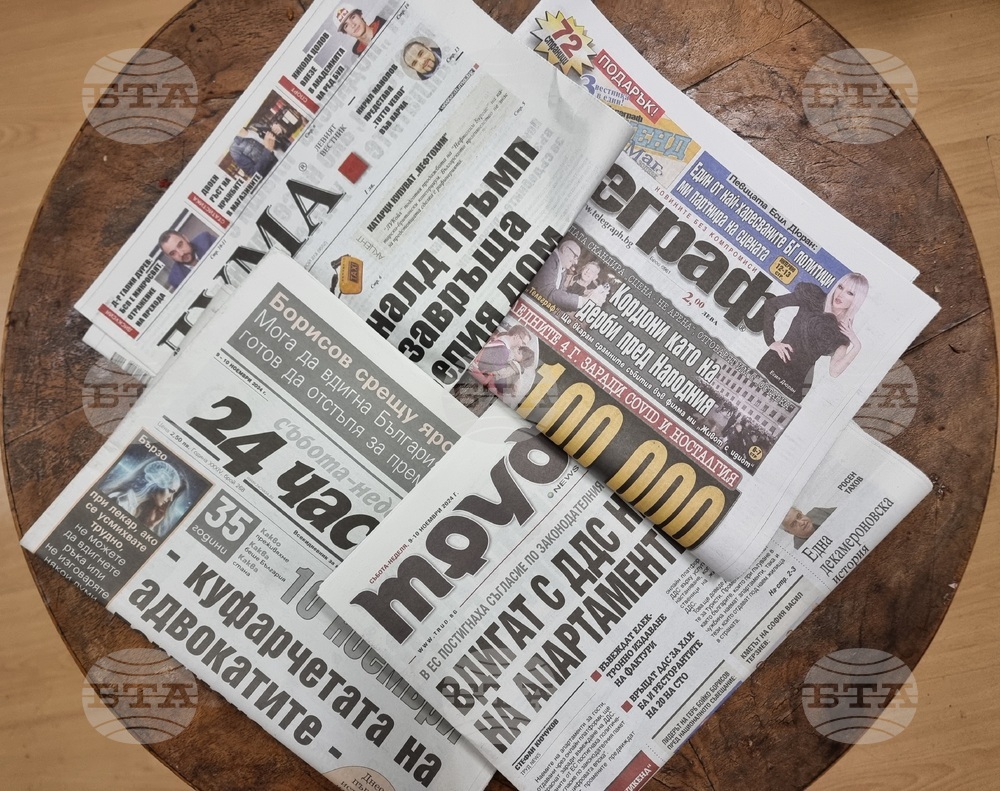
All print dailies report that Parliament’s Committee on Constitutional and Legal Affairs has adopted, at second reading, amendments to the Election Code providing for the introduction of optical devices for scanning paper ballots. The Council of Ministers is expected to supply the devices within a month; otherwise, elections will be held under the current rules, Duma writes. 24 Chasa notes that if the scanners cannot be procured in time, the parliamentary elections in the spring will be conducted using paper ballots and the existing machines, while the presidential elections in the fall will use the new scanning devices, which will automatically count the votes. Telegraph adds that there are six bids for the scanners, and political parties are disputing whether there is sufficient time to secure them.
Thursday's news media are also dominated by speculation about outgoing President Rumen Radev's expected entry into party politics.
POLITICS
Mediapool.bg writes that the question of who might join Rumen Radev’s future political entity remains open, even though Radev has not explicitly stated that he will take part in the elections. This is not due to any doubt about his intentions, but rather because he is waiting for the Constitutional Court to approve his resignation, the media outlet notes. Citing its own sources, Mediapool.bg reports that Radev and his team may be seeking to promote younger figures with no ties to the communist-era State Security Service and without extreme anti-European views as the public “face” of the new political project. “Such a move would aim to broaden Radev’s support base, particularly among those disappointed by his pro-Putin stance on the war in Ukraine and by anti-European moves, such as his surprise call for a referendum on the introduction of the euro last year, made after the procedure had already begun rather than two years earlier, when the issue was still being publicly debated,” Mediapool.bg writes. Most likely, the political project will be joined by his close advisers and secretaries, among them Galab Donev, currently head of the president’s office, who has previously served twice as caretaker prime minister. The media outlet recalls that immediately after Radev announced his resignation, political commentator Slavi Vassilev said he would join Radev’s party. On Tuesday, Anton Kutev, a former spokesperson for Radev’s caretaker governments, confirmed that he would also be involved in some capacity. Among former caretaker ministers, the name of ex–interior minister Ivan Demerdzhiev has been mentioned as a potential participant. Former regional development minister Ivan Shishkov has also publicly expressed his willingness to join Radev’s team. There is also speculation that former MEP and former Bulgarian Socialist Party (BSP) MP Petar Vitanov may also become part of Radev’s political circle.
Trud carries an interview with political analyst Tatyana Burudzhieva, in which she discusses Radev’s political future, the likelihood of his achieving the ambitious goal of securing a parliamentary majority, and his potential coalition partners. Burudzhieva says that Radev’s participation in elections would likely lead to fewer parties represented in Parliament. She expects higher voter turnout, driven both by protests and the emergence of new political players. "In my view, turnout will not be as high as some expect," she says, adding that for certain campaign ambitions to be realized, turnout would need to exceed 60%. Instead, Burudzhieva expects turnout to reach around 50%. She believes that Radev could attract voters who previously supported political parties but have since become disillusioned or disengaged. Such voters are particularly present on the left, especially among supporters of the BSP. In Burudzhieva's words, Radev is likely to position himself as equally distant from the left and the right, seeking and accepting support from across the political spectrum. She does not believe it is possible for Radev to secure a parliamentary majority. Asked about his potential political partners, Burudzhieva says there are none. She argues that Radev is attempting to enter the electoral space of all parties except GERB, a strategy that will inevitably provoke and deepen political tensions. According to her, Radev will compete with GERB leader Boyko Borissov for first place, aiming to demonstrate that he can defeat him. Burudzhieva adds that while Continue the Change might be willing to cooperate, Democratic Bulgaria would not. She also notes that Radev has categorically declared his opposition to the Movement for Rights and Freedoms – New Beginning. In her view, it would be difficult to form a government in the next Parliament. If current predictions hold, Bulgaria is more likely to head toward yet another round of elections, she notes.
Asked whether the BSP is the most threatened by Radev’s emergence on the political scene, BSP-United Left MP Nataliya Kiselova told Bulgarian National Television (BNT) that the appearance of any new political player should be a cause for concern for everyone. "The key issue in the election campaign will be who aligns with whom and who stands against whom. As far as the BSP is concerned, I expect areas of common ground to prevail," she said.
In an interview on bTV's morning programme, former BSP leader Mihail Mikov said that Rumen Radev’s possible participation in the elections could reshuffle the political landscape and mark a historic turning point for the BSP. He described the growing distance between the BSP and its coalition partners as a sign of deeper processes unfolding on the left. Asked whether Radev’s political project could push the BSP below the 4% electoral threshold, Mikov replied that the project could end the BSP’s 130-year history. In his words, if the BSP is seeking a way out of the crisis, it must adopt a clear political stance and engage in a normal dialogue with Radev - not in his capacity as president, but as a prospective party leader.
Speaking on BNT, Morality, Unity, Honour (MECh) leader Radostin Vasilev said that his party sees an opportunity for partnership with Radev after the elections. Vasilev also commented on the Election Code amendments, saying that there is not enough time to introduce scanning devices for paper ballots ahead of the upcoming elections. According to him, the real aim of the changes is to prevent the use of the old voting machines. He added that scanning devices are a good option for eliminating subjectivity in the vote-counting process at election commissions and preventing manipulation, but they require time to be properly implemented.
Sociologists Boryana Dimitrova of Alpha Research and Parvan Simeonov of Myara also commented on Radev’s future political project during bTV’s morning programme. Simeonov said Radev has the potential to attract more than one million votes, though this will depend on whether the project is supported by a clear structure. The analysts agreed that the next parliament is likely to be dominated by three large political formations, each wielding a different degree of influence.
On Nova TV's morning programme, sociologist Kancho Stoychev echoed Parvan Simeonov’s assessment, saying that Radev has the potential to win one million votes, "which no other political player currently has."
*
Also on Nova TV’s morning programme, Tsvetelina Peneva from the Public Council to the Central Election Commission (CEC) commented on the revisions to the Election Code. She said that it is unrealistic to introduce a radically new technology that voters, experts, and even the CEC itself have never seen or used before in just two months. "This effectively sabotages the electoral process," Peneva said. She added that the greatest risk lies in the lack of time to develop clear rules and procedures that would give voters confidence that their ballots will be counted correctly.
CORRUPTION
Duma reports that the National Assembly Wednesday adopted, at first reading, a GERB–UDF bill proposing the closure of Bulgaria’s Anti-Corruption Commission and the transfer of its functions to the General Directorate Combating Organized Crime and the National Audit Office.
In a story on the topic Capital.bg says that GERB-UDF's bill is virtually identical to an earlier proposal by the Movement for Rights and Freedoms - New Beginning and signals a deliberate attempt to undermine the fight against corruption. The media outlet quotes Bulgarian Institute for Legal Initiatives Director Bilyana Gyaurova as saying that the proposed amendments are entirely politically motivated and reflect fear rather than a genuine commitment to limiting corruption in the country. Gyaurova argues that this fear stems from Radev’s appearance on the political scene and the prospect that a party led by him could secure a significant number of seats in the next National Assembly. "Over the years, Mr. Radev has taken a firm stance against corruption. This suggests that there would likely be pressure in Parliament to elect commission members with the backbone and character to give substance to the Commission’s powers through action. In other words, the Commission’s leadership could become independent of the ruling status quo." She argues that it is precisely to prevent this scenario that the governing parties are now proposing, at the last possible moment, to dismantle the Anti-Corruption Commission. In her view, the ruling establishment is willing to forgo hundreds of millions of euros in funding currently withheld by the European Commission due to Bulgaria’s failure to meet its commitments under the National Recovery and Resilience Plan. These commitments include ensuring a transparent procedure for appointing the Commission’s leadership and guaranteeing its political and financial independence.
***
Capital.bg runs a story titled "Austrian Companies in Bulgaria: 96% Deem Corruption a Major Problem." The article summarizes the results of the annual survey of Austrian investors on the business climate in Bulgaria, organized by the Austrian trade promotion organization Advantage Austria. The findings indicate growing optimism among Austrian investors, along with a positive assessment of the country’s tax and customs system. However, the main challenges facing businesses remain unchanged - corruption, bureaucracy, infrastructure, and labor shortages. The survey was conducted in October 2025 and included 100 managers from Austrian companies operating in Bulgaria.
In an interview with Bulgarian National Radio, Philippe Kupfer, Commercial Counsellor at the Austrian Embassy, said that for the second consecutive year, corruption has been ranked as the top concern and negative trend for Austrian companies, with 96% of companies operating in Bulgaria confirming this. Kupfer noted that crime and corruption are not being adequately addressed and emphasized that this concern is not limited to Austrian businesses. He added that the European Commission has also pointed to insufficient progress in tackling corruption, which has led to the withholding or delayed release of European funds, causing financial losses for Bulgaria. Kupfer also stressed that the introduction of the euro alone is not enough to attract foreign direct investment, adding that further efforts are needed.
BOARD OF PEACE INVITE
All print dailies report that outgoing President Rumen Radev has received an invitation from US President Donald Trump for Bulgaria to join the founding members of a planned Board of Peace for Gaza. 24 Chasa highlights key points of controversy, noting a dispute over when Radev actually received the invitation. According to the President's Administration, it arrived after Radev announced his resignation, while Foreign Minister Georg Georgiev insists it was received earlier. Another contentious issue is whether Radev had the institutional authority to decline the invitation on his own, without consulting the government and Parliament. It remains unclear from the statement issued by the President’s Administration whether Radev has taken any such action. Under the Constitution, foreign policy falls within the remit of the executive branch, which is why outgoing Prime Minister Rosen Zhelyazkov and Foreign Minister Georgiev are representing Bulgaria at the World Economic Forum in Davos, the daily says. The Foreign Ministry also criticized Radev for the absence of a clear position on resolving the conflict in Gaza, as well as on Trump’s proposed 20-point peace plan for Ukraine.
Commenting on the issue on bTV's morning programme, former foreign minister Nadezhda Neynsky said that such invitations are extended from one head of State to another and should not be interpreted as personal. "No one seriously believes that Donald Trump invited Rumen Radev in a personal capacity," she added. In her words, similar invitations have been sent to more than 60 countries, making the move far from unusual. Some of the invited states - particularly European partners - are still considering whether to take part. Before any decision is made, it must be clear what the role of the board would be, Neynsky said, noting that it involves a substantial financial contribution.
EDUCATION
Citing data from the Ministry of Education and Science for 2025, Telegraph reports that only one student made use of a state-guaranteed loan intended to support a child born during their studies. A total of 216 loans were granted last year under the Student and Doctoral-Candidate Loans Act, totalling EUR 3,818,844. Of these, 215 were used to cover tuition fees. Currently, 125,690 students aged 35 or younger enrolled in state universities are eligible for such loans, along with an additional 2,192 PhD students.
*
Sega.bg reports that Bulgaria is among the EU Member States with the lowest share of students who are employed while studying. Citing the latest Eurostat data, the media outlet noted that in 2024, 25.4% of young people aged 15–29 in the EU were working while enrolled in formal education; 71.4% remained outside the labour force, while 3.2% were unemployed but available for work and actively seeking employment during their studies. The highest shares of young people combining work and education were recorded in the Netherlands (74.3%), Denmark (56.4%), and Germany (45.8%). At the opposite end of the scale were Romania (2.4%), Greece (6%), and Croatia (6%). Bulgaria ranks fourth from the bottom, with a share only slightly higher than that of Greece and Croatia.
/IV/
news.modal.header
news.modal.text