site.btaMedia Review: January 20
POLITICS
All dailies lead on President Rumen Radev’s televised address on Monday, in which he said he would submit his resignation to the Constitutional Court on Tuesday, and on reactions from parties, lawyers and analysts.
***
Trud reports that Radev attacked what he called a “vicious model of governance” that looks democratic but operates through oligarchic mechanisms, arguing that politics is conducted “outside the institutions” by “puppet-masters” who capture parties, banks, business and the media. The paper notes that the resignation takes effect only after a Constitutional Court ruling, after which Vice President Iliana Iotova would assume presidential functions.
***
24 Chasa quotes sociologist Andrey Raychev as saying Radev avoided spelling out post-office plans and gave no explicit party signal, but that any future project would likely be moderately patriotic with mild left elements. The daily adds that a new party cannot be registered in time and discusses a possible coalition vehicle, while lawyers recall the 1993 Blaga Dimitrova precedent and note the Court has no deadline and would assess whether the resignation is voluntary.
***
Dnevnik likewise notes the lack of a statutory deadline for the Court, though lawyers expect a decision within about a week. It says the main unknowns are the caretaker-government appointment process and the election timetable, and that Iotova may lead consultations to avoid claims that Radev is shaping an election in which he intends to participate.
Dnevnik writes that Myara sociologist Parvan Simeonov told Nova TV that a parliamentary majority between Rumen Radev and Continue the Change–Democratic Bulgaria (CC–DB) is conceivable, citing a “polite tone” between the presidency and the coalition in recent months, though he noted that parts of CC–DB may reject such a scenario. Simeonov said any large majority would likely also need GERB, despite CC–DB signalling openness to GERB while drawing a line at Boyko Borissov, and Trend sociologist Evelina Slavkova says it is natural for Radev to attack all sides but doubtful that he can secure 121 seats on his own.
***
Dnevnik writes that Democrats for Strong Bulgaria chair Atanas Atanassov described Radev as a rival in the anti-corruption field and warned that he could split the anti-corruption consensus “along a Russian line”. The paper adds that Continue the Change had not yet commented on the resignation, and notes that CC–DB floor leader Nikolay Denkov said earlier that Radev would become the coalition’s political opponent if he led a new party.
***
Nova TV aired an interview with Trend’s Evelina Slavkova, who said the caretaker prime minister selection was effectively on hold pending the resignation procedure and a Constitutional Court ruling, and that clarity was expected soon on the contours of a Radev-linked project and the people behind it. The broadcaster also cited commentators urging Radev to define whether he is pursuing centrism or an Orbán-style course, with assessments ranging from “pseudo-centrism” without a clear East–West line to claims that he could partner with CC–DB and mobilize non-voters, while key unknowns remained the vehicle for any bid and which smaller parties would be most exposed.
***
bTV aired a debate in which political scientist Slavi Vasilev said preparations for a Radev-linked party were complete and a launch was only a matter of time, describing the resignation as bold but necessary and arguing that staffing and candidate lists should be left to future party leadership. Political scientist Tsvetanka Andreeva countered that Radev has already used the presidency and caretaker cabinets to build and test a project, criticized his geopolitics as eurosceptic and pro-Russian, and said an election run would amount to a direct bid for executive power, with uncertain effects on polarization.
***
Bulgarian National Television (BNT) aired former Radev chief of staff Ivo Hristov, who said calls for Radev to enter party politics reflect “despair” over prolonged political gridlock, and suggested Nashata Bulgaria [Our Bulgaria] as a possible project name while portraying Radev as the only alternative amid attacks from across the spectrum. Hristov criticized CC–DB for entering government on an anti-corruption platform but then joining what he called a patchwork coalition and said the objective should be an outright majority via higher turnout or, failing that, a short-horizon programme government to deliver urgent steps such as judicial reform.
***
bTV aired former caretaker-government spokesperson Anton Kutev, who dismissed claims that Radev is pro-Putin as “dirty propaganda” and argued that Radev has not sought to change Bulgaria’s Euro-Atlantic orientation, while advocating diplomacy on Ukraine. Kutev said Radev supported a referendum on the timing of euro adoption rather than opposing the euro, linked public discontent to the way the process was handled and to price rises of around 14% since last summer, and warned that choosing a caretaker prime minister could trigger a constitutional crisis amid what he described as extensive vote control, with the Movement for Rights and Freedoms potentially expanding influence through election-control mechanisms.
***
Mediapool.bg writes that Ahmed Dogan, honorary chair of the Alliance for Rights and Freedoms (ARF), congratulated President Rumen Radev and declared “unreserved” support after Radev said he would submit his resignation and was expected to enter party politics, calling him “the decisive factor” for building an anti-mafia front against a “captured state”. The outlet notes that the ARF includes figures and MPs loyal to Dogan after the split in the Movement for Rights and Freedoms and its takeover by Delyan Peevski, sanctioned by the US under the Global Magnitsky Act, and recalls that Radev recently handed the third exploratory mandate to Dogan’s camp, which described the move as a “sensitive assessment” of its efforts to uphold democratic principles.
***
Trud reports the results of its weekly online poll of 4,424 readers (unique IPs over seven days), which puts GERB–UDF first with 41.64%, followed by a hypothetical formation linked to President Rumen Radev with 26.04% and Vazrazhdane with 10.33%, while the remaining parties stay in single digits. The paper frames a potential early election as a contest between establishment and anti-establishment forces, though the online vote is not representative.
***
Telegraph interviews sociologist Petko Petkov, who says the caretaker-government timetable hinges on consultations around the limited “menu of options” and on finding a nominee willing to serve, with names such as Raya Nazaryan, Dimitar Glavchev and Andrey Gurov discussed alongside more neutral candidates like a deputy head of the National Audit Office or the deputy ombudsman. Petkov describes Radev’s resignation address as a measured step towards party politics, likely via an existing party or coalition because registration takes months, and argues the move reshuffles the field by squeezing smaller parties while setting up rivalry with GERB and the Movement for Rights and Freedoms.
***
Telegraph profiles Vice President Iliana Iotova, who would assume presidential functions after Radev’s resignation takes effect, describing her as a journalist and BSP politician, an MEP from 2007 to 2017 and vice president since 2017. The paper notes she was born on October 24, 1964, studied Bulgarian philology with French at Sofia University, worked at Bulgarian National Television before entering politics, speaks French and Russian, and has one son.
***
Bulgarian National Radio (BNR) airs legal expert Petar Slavov, who says the Constitutional Court must confirm that Radev’s resignation is voluntary and valid, drawing a parallel with the 1993 Blaga Dimitrova case and expecting a decision within about a week. Slavov adds that political rivals may file complaints with the prosecution service during the campaign, which could even work in Radev’s favour.
***
BNR also airs former e-Government Ministry chief secretary Angel Petrov, who says replacing voting machines with optical scanners cannot be done within two months and would likely push elections back towards paper-only voting. Petrov warns that proposed changes shift certification to the Central Election Commission while expanding Information Services’ role, raising concerns about trust, control of the “trusted build” process and cryptographic keys, and parties’ access to software.
***
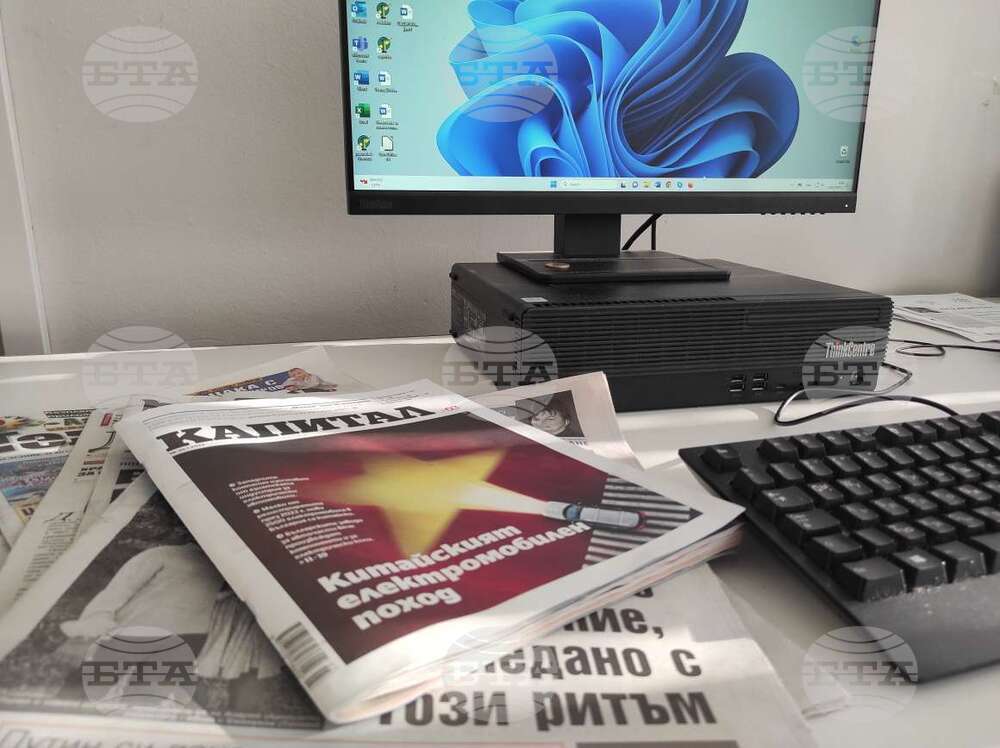
Capital previews a three-hour interview with GERB leader Boyko Borissov recorded on January 19, with the full video due on Tuesday, in which Borissov says Radev is behaving like a party leader while using the attributes of State power. At the same time, Borissov says he trusts Radev more than CC–DB and leaves the door open to cooperation on issues such as judicial reform, while reiterating conservative public finances, no tax rises and support for “new industrialization”, AI and infrastructure concessions.
ECONOMY
24 Chasa writes that more than 20 business organizations have come out against an “anti-speculation” price-control bill sponsored by BSP, MECh and Velichie, saying it would distort free pricing and risk shortages, grey-market growth and weaker investment ahead of euro adoption. The draft, backed at first reading, caps markups on basic foods at 10% and waives bank fees for exchanging BGN into EUR until year-end, while also covering essentials, fuel, medicines, mobile services and banking fees; the organizations argue it duplicates existing consumer-protection and competition tools.
The paper adds that Pharmacists’ Union chair Dimitar Marinov warned some over-the-counter medicines could disappear if prices are rolled back to December 2, 2024 levels, forcing pharmacies to sell at a loss after stocking at higher prices. The sector estimates that roughly one third of OTC medicines have risen over the past year with State approval, affecting more than 500 products, and the union urges MPs to halt the bill at second reading and consider wholesale-level ceilings instead.
***
24 Chasa reports that Parliament is expected to take a final investment decision in 2026 on building Units 7 and 8 at Kozloduy Nuclear Power Plant, with a Westinghouse–Hyundai design–build–handover contract as the next step, first concrete planned for 2030 and Unit 7 scheduled to enter operation in early 2036, according to Kozloduy NPP – New Builds chief executive Petyo Ivanov. The paper says a State-aid request will be sent to the European Commission within weeks alongside details on project and electricity costs, and outlines financing of up to 30% equity and 70% debt backed by State guarantees, with up to USD 8 billion in potential export-credit funding and advisers including Citibank, plus a contract-for-difference mechanism after completion.
24 Chasa adds that the AP1000 design allows flexible output for grid balancing and includes passive safety systems, and says BGN 500 million has been spent so far on preparation with another BGN 500 million planned in 2026, while EUR 1.5 billion in State guarantees has been carried over into 2025–2026. It also notes that a detailed plan for Site No. 2 was approved on January 8, enabling expropriation of remaining land after six plots totalling 82,889 sq m were bought at BGN 3,300 per decare, with 32 plots affected overall and the company owning 12.
***
Capital reviews Bulgaria’s position in a regional joint LNG-buying initiative for Southeast and Central Europe aimed at securing better prices and reducing dependence on Russia, with initial results expected by March and a government–industry meeting planned in Q1 2026. The paper says the Energy Ministry supports the idea but has not indicated volumes, and sets eligibility criteria linked to wholesale capability, current or post-2022 terminated Gazprom contracts, operational scale and annual consumption of at least 0.5 bcm.
Capital adds that the Energy Ministry has invited only Bulgargaz, while the European Commission has also approached private operators, with the process based on confidential demand submissions followed by an EC assessment of volumes, duration and geography. The outlet says Bulgaria has little to show so far: Bulgargaz secured one AggregateEU match for March 2024 but signed no contract because volumes were insufficient, while the Diversification Initiative remains at an early stage and an EC demand assessment is expected in January.
SOCIETY
Trud writes that euro topped a public poll for Bulgarians’ word of 2025, followed by outrage and protest, with the top ten also including volleyball, murshlyak (a morally/physically degraded individual), Gen Z and “capital D” (a nod to Delyan Peevski’s remark about creating a “State with a capital D”). Bulgarian-language teacher Doroteya Nikolova said the shortlist reflects public suggestions rather than expert selection, while Kak se pishe founder Pavlina Varbanova linked the ranking to eurozone accession and protest themes; the platform’s media-word analysis, the paper adds, puts Bulgaria first and child second, followed by Russia, Ukraine and war.
***
Trud reports that Sofia Mayor Vassil Terziev announces the launch of the Green Ring, a 30-km pedestrian and cycling route which the municipality says will link more than 30 neighbourhoods and provide access to the city’s green system for over 250,000 residents. Terziev says abandoned areas, old railway lines and river corridors would be converted into public walking-and-cycling spaces, with initial work focusing on the Vazrazhdane section in the Sredets industrial zone and full transfer of relevant State properties expected to be completed in 2026.
***
Duma writes that Bulgarian Medical Association chair Nikolay Branzalov said the lack of an adopted State budget and ongoing political instability are preventing meaningful healthcare reform, arguing that the budget underpins the National Framework Contract and sets medical-service prices that have not changed despite inflation. Branzalov said that without a serious increase in healthcare funding Bulgaria risks shortages of doctors and nurses and a renewed cycle of pay protests, and he called the patient fee disproportionate and insufficiently debated.
Duma also reports another attack on a paramedic in Polski Trambesh, described as the second in four days and the third in less than a month in the region, and calls for measures such as panic buttons and body cameras and for zero tolerance of violence against medics.
/КТ/
news.modal.header
news.modal.text