site.btaMedia Review: January 16
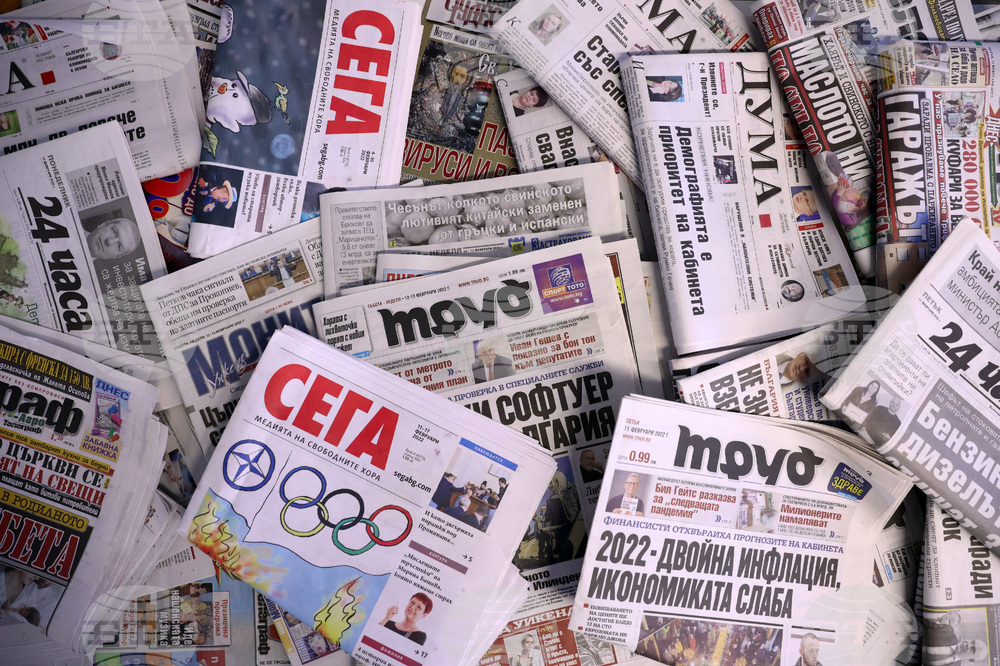
POLITICS
In an interview with Bulgarian National Radio, political scientist Georgi Kiryakov predicted that these would not be the last snap elections and said escalating political tension is extremely convenient for President Rumen Radev, as it creates a sense of crisis, fuels the perception that parties are incapable or unnecessary, and helps consolidate support behind a potential future project. According to him, this tension creates the impression that an alternative is needed, which is then associated with the president. Kiryakov said Radev will not enter the political arena in the upcoming elections due to lack of time and apparent desire, but will instead wait for further escalation of tension that could provide prospects for a satisfactory result of over 121 MPs, while noting that such a result may not happen at all, as the current fragmentation of the party landscape reflects a deeply fragmented society.
***
In a commentary for Trud daily, journalist Iliya Iliev argues that Bulgaria is heading toward another early parliamentary election amid voter fatigue and the absence of a convincing new political alternative, describing the repeated cycle of elections and fragile coalitions as a systemic crisis rather than a temporary political deadlock. He maintains that none of the existing political forces appears capable of mobilizing broad public support or delivering meaningful reform, while speculation about a possible political role for President Rumen Radev would not fundamentally change the situation. Iliev also links Bulgaria’s internal instability to a deteriorating international environment, which he describes as increasingly competitive and unpredictable.
***
In an interview with Bulgarian National Radio, BSP – United Left MP Gabriel Valkov commented on the current political situation, saying he had expected the third government-forming mandate to be handed to his parliamentary group but believes President Rumen Radev is currently placing the Bulgarian Socialist Party on the other side of the so-called “anti-mafia consensus.” He said this was due to the current party leadership’s participation in government, adding that he personally resigned from the Executive Bureau and apologized to the National Council for not being sufficiently critical when entering the government, while stressing the complexity of the political situation at the time. Valkov argued that after APS exited the government, a new BSP National Council should have reconfirmed the decision to remain in power, which he cited as one reason for the leadership’s resignation, adding that his view, shared by many young BSP members, is that the party should pursue a clear partnership with President Radev, with whom it has worked before and shares overlapping policy positions.
***
On Bulgarian National Television’s morning show, election experts Ivilina Aleksieva-Robinson, former chair of the Central Election Commission, and Kalin Slavov, executive director of Transparency International Bulgaria, outlined key points from debates on the upcoming elections, with Aleksieva-Robinson saying that malfunctioning electoral technologies reflect inadequate regulatory frameworks and lamenting the lack of consensus instead of cooperation. She noted that the EU and the Council of Europe strongly recommend adopting electoral technologies only when there is broad political and public consensus, which is currently absent. Slavov added that electoral rules should not be changed within a year of elections and stressed that Venice Commission standards explicitly prohibit changes after an election date has been set, warning that Bulgaria is approaching that threshold.
24 Chasa also features an extensive interview with Aleksieva-Robinson, who argues against fully machine-based voting and says changes to the Election Code should be made only when political tension has subsided and there is sufficient time for careful consideration. She criticized Bulgaria’s tradition of last-minute electoral changes, saying experience shows this worsens rather than improves the process, and added that mandatory voting rules disadvantage people who cannot or do not wish to use new technologies.
MERCOSUR
Trud features an interview with MEP Ilia Lazarov (GERB-UDF), who commented on Bulgaria’s and Europe’s position regarding the EU–Mercosur agreement, saying Europe must choose between a competitive, profitable industry or protecting agricultural producers. “We prefer to have a profitable and competitive industry, because rare earth elements such as lithium, copper and others come from South America. These are key for our industry, and China is trying to monopolise them. We are in direct competition with China. This is also part of the diversification we need to carry out,” he said. Lazarov added that Bulgarian industry is closely linked to European industry, noting that Germany has divisions in Bulgaria in the form of subcontractors producing various automotive parts, components and systems. “I have always given one classic example – all the electronics for all BMWs worldwide are manufactured at a single facility in Bozhurishte. The more BMWs are produced and exported to the South American market, the better off that facility will be. The same applies to the industrial zones of Plovdiv and Shumen, which host enterprises from various segments of the automotive industry. There are many people in Bulgaria who are directly engaged in this work and will benefit from the Mercosur agreement,” the MEP said, adding that industry feeds Europe and that supporting the Mercosur deal directly supports European industry and indirectly European agriculture, as an industrial crisis would inevitably lead to reduced agricultural funding.
***
On Bulgarian National Television’s morning show, National Grain Producers Association member Radostina Zhekova stated that the agriculture sector is firmly opposed to the EU–Mercosur deal, stressing that this stance is not merely symbolic solidarity. She said Bulgarian and European farmers would face enormous pressure from imports produced under non-EU regulations, noting that Europe has already struggled with Ukrainian imports and that the European Commission failed to manage that burden. Zhekova warned that following the Mercosur agreement, Europe would see an influx of GMO products produced using plant protection substances banned in the EU, adding that every European consumer should be concerned.
ECONOMY
Mediapool.bg reported that Gorna Oryahovitsa Airport has begun recruiting staff as part of efforts to restore civilian operations, a move presented as a sign that work on the project is advancing with political backing at national level. The initiative is being actively promoted by Gorna Oryahovitsa Mayor Nikolay Rashkov, who has publicly linked progress on the airport to support from MRF – New Beginning Floor Leader Delyan Peevski, with the two appearing together in a photo taken last spring in Peevski’s office. In comments quoted by the media, Rashkov said that after years of lack of interest and difficulties in securing state support, backing from MRF – New Beginning helped move talks with strategic investors forward. The media outlet notes that the project still faces major hurdles, including regulatory approval for civilian flights, the need for substantial investment and poor transport accessibility, with municipal plans including a new road connection to the future Hemus motorway under the EU’s Integrated Territorial Investments framework. The media outlet also highlights who owns the concession of the Airport. In April 2016 the Transport Ministry awarded the Gorna Oryahovitsa Airport as a concession to the company Gorna Oryahovitsa Civil Airport 2016 JSC. In the summer of 2025, control of Gorna Oryahovitsa 2016 passed to Kiril Klenovski through Project Company Gorna Oryahovitsa Airport, and his son Jordan joined the airport’s board of directors. Klenovski Sr. has been involved in business for decades and has holdings in a number of companies. In the mid-1990s, Klenovski had a joint venture with the late founders of VIS, Vasil Iliev and Georgi Iliev. The company is called VKJ Group and still exists today. However, Klenovski left its management in 2007. According to data from the Commercial Register, in 2003 he was one of the owners of Himimport Pharma, a company that is now called Pharmimport and is owned by Alexander Panushev. Until 2017, Tsvetan Botev, who is also on the board of directors of the business group Chimimport AD, was a member of the board of directors of this company. Klenovski also has an arms business through another company, which is licensed to trade in defense-related and dual-use goods.
***
Trud reports that caretaker Environment Minister Manol Genov has ordered the suspension of operations at Kronospan Bulgaria’s wood-processing plant in Veliko Tarnovo following numerous complaints from residents about air pollution. The daily writes that the Ministry has not issued official statement on the topic but Veliko Tarnovo Mayor Daniel Panov has confirmed the measure before the Bulgarian National Radio, saying local authorities had insisted on an immediate inspection, while representatives of the regional environmental inspectorate, the Municipality and the regional administration attempted to serve the order, which the company initially refused to accept for procedural reasons. Authorities said a new attempt would be made, after which the company would have 24 hours to submit a plan for the safe shutdown of production.
***
Mediapool.bg quoted a Bloomberg article which states that Bulgaria’s main stock index SOFIX has recorded the strongest performance worldwide in the first days of 2026 following the country’s accession to the euro area on Jan. 1, citing a comparison of 92 major global indices. According to data from the Bulgarian Stock Exchange, SOFIX has risen by nearly 16% since the start of the year and by more than 55% on an annual basis, placing it among the top ten performers globally. Bloomberg attributes the rally to investor confidence that euro adoption will lead to deeper European integration, noting that while Bulgaria’s capital market is relatively small, the current performance stands out and recalls similar optimism around the country’s EU accession in 2006–2007. Quoted by the media outlet, Bulgarian National Bank Deputy Governor Petar Chobanov said the euro transition is proceeding smoothly, with no signs of significant inflationary pressure, while the stock exchange reported a nearly 20-year high for SOFIX and a sharp increase in trading volumes.
***
On bTV’s morning show, Bulgarian Stock Exchange Executive Director Manyu Moravenov commented on the positive impact of Bulgaria’s eurozone accession on the capital market, noting that indicators are the strongest since EU accession and that eurozone entry is proving an even stronger catalyst. Drawing comparisons with Croatia, which joined the eurozone on January 1, 2023, he said its stock exchange became the fastest-growing in the region one year later and hosted some of the largest IPOs in the second year. Moravenov said the elimination of currency risk, improved credit rating and participation in eurozone monetary policy make Bulgaria more stable and visible to investors, although he emphasized that political stability remains crucial alongside financial predictability.
***
On Nova Television’s morning show, Bulgarian Association of Car Manufacturers Board Chair Aleksander Kostadinov said 2025 was the most successful year in Bulgaria’s modern history for new passenger car sales, with nearly 50,000 vehicles sold, marking growth of 12–15% year-on-year and surpassing the previous record from 2008 after 17 years. He attributed the growth to rising incomes and increased awareness that new cars are more cost-effective long term, but warned that Bulgaria still lags behind Europe in electromobility, with electric vehicles accounting for just 5% of sales compared to 23–25% in Europe, and an average vehicle age of around 20 years. Kostadinov stressed that Bulgaria ranks first in the EU for the oldest vehicle fleet, road fatalities and air pollution, warning that between 12,000 and 15,000 people die prematurely each year due to polluted air, with transport responsible for 40–50% of urban pollution.
SOCIETY
Telegraph reports on a newly created digital map showing dangerous and hard-to-navigate sidewalks in Sofia, marking broken pavement tiles, missing ramps, damaged manhole covers and non-functioning elevators in underpasses instead of landmarks or traffic. “These are the invisible walls of Sofia,” says its creator Tihomir Garmenliev, a 20-year-old informatics and software sciences student at the Technical University, explaining that what may be a minor inconvenience for most people is a daily battle for wheelchair users. Garmenliev notes that anyone can submit reports on the website, even anonymously, with the process taking about a minute and requiring a location, description and photo, after which verified reports appear on the map and are sent to Sofia Municipality for action.
/MR/
news.modal.header
news.modal.text