site.btaMedia Review: January 13
POLITICS
Commenters discuss the possible snap elections if all three cabinet-forming mandates fail after the Rosen Zhelyazkov cabinet resigned on December 11, 2025, and the appointment of a caretaker prime minister with the task of organizing those elections.
***
Interviewed by the Bulgarian National Radio (BNR), political analyst Daniel Smilov, a specialist in comparative constitutional law, said the key question is whether President Rumen Radev will enter the political arena and when. If he takes part in forming the caretaker government, he still bears responsibility. If he then forms a party and steps down as president, he would find it difficult to explain to voters how he can be involved in governance and participate in the race at the same time.
There is a quandary over who might agree to serve as caretaker prime minister, said Smilov. The ombudsman disputed that a representative of that institution could take the role. Including the Bulgarian National Bank leadership in the list of potential caretaker prime ministers is also problematic due to strict independence requirements under Bulgarian and EU law. He added that the Constitution's drafters never envisioned the president governing through seven successive caretaker governments, and if all potential candidates refuse, the outgoing government of Rosen Zhelyazkov should remain in office.
***
bTV interviewed Dimitar Ganev from the Trend polling agency and Parvan Simeonov, founder of the Myara polling agency. Regarding a possible new role for Radev, Ganev commented that a political alternative has been sought for some time. A new political formation led by the President would likely boost voter turnout, which historically rises whenever a new actor enters the scene.
Simeonov said that if Radev decides to enter the political arena, he would likely pursue a rapid, image-focused campaign. The more interesting question is what follows, as a parliament could emerge requiring collaboration between Continue the Change - Democratic Bulgaria (CC-DB) and Radev's formation. "The key issue is whether Radev can mobilize an anti-GERB and anti-Delyan Peevski vote. If he succeeds without significantly harming CC-DB, the next parliament could see an anti-corruption majority between forces that would otherwise not cooperate.
***
In a 24 Chasa interview, Bulgarian Socialist Party (BSP) leader Atanas Zafirov says that if the congress in early February supports him, he will launch a new, uncompromisingly left-wing programme. In his view, those who triggered the congress are contradicting themselves, after they acknowledged the BSP's performance in the government coalition. He criticizes the party for turning to personal disputes at critical moments: it claims to be a collective organization but defaults to leader-focused arguments when under pressure. The party's energy spent on internal elections rather than on national campaigns is pointless, says Zafirov, adding that some fear the Left, which has demonstrated capable governance and could become an unavoidable force in Bulgarian politics. The current efforts to control the party are being carried out by a few young people who rose to prominence thanks to the current leadership.
***
Nova TV featured comments by several analysts. Media expert Georgi Lozanov said the key question is whether the elections will change the political landscape or will reproduce the same governance model. It all depends on whether protest energy is converted into votes.
Sociologist Andrey Raychev said claims about the scale of vote-buying are exaggerated, estimating it at no more than 10%. He noted that Bulgaria's political balance has shifted: "There used to be one million centre-left, over a million centrists, and half a million right-wing supporters. Now something is missing." The president's next move, after the third mandate is returned which will lead to the appointment of a caretaker prime minister, will indicate whether he intends to enter active politics: "If he does not step down then, he will not do so at all."
Political analyst Rumyana Kolarova said the moment for change has arrived, but it is unclear whether a new political formation will appear before the snap elections. "Those who rely on the President entering party politics want to see a change of players. For me, this does not lead to real change, because it has happened before."
Analyst Miroslav Sevlievski said that in the past five years, voters have shown they "do not want to put all eggs in one basket". Voters are careful not to give all power to one person, to avoid the 15-year scenario of GERB and Boyko Borisov holding total control. The presidential elections will be the main focus of the year, though concrete candidates are still lacking.
Georgi Prodanov noted that after joining the EU, Schengen and the euro area, Bulgaria has exhausted its major foreign policy goals and is now searching for new purpose. "We need to rationally define why Bulgaria exists and what its goals are beyond emotions," he said.
***
24 Chasa looks at March 29 as the most realistic date for the snap elections. That date was mentioned by Rosen Zhelyazkov on Monday, when he returned the GERB-UDF cabinet-forming mandate as soon as Radev handed it to him. The daily says the school holidays start on April 4 and many families will travel, and then April 12 is Easter Sunday. A later date in April would be at odds with statements that the elections should not be delayed. For his part, social analyst Parvan Simeonov argued on bTV that March 29 would not be good timing because it is when Daylight Saving Time starts and clocks go forward.
***
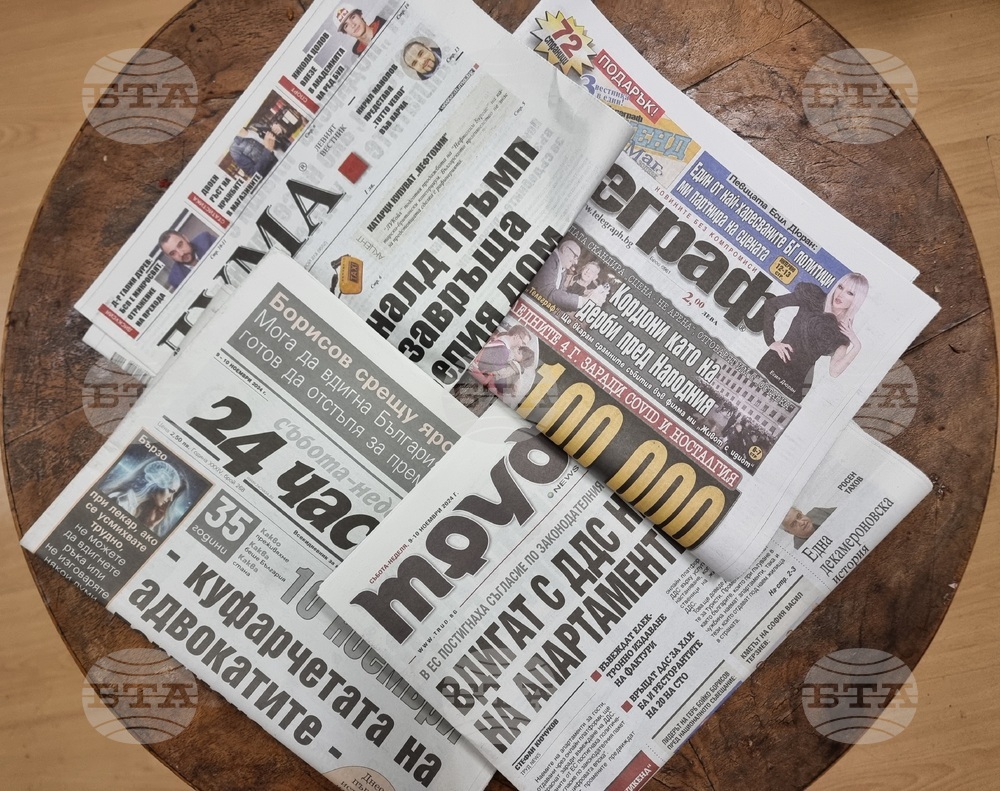
Ahead of the snap elections, Trud leads with Election Code amendments proposed by a working group. New optical voting devices will be used in all polling stations except those outside the EU. They will replace the Smartmatic voting machines used in previous elections. The new devices will be owned by national system integrator Information Services. Voters will mark their ballots in booths and then insert them into a scanning device that records, counts and stores the votes. After voting, the system prints a receipt, which is placed in a separate box. The proposal specifies that voters cannot change their vote by voting again.
24 Chasa says on an inside page that after a 25-day recess, the MPs will set about amending the Election Code.
ECONOMY
Confederation of Independent Trade Unions President Plamen Dimitrov told Bulgarian National Television (BNT) that regulatory bodies are trying to address price gouging with many inspections but few sanctions, which aim to discipline the market rather than punish specific traders. Supermarket chains have announced plans to freeze prices on basic goods for four months, though it remains uncertain if this will happen. Dimitrov expects the Finance Ministry to announce on January 15 which inflation figure it will use. He hopes this will be the consumer price index of 5.2%. Tension is mounting, with several sectors, including community centres, the Bulgarian State Railways (BDZ), Sofia public transport and Bulgarian Posts, already collecting signatures for protest actions.
***
Mediapool.bg reports that a tender lasting more than a year for the design, supply, installation and commissioning of two new hydro units at the Chaira pumped-storage power plant has ended without a single bid being submitted by the remaining three out of five candidates. Bids were expected from the Voith GBS Hydro consortium, Andritz Hydro GmbH, and VAPTECH & Toshiba - GP Group but none of the shortlisted candidates submitted a price offer.
The latest extended deadline expired on January 9. The procedure was launched on December 17, 2024 and was extended twice to allow bidders to prepare offers within the estimated value of EUR 124,028,969.29 excluding VAT.
This is the third failed tender for the full replacement of two hydro units, after all four were taken out of operation following a serious accident during testing in March 2022. One unit was repaired and returned to service at the end of 2024, two are currently being refurbished and are due to be commissioned in early 2026, while one will still require full replacement, prompting the National Electricity Company to seek a supplier for two new units.
***
Mediapool.bg has found from the public procurement register that with snap parliamentary elections in the offing, the Road Infrastructure Agency has rushed to finalize procurement procedures that had been stalled for a year, while setting one price record after another. The new benchmark cost for stabilizing 100 metres of a third-class road has peaked at over BGN 1 million (EUR 500,000). The current record is the stabilization of a 200-metre road section near the western town of Bobov Dol at a cost of EUR 543,375 per 100 metres. The contract was awarded to Georesurs EOOD at the end of last year.
***
24 Chasa leads with a report saying that cold weather has pushed up electricity prices on the Bulgarian market, prompting coal-fired plants in Bulgaria and across Europe to ramp up production. State-owned Maritsa East 2 TPP had its first sale under a bilateral contract for the new year on January 9, with high prices making the electricity profitable despite carbon costs. On January 13, the spot market price in Bulgaria hit a record EUR 251 per megawatt-hour, peaking at EUR 334, making Bulgarian and Romanian prices the second highest in Europe after Hungary's EUR 252. Such levels have not been seen since the 2022 gas crisis, when Russia cut supplies to Bulgaria on April 27. High electricity prices in early January, however, do not affect businesses or household consumers, as both sectors are protected by price caps.
***
Trud frontpages a story saying that pensioners are supporting Bulgaria's labour market, with nearly 200,000 people over 65 still working. This helps businesses, many of which report labour shortages. The group of working pensioners over 65 includes highly skilled professionals who contribute expertise, as well as individuals with relatively low pensions.
EU-MERCOSUR DEAL
Segabg.com reports that Bulgarian farmers will join a pan-European protest in Strasbourg on January 20 against the planned EU-Mercosur deal, warning that duty-free imports of grain and meat would undermine local production and fail to meet EU standards. Some 150-200 participants are expected to travel from Bulgaria by plane and bus to demonstrate outside the European Parliament. Heavy machinery will not be transported, but farmers are likely to join local colleagues on tractors, carrying Bulgarian flags and banners with slogans such as the key message "No Farmers, No Food, No Future" and "Bulgarian Agriculture- A Victim of Mercosur".
***
The Bulgarian National Radio featured a clash of opinions regarding the free trade agreement with Mercosur. While Ilia Lazarov MEP (EPP/Union of Democratic Forces), member of the European Parliament's Committee on International Trade, called the deal "very good" and the scale of resistance unjustified, Ilia Prodanov, head of the National Association of Grain Producers, said the protesters want the Mercosur deal rejected or, if approved, to be reconsidered, arguing that farmers have not been properly informed about its contents.
Lazarov said agriculture accounts for just 6% of trade under the EU-Mercosur agreement, with beef making up about 1.2%, arguing that farmers' fears are overstated and that planned compensation is sufficient. He said the main beneficiaries would be industrial economies such as Germany and France, while opposition in countries including France and Poland is driven by domestic political tensions, and warned that blocking the deal would be a major loss for Europe. For Bulgaria, the agreement would support exports of chemicals, spirits and automotive components, involving around 100 companies with an annual turnover of about EUR 630 million. For instance, Bulgaria exports brandy to South America and imports hail-control rockets from Argentina, which are subject to tariffs. Some MEPs are calling for a ruling by the Court of Justice of the EU, but Lazarov said that even a legal review would allow the agreement to enter into force provisionally.
In contrast, Prodanov warned that if European beef and poultry producers are wiped out, it could disrupt related markets. Imports of wheat, maize and soybeans from South America, including GMO products, might not meet EU standards. He criticized Bulgarian MEPs for defending the EU-Mercosur agreement with misleading figures, and pointed out that Argentina alone produced more wheat than Ukraine last year. He said protective clauses have failed to shield European farmers, with wheat prices at historic lows and 35-40% of farms lost in the past five years. "If current policies continue, European agriculture could be destroyed within five years," he warned.
IRAN PROTESTS
Security expert Tihomir Bezlov from the Center for the Study of Democracy commented on the Bulgarian National Television on the situation in Iran in the wake of the Venezuelan operation, in which the US administration showed a willingness to cross normally avoided boundaries. "Iran is far more influential than Venezuela for our region. Some forecasts suggest the fall of this religious-theocratic regime could lead to state collapse, reminiscent of the Arab Spring," he said. There are currently no significant migrant flows towards Turkiye, the main route to Western Europe, and illegal migration patterns in 2025 showed a shift from Bulgaria towards Serbia and from Greece through Bulgaria to Romania, complicating traditional control measures. While many experts believe the Tehran regime is likely to suppress protests, the new factor is "the threat of intervention by the Trump administration".
SOFIA-SKOPJE RELATIONS
Following an attack that smashed the glass door of the Bulgarian Embassy in Skopje, journalist Nina Spasova told bTV that there were no signs of warming between the two countries in 2025 and no change in relations. She called the incident, for which a suspect was arrested, "another provocation," adding that the suspect deliberately threw a stone at the embassy on a Sunday when no one was around, and that it appears to be a paid provocation, with the Macedonian authorities' response still unclear.
Also on bTV, journalist Petar Kolev said that North Macedonia's foreign minister downplayed the incident as minor and isolated, but that he was left with the impression that the government in Skopje is encouraging attacks against Bulgarian institutions. Relations with North Macedonia illustrate how a state leadership, through deliberate policy choices, continues to destabilize the Balkans, said Kolev. He argued that the region has several geopolitical "triggers" which are activated to cause instability. "Bosnia is used to affect Croatia and Slovenia, northern Kosovo to shake Albania, and when one wants to hit Bulgaria and the Black Sea region, one pushes the trigger Skopje," he said.
/DD/
news.modal.header
news.modal.text