site.btaMedia Review: December 5
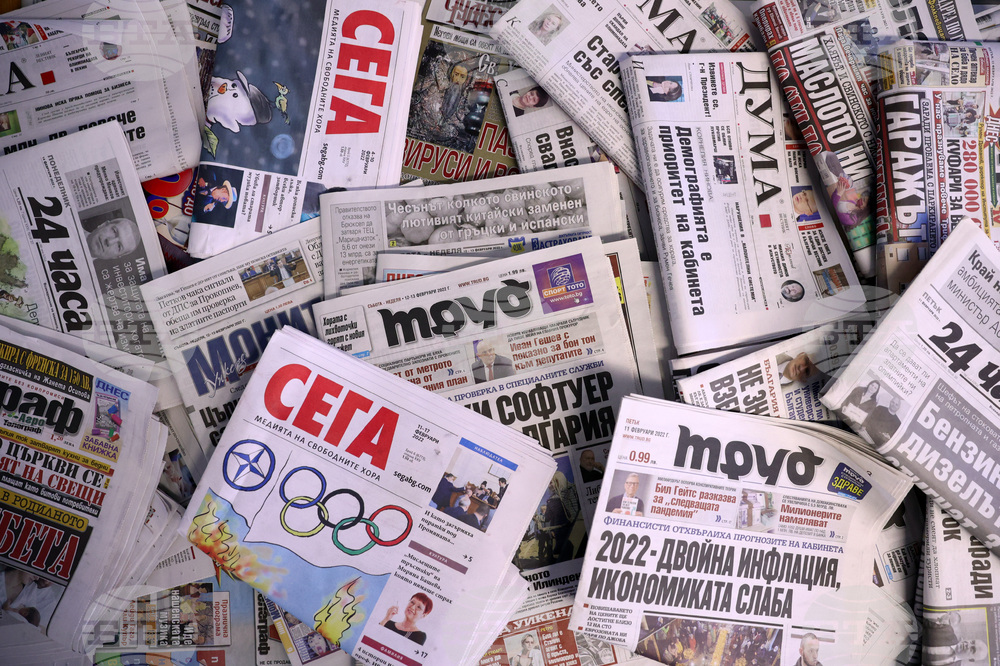
Friday's news media are dominated by Bulgaria’s economic outlook amid the 2026 budget debate, highlighting both public concern and political contention.
ECONOMY
24 Chasa publishes an interview with Bulgarian National Bank (BNB) Governor Dimitar Radev, who comments on the forthcoming euro area entry as of January 1, 2026, the condition of the banking sector and the challenges facing the 2026 budget. According to Radev, the European Central Bank’s planned new stress tests are a necessary instrument in the current environment of uncertainty. He said that Bulgarian banks are in “very good condition”, but the tests may indicate areas where additional measures are needed.
Commenting on the draft 2026 budget, Radev said that the initial version lacked a necessary balance of interests and responsibilities. He warns that similar imbalances historically have triggered economic and political turbulence. The Governor argues that what he calls the “devaluation of the budget process” began after 2020, when short-term political considerations started replacing strategic vision and institutional discipline. Whether the political class can overcome this, he says, is now a central question. On income policy, Radev underlined that real incomes cannot grow sustainably through political decisions. According to him, they increase only when the economy expands through higher productivity, investments and a predictable business environment.
24 Chasa also publishes an interview with Petia Dimitrova, Chair of the Management Board of the Association of Banks in Bulgaria, who reviews the sector’s performance in 2025 and outlines its readiness for the euro changeover and the ongoing digital transformation. Dimitrova said that the Bulgarian banking sector remains among the most stable and well-capitalized in Europe. Indicators such as capital adequacy, liquidity and resilience exceed the EU average, while the share of non-performing loans is among the lowest in the Union. She noted that, despite geopolitical uncertainty and rapid technological change, the sector has shown maturity by adapting business models, accelerating digitalisation and developing new opportunities for growth.
On the forthcoming introduction of the euro, Dimitrova said that the sector is fully prepared. Beyond its financial role, she highlights banks’ importance as communicators, providing citizens with clear and timely information through digital channels, contact centres and branches. She noted that banks have invested over BGN 400 million in system upgrades, staff training and communication to ensure a smooth and secure transition. According to her, joining the euro area represents not only a technical change but also a new phase of economic development, offering deeper integration with European markets, stronger competitiveness and more sustainable growth.
***
Speaking on the bTV morning programme, former European Commissioner and former deputy prime minister Meglena Kuneva said that Bulgaria has “entered the eurozone with a budget that, in itself, is a form of protest.” She emphasized that, for the first time, Bulgaria is preparing a budget without the constraints previously imposed by the currency board, describing it as “a new moment and a new responsibility.” Kuneva recalled that the European Commission has already urged Sofia to exercise caution, following a wave of criticism triggered by the draft budget. She sharply criticized the lack of transparency and dialogue in its preparation. “The Fiscal Council cannot claim to gather information from the press because no one provided them with the budget. This is not just a problem with the numbers, it is a problem for democracy,” she stressed.
***
Trud reports that November heating bills will be issued on a forecast basis, calculated according to consumption in the same month of the previous year. The reason is the Supreme Administrative Court’s decision to annul the formula for determining the share of the building installation in heating bills. The information was presented during a national conference on heating utilities organized by the Bulgarian Energy and Mining Forum. According to Ivan Marinov, Director of the Security of Energy Supply and Crisis Management Directorate at the Ministry of Energy, although the formula was annulled, the Heat Supply Ordinance still contains rules for calculating monthly charges. The ordinance allows homeowners’ associations to set the building-installation share between 20% and 40% of total consumption. In buildings without such a decision, consumers will receive forecast bills based on last year’s usage, even when they are on real monthly readings. Marinov stressed that the building-installation component remains due and must be allocated.
He noted that the ruling of the Supreme Administrative Court does not question the correctness of the formula or its parameters but finds procedural violations in adopting the Ordinance. An EU Court of Justice decision cited in the discussion states that the formula lacks transparency for end users and that all parameters must be clearly defined and verifiable so consumers can influence their consumption decisions. The reporting judge stated that heating costs should be divided into two groups: those dependent on individual consumption and those representing fixed costs such as vertical risers and basement pipes. Marinov added that the Ministry’s task is to create a new formula with fully transparent parameters.
***
Telegraph’s front-page story reports on how pensioners across the country plan to use their Christmas bonuses, highlighting frustration with inflation, rising food prices and the limited purchasing power of older citizens. The paper’s feature carries testimonies from pensioners in Blagoevgrad, Sliven, Dobrich, Sofia and other regions, describing how the traditional one-off holiday supplement will barely cover part of the festive expenses this year. The daily notes that 536,000 pensioners nationwide fall below the poverty line and are therefore expected to receive the BGN 120 (EUR 61.36) Christmas bonus this year, according to the eligibility rules set by the Government. Many pensioners interviewed express dissatisfaction that the supplement does not reach everyone and argue that the criteria exclude people who still struggle financially despite having pensions slightly above the threshold. At Sofia’s Zhenski Pazar (Women’s Market), where pensioners gathered to compare prices for holiday meals, several point out that their pensions are too high to qualify for the bonus but still insufficient to afford rising food costs. Other pensioners interviewed emphasize similar difficulties. A 74-year-old man from Sliven said that the minimum pension raised to BGN 650 (EUR 332,35) still does not meet the rising cost of living. Another elderly interviewee expresses disappointment that the Government is “releasing this money for the holidays, as if they give it out of their own pockets”, while MPs receive significantly higher monthly allowances.
PROTESTS’ AFTERMATH
Capital.bg reports that the December 1 protest against the 2026 State Budget Bill saw significant participation from Generation Z, described by analysts as a potential “black swan” for the oligarchic political model associated with MRF-New Beginning leader Delyan Peevski and GERB leader Boyko Borisov. Opposition party Continue the Change – Democratic Bulgaria (CC–DB) played a key role in amplifying awareness through social media, turning budgetary discontent into broader demands for fairness and accountability. Attempts by the ruling coalition to downplay or politicize the protests, including linking them to euroscepticism or conspiracy theories, largely failed. Under public pressure, Prime Minister Rosen Zhelyazkov announced that the proposed budget would be withdrawn, with plans to revise controversial measures such as increases in social security contributions and dividend taxes.
According to sociologists cited by Capital.bg, the protests have highlighted deep structural issues in Bulgaria’s governance, including judicial oversight, regulatory independence, and state accountability, and have created a window for political realignment. It remains unclear whether the revised 2026 budget will ease public tensions or mitigate political damage for the government. The protests, however, have already outgrown their immediate trigger, escalating into broader calls for the government's resignation. This shift immediately shaped opposition strategy. CC–DB, now acting as the political voice of the demonstrators, announced on Tuesday that they will submit a no-confidence motion against the government on Friday and organize a new protest on the day of the parliamentary debate. Political analysts warn that if civic momentum against the government persists, Bulgaria could face a sustained protest wave that may trigger a wider political realignment in Parliament. The outcome, whether early elections are ultimately called or the movement gradually loses steam, will depend on how effectively the participants channel and maintain this energy.
Capital.bg also predicts that if the protest energy, reinvigorated by previously politically apathetic youth, is sustained, voter turnout in the next elections could rise, reshaping parliamentary dynamics. The main political contest is expected to unfold within a triangular competition between GERB and MRF– New Beginning, CC–DB, and a potential new alternative represented by the anticipated party of President Rumen Radev. According to sociologist Dobromir Zhivkov, “If he does not step forward, other candidates will emerge.”
***
Duma’s front-page article, titled “CC-DB, You Will Mislead the People Again!”, reports that BSP–United Left accused CC–DB of deliberately politicizing protests against the 2026 budget bill. The article quotes BSP–United Left Floor Leader Dragomir Stoynev, who said that the CC-DB were “once again deceiving the public” by attempting to exploit social discontent for political gain. “We respect people’s right to protest and to express their dissatisfaction, but we believe the demonstrations are being intentionally and subjectively politicized,” Stoynev said. According to him, CC–DB are “abusing the situation” and have become “intoxicated by the prospect of power,” pushing the protests beyond the scope of the permitted demonstration.
***
In a story headlined “Tsonev, Bayram, Hamid, Anastassov: Peevski’s Praetorians" (subheading "Who are the four MPs of MRF-New Beginning who angered the Gen Z protesters?”), Capital profiles in detail MPs Yordan Tsonev, Hamid Hamid, Bayram Bayram, and Stanislav Anastassov, who became widely noticed after their ugly behavior during the first major protest against the 2026 budget. Though not the top figures in the party hierarchy beneath leader Delyan Peevski, they serve as his most loyal and vocal enforcers, often defending controversial policies, attacking internal rivals, or pushing legislation through Parliament. Their confrontational conduct toward young activists during the protest, combined with earlier incidents in Parliament, turned them into symbols of the party’s abrasive style of politics, drawing intense backlash especially from Gen Z demonstrators who had not been familiar with them before.
***
In an interview for Bulgarian National Radio, CC-DB MP Elisaveta Belobradova described Monday’s protest as a “staged reenactment” of the Ilinden-Preobrazhenie Uprising [against Ottoman rule]. She said that the first 30 minutes resembled a theatrical performance, with protesters observing from a distance while fires were deliberately set in bins and the GERB office was vandalized, allowing for photos before police intervened. Belobradova criticized the authorities for failing to isolate provocateurs, despite her direct appeals to officers, and highlighted that responsibility lies with individuals for their own actions rather than the entire protest crowd. She emphasized that many young participants were politically aware, acting with clear purpose linked to income and social concerns. Belobradova also questioned why Interior Minister Daniel Mitov was absent and renewed calls for his resignation, condemning the authorities’ “mockery, contempt, and disregard for ordinary citizens.”
***
Speaking on Bulgarian National Television, former interior minister Emanuil Yordanov commented on the acts of vandalism and violence that occurred during Monday night’s protest. “Police violence occurs when officers exceed their powers. The law is very clear on when physical force and auxiliary means may be used, and it must be followed,” Yordanov explained. He added that there is also a law regulating assemblies, rallies, and demonstrations, and, in his view, the Ministry personnel were not sufficiently familiar with its provisions. “There are times when people ask why there is police violence, and at other times why there is police inaction. Officers clearly prefer inaction because the criticism is less severe than when force is used, and there are many cases where there is no one to defend them even when they have performed their duties correctly, albeit using physical force,” Yordanov noted.
/DS/
news.modal.header
news.modal.text