site.btaMedia Review: December 4
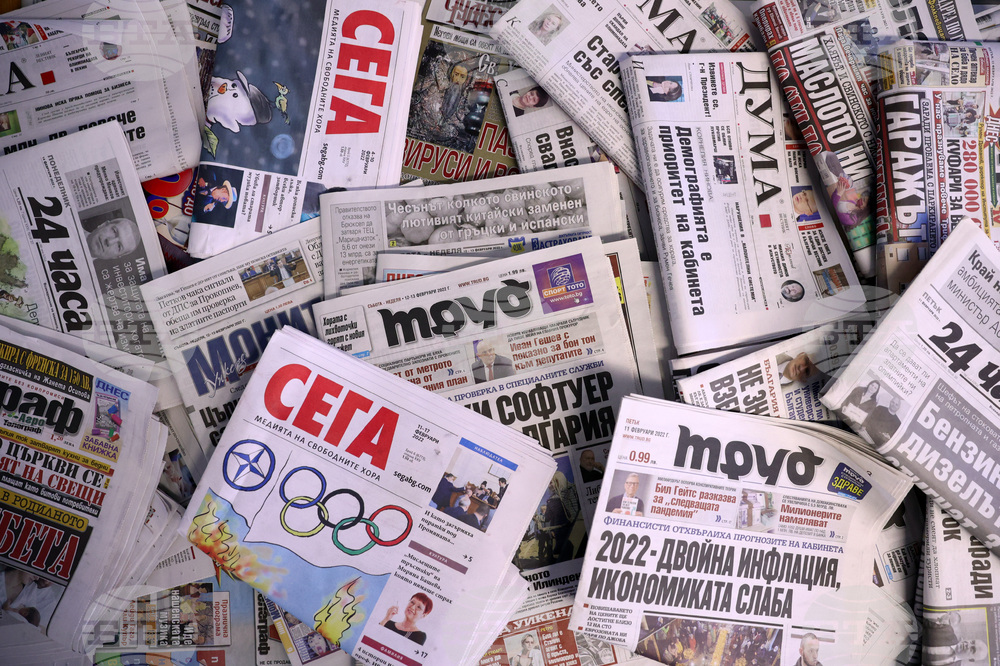
The current political situation after Monday’s large-scale protests across Bulgaria dominates the media on Thursday.
In an interview with Trud, Sofia’s Oborishte borough Mayor Georgi Kuzmov criticized the police for inaction during the December 1 protest, claiming residents pleaded with officers to intervene while organized groups carried out vandalism, allegedly coordinated with a suspicious power outage that coincided with the unrest. Kuzmov argued that the protests reflect dissatisfaction not only with the national budget but with the country’s overall governance, noting a notable rise in youth participation, which he sees as a positive sign for Bulgaria’s future. He dismissed claims that the demonstrations were organized through social media marketing, stating the scale of mobilisation cannot be achieved in such a short time. The Oborishte Mayor predicted snap parliamentary elections in early 2026.
24 Chasa features an interview with political scientist Dimitar Ganev. He said that whether the large-scale protests across the country trigger a renewed political crisis will depend on their persistence after the holiday period. If the mobilization resumes in January with similar force, the Government could face unmanageable pressure, with virtually every decision triggering backlash. Ganev added that President Rumen Radev’s strategy suggests preparation for launching a political project prior to presidential elections, entering the anti-establishment field where parties like Vazrazhdane, MECh, and Velichie currently operate - potentially threatening their support. Any future political configuration remains difficult to predict and depends heavily on the scale of Radev’s potential political project, particularly its ability to mobilize non-voters.
On Bulgarian National Television’s morning show, political scientist Daniel Smilov and Georgi Harizanov commented on the current political landscape in the country. Assoc. Prof. Smilov said that the protesters demanded the removal of the political arrogance symbolized by MRF – New Beginning Floor Leader Delyan Peevski in tandem with GERB-UDF Floor Leader Boyko Borissov, as he behaves like someone dependent on decisions taken by Peevski. In the public sphere, they operate as a single entity, the political scientist argued. Harizanov noted that the protest has moved beyond the issue of the draft state budget. “It remains to be seen whether a larger, more systemic problem exists and whether this will continue as a “process”. The dependencies are very transparent and very visible within the balances drawn by Bulgarian voters in this Parliament,” he added.
bTV’s morning show featured an interview with former health minister and Conservative Rightist Unity (KOD) party leader Petar Moskov. He stated that although he opposes the current Government, he did not take part in the December 1 protest, noting that he has only supported demonstrations when a genuine right-wing alternative existed. Moskov argued that the Government surrounding GERB could be removed, yet those presenting themselves as spokespeople for the protest are part of the problem, not the solution. He criticized successive administrations – the caretaker cabinets appointed by President Rumen Radev, the one led by former CC chair Kiril Petkov, and the current one - for making income dependent on administrative criteria rather than productivity, normalizing what he called a “life on credit”. Moskov insisted that a regular government is needed in the next six months, but this can only happen if the Movement for Rights and Freedoms is removed from power, saying that isolating the party is the responsibility of Borissov. If not, he warned, the public’s justified anger may “sweep everything away regardless of the consequences”. He pointed out the paradox in the healthcare sector: record-level funding alongside worsening outcomes.
bTV’s morning show also showed an interview with former justice minister Krum Zarkov, who described the December 1 protest as “massive, determined and intense,” stating that demonstrators filled central Sofia with the clear intention of ending what he called the “mafia-style takeover of the state.” He argued that public anger is directed primarily at Peevski, who he believes has become the sole political centre of power in recent months. Zarkov warned that the government cannot survive unless it distances itself from Peevski, noting that GERB leader Boyko Borisov is already attempting to do so, despite appearing unusually subordinate for the first time in years. According to Zarkov, protesters see Borisov and Peevski as inseparable, and he called on parties to reinstate a political “cordon sanitaire” around Peevski and work towards ending the current administration. He cautioned that failure to respond to public demands will lead to larger protests, a paralyzed parliament and a government unable to pass its own budget. The cabinet may remain in place only until the presidential elections, losing political capital daily, he said. Zarkov also said Peevski’s attempts to use ethnic rhetoric show he feels threatened, emphasizing that controlling the Movement for Rights and Freedoms party brand does not give him legitimacy to speak on behalf of its supporters. Though counter-protests are possible, rejection of the government, he said, is evident across everyday life - not only on the streets.
Nova Television’s morning show broadcast a discussion featuring sociologist Evelina Slavkova and political analyst Dimitar Avramov. Slavkova stated that the Cabinet may attempt to hold on to power, but if the protests continue at scale after the holidays, it will signal that remaining in office will be very difficult. Both the ruling parties and the opposition view early elections as risky. She noted that public frustration is driven by inflation and price increases. She expects attempts to publicly distance the Government from Peevski, even if his party continues to support it. Avramov argued that public trust in the ruling majority has been exhausted. He compared the Government’s approach to the budget to populist spending seen in Venezuela, warning of potential economic instability similar to Greece. He said people are angry on a practical, everyday level and that political leaders do not seem to grasp the situation. He described the protests as a response not just to specific politicians, but to the misuse of power and the removal of people’s ability to influence decisions.
In an interview with the Bulgarian National Radio, Center for Analysis and Crisis Communications Chair Alexander Hristov stated that a decisive protest movement has clearly emerged, sparked within just a few weeks by a budget perceived as taking from working people and giving to what he described as a problematic and ineffective administration. He argued that protests gain real strength when they affect incomes and everyday life, unlike recent politically driven demonstrations that failed to build momentum. Hristov suggested that a turning point could come with early elections, depending largely on whether the President decides to enter the political scene. He argued that only the head of State’s direct involvement would lead to radical political change.
***
Trud has an infographic highlighting the role of Generation Z in the anti-government protests in Africa, Asia and South America. “The first generation to grow up in the internet era is at the forefront of protests that force governments to collapse and leaders to resign,“ the infographic reads. Gen Z includes people born between 1997 and 2010. The daily highlights a pirate symbol from the Japanese manga series One Piece as a symbol of their struggle – a flag that was also seen at the protests in Sofia. The newspaper lists countries where large-scale, youth-led protests have emerged, gaining momentum in the digital space and driven by a desire to overthrow governments and leaders seen as corrupt, unjust or inadequate: Peru, Kenya, Indonesia, Timor-Leste, the Philippines, Nepal, Bangladesh, Madagascar, Morocco and Serbia.
JUSTICE
Mediapool writes that acting Prosecutor General Borislav Sarafov “took leave on the occasion of the opening of the new office of the European Public Prosecutor’s Office in Bulgaria.” European Chief Prosecutor Laura Kövesi visited Bulgaria for the event, and together with Justice Minister Georgi Georgiev opened the new headquarters of the European Public Prosecutor’s Office in Sofia. “The acting Prosecutor General, Borislav Sarafov, whose legitimacy is under question, did not attend the opening of the office of the European Public Prosecutor’s Office. He is on leave, and this is the reason for his absence at the event,” the media outlet reported after an inquiry to the prosecution service.
ECONOMY
Duma quotes data from the Bulgarian Food Safety Agency, according to which 29 consignments originating from third countries were rejected at border control points between November 3 and 30. As a result of official veterinary and phytosanitary inspections - including temporarily enhanced controls and the application of emergency measures for consignments of food and feed of non-animal origin destined for import into the European Union - more than 206 tonnes of goods were not allowed to enter the country, the agency reported. The rejected consignments included products of non-animal origin such as peppers and lemons, due to detected excessive levels of pesticide residues.
***
Telegraph features an interview with the Chair of the General Assembly of the Bulgarian Industrial Capital Association, Vasil Velev. He said that employer organizations express cautious optimism regarding the updated budget, pending written confirmation of all agreed measures. Velev added that agreements have been reached to scrap the planned increase in pension insurance contributions, the higher dividend tax, and the mandatory implementation of the state-approved sales management software. Employers argue that these revenue expectations were unrealistic and that removing them, coupled with expenditure cuts, improves the fiscal balance by hundreds of millions in the medium term. They support decoupling salaries in key public sectors - such as defence, healthcare, higher education and the judiciary - from the national average wage, claiming this could save EUR 653 million next year and fully offset the dropped revenue measures. According to Velev, employers propose only limited pay rises in the public sector and solely where salaries have not already far outpaced inflation, arguing that wage growth should not exceed the nominal GDP increase of 6.4%. The interview highlights what employers view as major opportunities for savings: freezing operational spending, cutting unfilled positions in the administration, cancelling duplicate investment projects, and significantly reducing defence and arms expenditure, labelled as “death spending”. They oppose raising the maximum social-security threshold and strongly reject the return of minimum insurance income brackets, calling them regressive and akin to planned-economy practices. The interview concludes that removing the government without an adopted budget would be damaging and risk populist escalation. The employers’ stance, strengthened by public protests, is presented as moderate and aimed at preventing long-term debt burdens that, in their view, fund unreformed systems rather than future growth.
/MR/
news.modal.header
news.modal.text