site.btaMedia Review: December 3
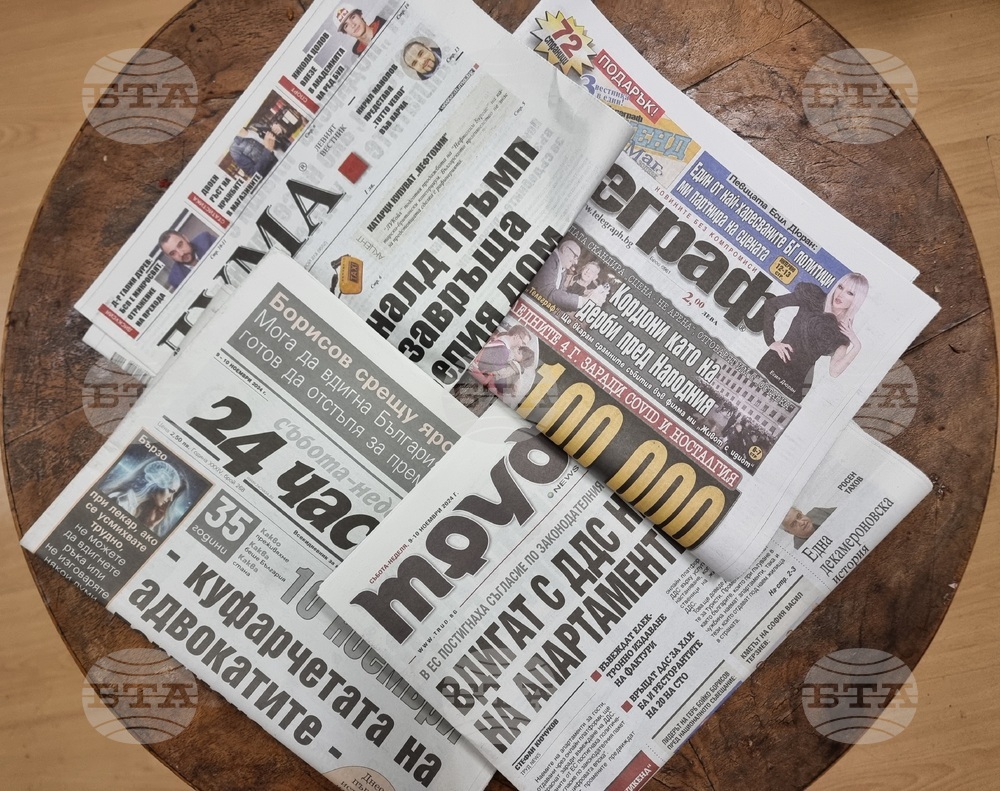
HEADLINES
Wednesday’s news media are dominated by the fallout from the recent nationwide protests against the 2026 budget.
On its front page, Duma runs the headline: "Cabinet Withdraws Budget, Will Not Resign." The daily quotes Prime Minister Rosen Zhelyazkov, who says the Cabinet will not step down despite growing public pressure and mass protests against the budget. "We are making a U-turn and withdrawing the three budget bills," he says, referring to the State Budget Bill, the National Health Insurance Fund Bill, and the Public Social Insurance Budget Bill.
Trud quotes President Rumen Radev as saying in a Tuesday address to the nation that the Cabinet has failed and its resignation is inevitable.
Leading with the headline "Budget Restart," Telegraph highlights Radev’s view that snap elections are the only path forward.
24 Chasa writes that GERB, which holds the cabinet-forming mandate, has urgently convened its coalition partners and the Movement for Rights and Freedoms (MRF) – New Beginning in Parliament. "[GERB leader] Boyko Borissov Presents Partners with Ultimatum: Support GERB Without Populism, or Face Elections."
POLITICS
Bulgarian National Television (BNT) notes that tens of thousands took to the streets in several major cities in the country on Monday evening. On Tuesday, Continue the Change – Democratic Bulgaria (CC–DB) demanded the government’s resignation and the withdrawal of Boyko Borissov and MRF - New Beginning leader Delyan Peevski from politics. CC-DB also announced they would submit a motion of no confidence against the Zhelyazkov Cabinet.
Interviewed on BNT, Vazrazhdane MP Petar Petrov said that "the government is harmful to the Bulgarian people." "Monday’s protest was not political but an expression of civic discontent from various social and political groups. The attitude of those in power toward citizens is what drew so many people," Petrov said. "There is certainly disappointment with the political class, and more specifically with the way it shapes public and political attitudes and constructs power. This is why for several months we have been speaking about re-founding the State, convening a Grand National Assembly, adopting a new Constitution, concentrating responsibility in fewer political entities, and eliminating widespread irresponsibility," Petrov added.
Appearing on BNT’s morning programme, journalist Veselin Stoynev said that the protest has created “the runway” for snap elections.
Trud reports that 71 people were arrested following the pogroms, arson attacks, and assaults on uniformed officers with stones and wooden sticks in downtown Sofia on Monday evening. 24 Chasa writes that 200 black-clad provocateurs took over the protest after 10 p.m. Both dailies note that among the detainees was the son of businessman Atanas Bobokov, 19-year-old Bozhidar Bobokov, who was caught setting fire to a waste bin.
Speaking on bTV’s morning programme, Atanas Bobokov commented on the matter, saying: "My son is a hostage. He did not set any trash bins on fire." The businessman argued that the aim is to harm his family through those closest to him, because there is no legal instrument to target him directly. His brother, Plamen Bobokov, also appeared on the show, saying that the two had not financed the protests. He added that he respects both President Rumen Radev and former Continue the Change co-chair Kiril Petkov. In his words, "good people must unite in order to clean up the mafia."
Speaking on Bulgarian National Radio (BNR), Movement 21 leader Tatyana Doncheva said that CC–DB are the ones who will ultimately benefit from the public discontent. She believes that the number of people who came out and the fact that for the first time since 1996 she saw people outside of Sofia taking to the streets - especially "in towns considered impossible to mobilize for any political event" - shows that people have clearly reached a breaking point. "The fact that the business community also joined in is further proof of this," she added. "The question is when the right moment will come, how to reach that moment, and what needs to be done to allow new political entities to take part. As for what will remain of the current governing majority, I think part of it will simply drain away into the gutter," the Movement 21 leader said. In her words, elections should be held in the spring. "This is a matter of negotiation. I do not see people in the current Parliament who can sit down and talk the way we could talk back in the 1990s," she said, adding that everything is based on emotion. Other combinations will have to be considered, she noted. "For several years now it has been increasingly evident in the field of political commentary that many of the people appearing in the media are 'booked' by GERB and Delyan Peevski," Doncheva said.
Also on BNR, sociologist Dobromir Zhivkov said that "Bulgarians are protesting primarily to defend values, the foundations of the democratic system." "The characteristics we see in this major protest wave largely overlap with those from 2020. We can speak of a continuation of that political dissatisfaction and social tension that we saw in the squares five years ago, which ultimately failed to achieve its goals - namely reforms in the country, above all the establishment of functioning anti-corruption institutions, a functioning prosecution service, and a functioning justice system as a whole. Those demands from five years ago - when around 75% of Bulgarian citizens supported the protests with exactly those demands - never received their natural development, and that energy remained smoldering, even though it was scattered over the years through numerous election campaigns," he noted.
In a signed commentary in Duma, journalist Aleksandаr Simov argues: "Тhe protests clearly showed the political crisis is far from over. It was only temporarily postponed, and now it has returned with full force, like a tornado." He writes that "the consequences are the following: the government has withdrawn the budget; big business is satisfied; a parliamentary deadlock is bound to occur; and snap elections offer no real hope." "It is becoming increasingly unrealistic for the National Assembly to elect a new Supreme Judicial Council, meaning [acting Prosecutor General] Borislav Sarafov will remain cemented in place. The country will enter the euro area without a budget, and prices are likely to rise. It is a complete mess and a dead end," he notes.
Telegraph carries an interview with political analyst Hristo Panchugov, who outlines two hypotheses facing those in power: resignation or reformatting of the government. "This protest is good news because it shows that low voter turnout does not imply apathy or a lack of motivation to take part in political processes. It simply means that for a large part of Bulgarian citizens, politics is uninteresting and they do not feel represented," he says. "The protest must put forward its own leadership and identify people who can coordinate and organize the process of political change. That is one option. The second option is for the opposition, represented by CC-DB, to begin an internal transformation, because a large part of the reasons we are where we are lies with the current leadership of these parties. Perhaps it is time for them to step back and begin a meaningful and adequate conversation about what political change should look like after this protest. Not to mention that the protest clearly demanded an end to any partnership with MRF – New Beginning and GERB. And we know that these two formations have partnered with them," Panchugov adds. Asked whether he sees possibilities for reformatting the Cabinet, Panchugov says: "The only option that has existed from the very beginning is some form of partnership between GERB and CC-DB. All other formulas are unacceptable. After this protest, even that formula’s acceptability is unclear. It has been avoided since day one of the current Parliament, and I doubt that has changed." "The most probable scenario is for the cabinet to resign and for snap elections to be held," the political analyst adds. If anyone stands to gain from what is happening, it is President Rumen Radev, Panchugov argued. "Against the backdrop of all the missed opportunities he has had to enter politics, he is once again being handed an ideal chance to do so. Of course, he will not be able to launch his own political project because the timeframe is too short, but I am sure there will be plenty of people ready to carry his idea of political change - whatever it looks like and whichever people he chooses to make it happen. The chances of seeing him appear on the electoral field are increasing," Panchugov says.
Speaking to Trud News, political analyst Stoycho Stoychev says that the result of the protests is that "we will enter the euro area without a budget, which is a very bad signal." "We will join the euro area with major political instability and fiscal and economic uncertainty," he adds. Sociologist Yurii Aslanov says that although the protest was triggered by the budget, it is no longer about that. It is obvious that the protest will escalate into calls for the government’s resignation and new elections, he notes. "The generation now filling Bulgaria’s squares is different from previous ones, which is why we do not know how this will end. In the past, it always ended the same way - the backstage power structures managed to take control, channel, and crush these mass uprisings. Now we do not know whether that will happen," Aslanov says. Haralan Alexandrov says that there are two possible paths for developments: "One is de-escalation and rewriting the budget with broad participation from all stakeholders. The second option is that the forces seeking to stabilize the country and trigger snap elections gain the upper hand, and that the protests continue, radicalize, and lead to violence. In that case, it is entirely predictable that Borissov will withdraw," Alexandrov notes, adding that the GERB leader's top priority is avoiding civil clashes and violence. "That would mean early elections and a caretaker government," he adds.
24 Chasa runs an interview with linguist Vladislav Milanov, who says: "The language used by politicians reveals such depressing trends that we have given up trying to analyze it." "The breakdown of dialogue is increasingly shaping up as a lasting process on multiple levels. Verbal aggression is no less serious a problem," he adds.
ECONOMY
Speaking on Nova TV’s morning programme, Bulgarian Industrial Capital Association Executive Director Dobrin Ivanov said that following a Joint Governance Council meeting on Tuesday, Finance Minister Temenuzhka Petkova had presented the proposals for the 2026 budget. The planned increases to the dividend tax and pension insurance contributions have been dropped. The maximum contributory income was not discussed. "We presented our demand. We still insist that it be adjusted, as foreseen in the medium-term budget forecast - BGN to 4,430 for 2026, up from BGN 4,130 for 2025," he said. The chief economist of the Confederation of Independent Trade Unions in Bulgaria, Lyuboslav Kostov, said that a new meeting is scheduled for Friday. "We agreed to meet again on Friday and find some kind of balance," he added.
***
Dnevnik.bg cites findings from the Economist Intelligence Unit’s year-end analysis, which, as the media outlet sums up, concludes that Bulgaria has several structurally strong economic fundamentals that support growth. Schengen and euro area membership are expected to further boost the country’s outlook through the end of the decade. The report warns that corruption, slow judicial reform, an inefficient administration, political instability risks, and relatively underdeveloped infrastructure will continue to limit opportunities for Bulgarians through 2030. As a result, Bulgaria is likely to remain less attractive to investors compared with other Eastern European countries. The analysis also notes a moderate likelihood of snap elections in 2026 and predicts that the current government will not serve its full four-year term through 2028, the media outlet adds. According to the report, Bulgaria performs worst in the areas of political culture and government functioning. There are very few efforts to encourage political participation. Most of these come from non-governmental organizations, while the government, political parties, the President, and other institutions rarely engage in such initiatives, the report adds as cited by Dnevnik.bg.
ENERGY
Mediapool.bg reports that former caretaker energy minister and former Bulgargaz head Nikolay Pavlov and former transport minister Plamen Petrov have been jointly developing energy storage projects since 2024. Four of these projects have already secured over BGN 70 million in European funding under the RESTORE project, part of the National Recovery and Resilience Plan. The projects are expected to be commissioned in March 2026, and two have already attracted interest from major Western companies. A legal review for a potential deal is currently under way, although finalizing such a transaction could take several months, Pavlov told the media outlet.
/IV/
news.modal.header
news.modal.text