site.btaHow Much Will Bulgaria's Neighbours Spend on Easter 2026?
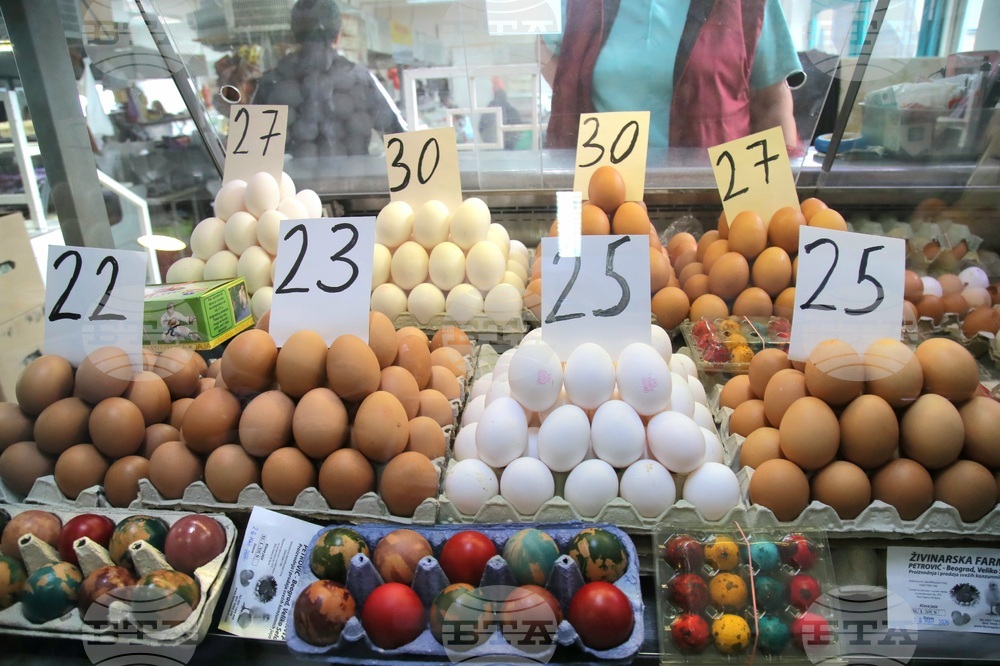
Bulgaria's neighbouring countries are bracing for an expensive Easter this year - prices for nearly all staple foods for the holiday meal have risen compared to 2025. A similar trend is also evident in Bulgaria ahead of Easter.
A summary report from the regional offices monitoring consumer prices under Bulgaria's Agricultural Market Information System (SAPI) indicates an accelerated rise in prices for traditional Easter products ahead of the holidays (as of April 1).
Against the backdrop of annual inflation of 3.3% and the upcoming first Easter in the eurozone, Bulgariann consumers are facing a holiday meal that is 15 to 20% more expensive than in 2025, according to SAPI. The national average price of lamb is EUR 16.10 per kilogram, with leg of lamb averaging EUR 16.65 per kg and shoulder of lamb at EUR 15.71 per kg, though significant regional variations are observed. Compared to last year’s Easter basket (April 11-19, 2025), when lamb was priced at EUR 13 to 14 per kg, the price increase is about 15%. A pre-Easter price increase is also observed for greenhouse vegetables. Class M eggs in Bulgaria average EUR 0.29 each, and Class L eggs EUR 0.31 each. Organic Class M eggs reach EUR 0.53 euro each, the data in the report further shows.
Greece
This year’s traditional Easter meal in Greece is noticeably more expensive, according to data from a study by the General Federation of Consumers in Greece (INKA), cited by local media. A survey of market prices in the week leading up to Easter shows an expenditure of EUR 412 for products intended for six to eight people, representing an increase of 14 to 20% compared to 2025, when the total was EUR 361.95. The increase amounts to approximately EUR 50.
According to the data, a kilogram of lamb costs between EUR 14 and 16 in the provinces, but in Athens and Thessaloniki the price can reach up to EUR 18, and sometimes even more. The traditional Greek dish kokoretsi - made from lamb or goat offal - costs about 24 euros for a kilogram and a half.
The study also provides information on vegetable prices. A head of lettuce sells for EUR 1 euro; a kilogram of tomatoes at EUR 3.20 euros; a kilogram of cucumbers at EUR 0.90; fresh onions at EUR 0.95. The traditional Greek dip tzatziki costs EUR 4.90 per kilogram; a kilogram of feta cheese EUR 14; traditional large eggs for home dyeing, plus the dye, cost EUR 15.60 for 20 eggs. Bread trades at EUR 2.40.
The data also shows a price increase for traditional Easter bread (kozunak), with a kilogram of it reaching up to EUR 22.
The study also covers other types of expenses, such as charcoal for grilling. It is noted that a 20-kilogram bag of charcoal costs EUR 36. Also included are the prices of alcohol, soft drinks, olive oil, the electricity needed to prepare food, and other expenses.
Romania
Romanians are set to face the most expensive Easter yet, according to estimates by local economists. According to experts, the main reasons for the price increase are high inflation, rising prices of traditional products, and higher fuel costs due to the crisis in the Middle East.
Egg prices have risen by 14% compared to last year, according to local media reports on the subject. In large retail chains, the average price of a single egg is currently around RON 1, or EUR 0.20 each, if a large carton of 30 eggs is purchased, as verified on site by a BTA correspondent. The price of 10 eggs ranges from RON 12 to 23 (EUR 2.35 to 4.51); the dyed eggs are imported from Austria and the Netherlands and are more expensive - between RON 22 and 26 (EUR 4.32 to 5.10).
The prices of Romanian-made Easter breads vary more widely - the cheapest is RON 13 (EUR 2.55), and the most expensive is RON 41 (EUR 8.04). In traditional bakeries and pastry shops, the price of sweet pastries starts at RON 40 (EUR 7.85) and reaches RON 120 (EUR 23.54).
The most expensive item on the traditional Easter menu remains lamb. At markets and in stores, a kilogram of lamb sells for between RON 55 and 65 (EUR 10.79 and 12.75).
Fresh salad vegetables are relatively affordable. A head of lettuce sells for RON 2.49 (EUR 0.49), a bunch of green onions costs RON 1.49 (EUR 0.29), and radishes are RON 1.69 (EUR 0.33) each.
Romanians will spend between RON 500 and 1,000 (EUR 98 and 196) on Easter, reports the Adevarul daily, citing the Consumer Price Index. A total of 40% expect higher holiday expenses than in 2025.
Republic of North Macedonia
Lamb meat is sold in stores in North Macedonia for between MKD 700 and 1,000 (12 to 17 EUR) per kilogram, despite the purchase price farmers receive - between MKD 270 and 280 (just over EUR 4) per live weight. Producers in the country traditionally export lamb to the European market. Last year alone, nearly 100,000 lambs were sold outside North Macedonia - most to Croatia (44,000), Bulgaria (25,000), and Greece (8,400). This year, about 80% of the 25-26 kg lambs have already been exported to Croatia, Italy, and Albania.
Eggs, which are traditionally dyed in North Macedonia for Easter, are sold for MKD 11 to 13 (EUR 0.18 to 0.19) each in stores. Farm-fresh eggs can also be found at markets, priced at MKD 20 each (EUR 0.32).
As for vegetables, tomatoes can be found at prices ranging from MKD 180 to 300 (about EUR 3 to 5); in hypermarkets, the cheapest cucumbers are MKD 80 (EUR 1.80), while at markets they can cost twice as much; lettuce sells for MKD 50 to 70 (EUR 0.80 to 1.30), and spring strawberries for MKD 300 per kilogram (just under EUR 5).
In the country, Easter bread is not part of the traditional Easter meal.
Serbia
The traditional choice for Easter lunch in Serbia is roast pork, not lamb as in Bulgaria. Pork is sold for between RSD 600 (EUR 5.11) and RSD 850 (EUR 7.24) per kilogram, while lamb, depending on the region of Serbia, costs between RSD 420 (EUR 3.58) and RSD 500 (EUR 4.26) per kilogram of live weight.
Eggs in supermarkets cost about RSD 13 (EUR 0.11) each, but at the market they can go as high as RSD 30 (EUR 0.26).
Egg dye and decorations are an additional expense and range from RSD 80 to 200 (EUR 0.68 to 1.70) each, while a full set of dye and decorations costs up to RSD 3,000 (EUR 25.56).
Some of the Easter dishes also include fish, which is traditionally eaten in Serbia on Good Friday. At city markets across the country, fresh hake and mackerel cost RSD 900 (EUR 7.67) per kilogram, while frozen mackerel can be found for RSD 450 (EUR 3.83). Fresh carp at the markets costs RSD 1,300 (EUR 11.08), and fresh catfish can be found for around RSD 1,800 (EUR 15.34) per kilogram. More expensive fish, such as salmon and trout, reach prices ranging from RSD 1,200 to 2,000 (EUR 10.23 to EUR 17.04) per kilogram in stores and supermarkets, depending on origin and processing method.
/DS/
news.modal.header
news.modal.text