site.btaAugust 15, 2001: Black Sea-Noah 2001 Expedition Sets Off
Twenty-five years ago, on August 15, 2001, a Bulgarian-American expedition in the Black Sea, led by National Geographic Society explorer Robert Ballard, got underway. Bulgarian and American oceanographers explored part of Bulgaria’s Black Sea waters in search of ancient shipwrecks as evidence that the sea had once been the site of a devastating flood that occurred approximately 7,500 years ago.
Earlier, at the end of June, the government authorized the Bulgarian-US research project "Black Sea 2001: Hydrolocator Research" to be carried out from August 15 to 31, 2001. The project was also known as the Black Sea-Noah 2001 Expedition, according to the Bulgarian News Agency (BTA) archive records.
Here’s how BTA’s English Service covered the expedition in 2001:
Expedition Sets Out to Prove Biblical Deluge Started in Black Sea
Sofia, August 8 (BTA) - Doctor Robert Ballard, who discovered the exact location of the remains of the "Titanic" and the "Bismarck", arrived here on Tuesday. Starting August 15, Ballard and his team will search for evidence that the Biblical deluge started in the Black Sea some 7,500 years ago.
Ballard has already gathered evidence that a great portion of the Black Sea coast was submerged by a catastrophic deluge some 7,500 years ago. According the Biblical myth, the deluge started in the Middle East in 2,400 BC.
The Bulgarian-American expedition will search for underwater remains from ancient settlements and ships. The Council of Ministers approved the August 15-31 implementation of the Bulgaria-US project "Black Sea 2001: Hydrolocator Research".
Professor Petko Dimitrov from the Institute on Oceanology will head the 10-strong Bulgarian team. In 1985, Dimitrov unearthed a find which proves the existence of a highly advanced civilization along the Black Sea coast: a clay plate whose perfect proportions suggest it was moulded on a potter's wheel. The decoration of the plate helped archaeologists date it at 7,000-8,000 years.
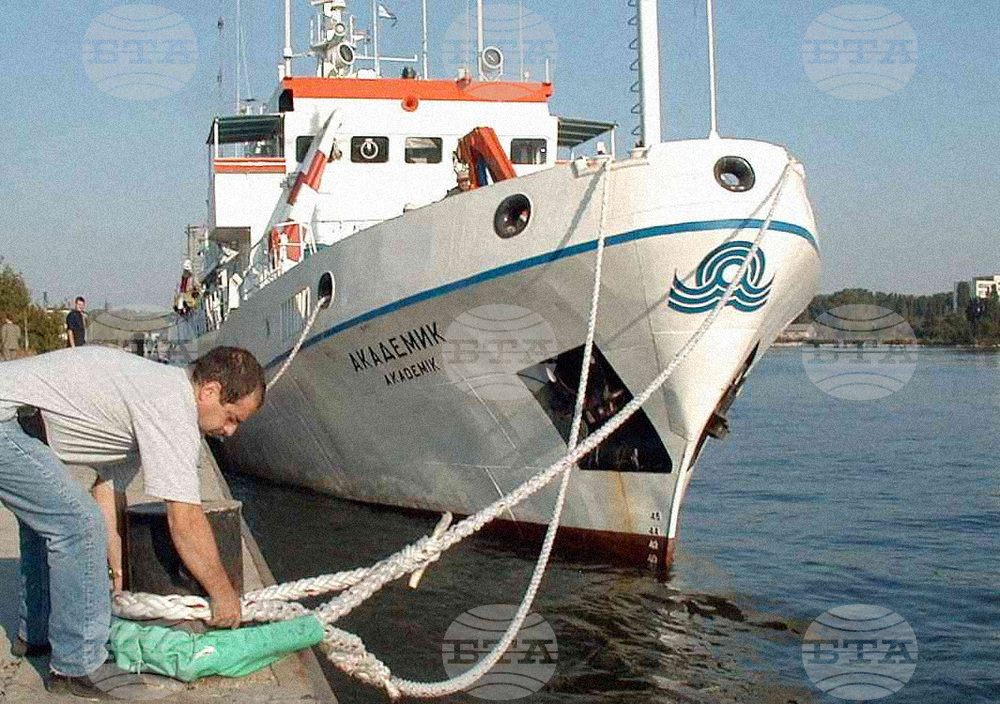
The expedition will have at its disposal the "Academic" ship and a mini-submersible with unique equipment provided by the Americans.
The first task of the scientists will be to map out the sea bed at the Danube delta with the help of a sonar. In case any remains from ancient life are uncovered, the expedition will return to examine them thoroughly in 2003.
***
50-Plus Underwater Objects Earmarked for Detailed Exploration during First Black Sea-Noah 2001 Expedition
Varna (on the Black Sea), August 31 (BTA) - More than 50 underwater objects have been earmarked for detailed exploration during the first Black Sea-Noah 2001 expedition that has just ended, BTA learnt from the leader of the Bulgarian team, Prof. Petko Dimitrov of the Institute of Oceanology.
In the course of two weeks, ten Bulgarian and ten American oceanologists, led by Dwight Coleman, used sonar equipment and an acoustic profiler to explore the shelf fringe at a depth of 90 to 300 m. The objects were spoted from the research ship "Akademik" some 100 km to the east of Varna, along the pre-flood shoreline of the Black Sea.
"My dream now is to discover the ancient history off the Bulgarian coast," world famous American oceanographer Robert Ballard told BTA on the eve of the ambitious project. Dr Ballard visited Varna personally before the start of the sail and was kept updated of the proceedings on a daily basis by Coleman, his second in command, members of the research team said.
On Thursday the US equipment was unloaded from "Akademik." The information collected will be processed over the next half year simultaneously in Varna and in Boston. The American team will shortly hold a news conference to unveil the results of the Black Sea exploration. The news conference will be organized by the National Geographic Society, the principal sponsor of the expedition.
The US oceanographers are terribly tired but obviously pleased. They will rest for a couple of days in Bulgaria before flying home. It is certain even at this stage that the Institute's submersible will be used during the second expedition next year, BTA learnt. Depending on the yield of the information collected now, Prof. Ballard may come with his own one-man submersible "Little Hercules" next summer.
The oceanologists were lucky weatherwise. The sea was a little turbulent only at the beginning and the end of the expedition. Among other places, they explored the area where Prof. Dimitrov found the so-called "Noah's Plate" in 1985 during deep underwater exploration with the submersible "Argus."
***
Settlement Discovered by Bulgaria, US Oceanographers Believed to Be 8000 Years Old
Varna, October 29 (BTA) - The 300/300 m site of an ancient settlement, believed to be as old as 8000 years, has been discovered 115 m under the sea level in the delta of the Danube. The settlement was located in a lagoon that was submerged during an ancient flood, said Professor Petko Dimitrov who represented the Bulgarian side in the leadership of a Bulgarian-US expedition organized back in August. Famed scholar Robert Ballard came here in person to take part in the expedition.
The US researchers, headed by geologist Dwight Coleman, and their Bulgarian colleagues scanned the seabed of four Black Sea parameters and discovered over 50 submerged objects, including ship wrecks, settlements and boats.
The first parameter was in the vicinity of Varna; the second one was at the Kaliakra cape; the third one was in the delta of the Danube and the fourth one was at the Emine cape.
The finds will be analyzed electronically in the US and the results will be announced next spring.
Dimitrov said that Ballard was very intrigued by the finds and the further research in the Black Sea is planned.
/RD/

Additional


news.modal.image.header
news.modal.image.text
news.modal.download.header
news.modal.download.text
news.modal.header
news.modal.text