BTA's archives: confidential
![Chernobyl Nuclear Disaster Reaches 40-Year Mark]()
![Chernobyl Nuclear Disaster Reaches 40-Year Mark]() Chernobyl Nuclear Power Plant, Ukraine, 1986. Damage from the April 26, 1986 explosion and fire in reactor No. 4 is visible in this aerial photo. The blast released large amounts of radioactive material into the atmosphere. (AP Photo/Volodymyr Repik)
Chernobyl Nuclear Power Plant, Ukraine, 1986. Damage from the April 26, 1986 explosion and fire in reactor No. 4 is visible in this aerial photo. The blast released large amounts of radioactive material into the atmosphere. (AP Photo/Volodymyr Repik)
site.btaChernobyl Nuclear Disaster Reaches 40-Year Mark
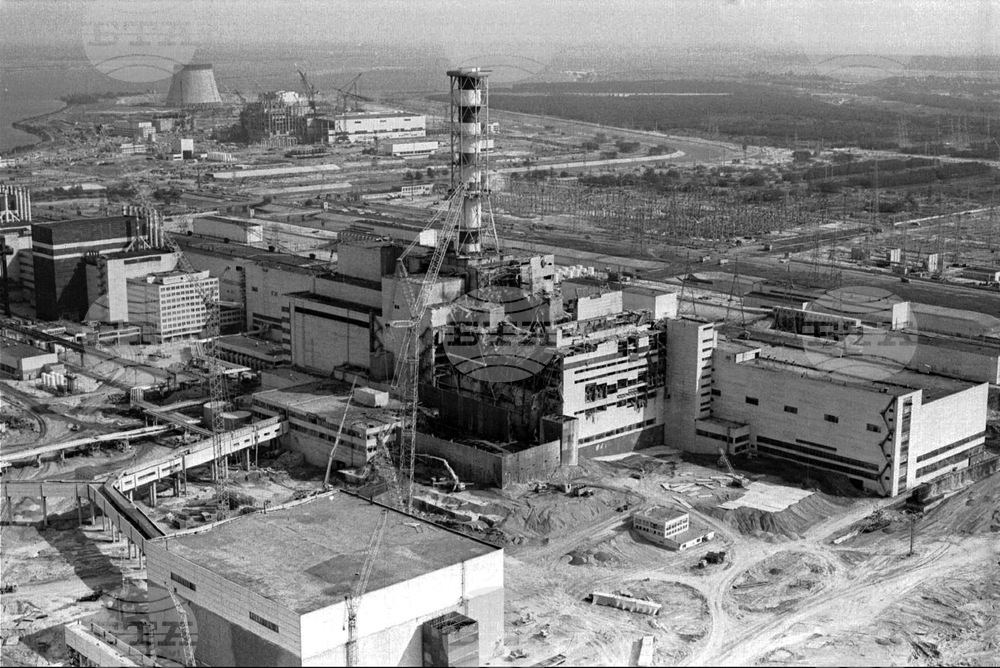
Unit 4 of Chernobyl Nuclear Power Plant exploded 40 years ago, at 1:23 a.m. local time on April 26, during a planned shutdown at the Soviet plant in what is now Ukraine. The blast in the RBMK-1000 reactor became the world’s worst nuclear power disaster.
Two people died in the accident. About 600 plant workers and firefighters received high radiation doses; 28 had died by the end of 1986. More than 200,000 sq km of the then USSR was contaminated by radioactive fallout, mainly in present-day Ukraine but also in Russia and Belarus. Nearly 52,000 sq km was contaminated with the highly radioactive elements caesium-137 and strontium-90, which have half-lives of 30 and 28 years, respectively.
More than 600,000 people took part in the cleanup after the accident. About a tenth of them died, and 165,000 were left disabled. Around 115,000 people were evacuated from the 30-km zone around Chernobyl Nuclear Power Plant.
The USSR issued a brief notice on the accident two days later, on April 28. Scandinavian countries were the first to sound the alarm after detecting elevated radiation levels. The Soviet Union declined to disclose what was happening on its territory and released information only as a last resort.
On June 5, 1986, Nikifor Kovachev, science and technology commentator for Radio Free Europe’s Bulgarian service, reviewed Moscow’s information policy on the nuclear accident: “Wednesday, June 4, 1986. Until then, Moscow had told the people of the Soviet Union and the rest of the world: at first, nothing; on the fourth day, that an accident had occurred in reactor No. 4 at Chernobyl Nuclear Power Plant; that there were casualties; that a government commission had been appointed and the necessary measures were being taken; in the second week, almost nothing.
“On the 18th day, Mikhail Gorbachev said in a televised address that there had been an accident, that two people had died and that others exposed to radiation were receiving treatment. Over the next three weeks, Moscow said all necessary measures had been taken and that outside the established 30-km exclusion zone there was no danger to anyone, had been none and would be none.
“In the meantime, the death toll rose to 26. The Soviets continued to insist on calling the worst nuclear reactor disaster in human history an ‘accident’.”
Many Bulgarian News Agency (BTA) bulletins from late April and May 1986 carried reports on developments in the Ukrainian Soviet Socialist Republic (Ukrainian SSR). The dispatches appeared in the open and service bulletin International Information, as well as in BTA’s confidential bulletins S-1, S-2 and S-3, which reached a very small circle of Bulgarian readers, probably several hundred people.
In the first days after the disaster, the most extensive coverage appeared in the confidential bulletin S-2. It carried dispatches on the movement of the radioactive cloud around the world, measures taken in various countries, and reactions.
BTA’s confidential bulletin S-2 shows what happened in the first days after the Chernobyl accident. Reports from Western news agencies said the first suspicions of a possible incident at a nuclear power plant came from Sweden, where radiation levels were measured at five times the norm. Other Northern European countries, including Finland, Denmark and Norway, later also reported elevated radiation. The S-2 dispatch was dated April 29, 1986. That same day, the bulletin also carried a report from Moscow:
Moscow, April 29, 1986 (Agence France-Presse, AFP): “Life is normal” in Kyiv, about 150 km south of Chernobyl Nuclear Power Plant, where an accident occurred in one of the reactors, a journalist from the local newspaper Pravda Ukrainy said by telephone.
“I cannot tell you anything,” the journalist told AFP, refusing to provide any information about the incident.
Telephone links from Moscow to Kyiv were patchy, and it took hours to get through to the city.
No information was available about possible safety measures being taken in Kyiv.
Flights from Moscow to Kyiv were operating as usual this morning, Moscow airport said.
***
Sofia, April 29, 1986 (BTA): (...) Intourist in Moscow said no tourist groups to or in Kyiv had been cancelled. A Western source in Moscow told AFP that “a security zone” had been set up within a radius of about 30 km around the plant and that tens of thousands of people had been evacuated. (...)
The Associated Press (AP) reported concern among residents of Copenhagen, where local pharmacies were flooded with customers seeking iodine tablets as protection against possible radiation from the cloud moving toward Scandinavia.
On the last day of April, as it became clear that the Chernobyl incident was serious, the USSR declared Kyiv a closed city:
Moscow, April 30, 1986 (AFP): The USSR Ministry of Foreign Affairs declared Kyiv a closed city after the accident at Chernobyl Nuclear Power Plant. Diplomats and foreign journalists were not allowed into the area.
The first reaction from the United States came from Bali:
Bali, April 30, 1986 (BTA): The White House called on the USSR “to fulfil its international obligations” by informing the world about the consequences of the accident at Chernobyl Nuclear Power Plant, Western news agencies reported. President Ronald Reagan sent a message to Mikhail Gorbachev expressing concern about the incident, spokesman Larry Speakes said. The message was handed to the Soviet chargé d’affaires in Washington, Oleg Sokolov. Speakes added that the United States had offered assistance to the USSR, but Moscow had not yet made a request.
Western experts also began speculating about what was happening at Chernobyl:
After the accident at Chernobyl Nuclear Power Plant
Stockholm, April 30, 1986 (Reuters): Soviet technicians risked fatal exposure while trying to cool and bring the damaged reactor in Ukraine under control, a Swedish specialist said yesterday.
“The advice we gave the Russians was to shut down the other reactors and cool the core of the damaged one... The problem, however, is that it is deadly dangerous to get close to it,” Frigyes Reisch of the Swedish Nuclear Power Inspectorate said. In his view, it was clear that the core of one of the reactors had melted down “partly or entirely”. (...)
And while Kyiv was declared off-limits to foreign media, the Ukrainian health minister, who was in the United States, said everything was fine:
Atlanta, April 30, 1986 (AP): Reports of many casualties after the incident at a nuclear power plant in the Soviet Union were largely the product of the Western press’s “imagination”, Ukrainian Health Minister Anatoly Romanenko said yesterday in Atlanta. Romanenko stressed that the fact that he was continuing to attend a healthcare conference in Atlanta, United States, “is a good indication” that the Chernobyl incident was not as serious as was being claimed in the West.
At the same time, information from the disaster area was coming through unofficial channels or from foreigners who were there at the time:
Amsterdam, April 30, 1986 (AP): A Dutch ham radio operator said he had tuned in last night to a transmission by a Soviet ham radio operator who spoke of “many hundreds dead and injured” in the Chernobyl Nuclear Power Plant incident. Anis Kofman, a ham radio operator, said he had picked up a transmission apparently from the area around Chernobyl, near Kyiv, in which a person speaking English with a strong Russian accent said: “Not one but two reactors melted down, exploded and are burning.”
***
Moscow, April 30, 1986 (United Press International, UPI): The accident at the nuclear power plant in Ukraine killed about 2,000 people, and many others were hospitalized with radiation sickness, while the evacuation of thousands of residents in the area continued, a Kyiv resident said yesterday. “Eighty people died immediately, and about 2,000 on the way to hospitals,” the Soviet citizen, who was linked to hospital authorities and rescue teams, said in a telephone interview with UPI.
***
New York, April 30, 1986 (AP): A college lecturer who was in Kyiv with a group of students said today that guides had told her 300 people had died in the Chernobyl incident and that the city had been connected to backup water supplies.
There were no signs of anything unusual in Kyiv, said Karen Black, a literature lecturer at Bates College in Maine. Interviewed by telephone by NBC, she said Intourist guides had informed them about the incident. “They told us there had been an accident at a nuclear power plant, they told us where it was located and that, according to their information, there were about 300 victims,” Black added.
The Soviet Union’s “silence” worried the world:
Bali, May 1, 1986 (AP): US President Ronald Reagan said today that the Soviet Union had maintained “complete silence” about the nuclear accident in Ukraine and that the message from Soviet leader Mikhail Gorbachev provided no more information than was already known.
“We are trying to monitor what is happening there,” Reagan said before a meeting with Indonesian President Suharto. “We are limited in our information.”
Reagan said he had received a notification from the Soviet leader about the accident at Chernobyl Nuclear Power Plant, but the message contained no more information than was generally known.
“It would be useful,” Reagan said, “if Gorbachev gave more details.” (...)
Asked whether the Soviets had provided the necessary information to the United States, Reagan said: “As usual, they are silent on these matters, and this is no exception.” (...)
***
Warsaw, May 1, 1986 (German Press Agency, dpa): Poland’s population was alarmed yesterday by the lack of specific information about the true scale of the accident at the Soviet nuclear power plant in Chernobyl and its consequences. Long queues formed early yesterday morning outside state health centres where iodine tablets were being handed out. Everywhere, people were asking what had actually happened and how they could protect themselves. Highly contradictory rumours were spreading.
Yesterday afternoon, the Polish Interpress Agency said a news conference with representatives of the government commission studying the consequences of the accident had been scheduled for today.
Powdered milk and some other dairy products were bought up from shops. The authorities warned against consuming milk from cows kept outdoors. In schools, all children under 16 received iodine tablets. The measure was intended to saturate pupils’ bodies with stable iodine and prevent the absorption of radioactive iodine. School doctors in Warsaw also told children not to spend long outdoors, to wash their hair daily and to change their underwear.
Meanwhile, Western nuclear experts were seeking information about what was happening in the Soviet Union from space:
Stockholm, May 1, 1986 (Reuters): Michael Stern of Satellitbild, which analysed images of Chernobyl Nuclear Power Plant taken by the US Landsat satellite at 08:00 GMT on Thursday, said: “Two bright red spots can be seen under a cloud of bluish smoke. Judging by the comments of nuclear energy specialists, it seems likely that these are two separate reactors.”
Despite the USSR’s official silence, the situation was clearly spinning out of control, and local experts were seeking advice around the world on how to deal with the consequences of the disaster:
Rome, May 1, 1986 (Reuters): Soviet scientists asked Italy for help in dealing with the Chernobyl nuclear disaster, officials in Prime Minister Bettino Craxi’s office said today. A spokesman said Craxi had been informed yesterday of the request, which had been conveyed through diplomatic channels to the Italian Atomic Energy Agency.
***
Bonn, May 1, 1986 (dpa): Cologne nuclear energy specialist Karl-Heinz Lindackers of TÜV Rheinland recommended to Soviet diplomats who had sought advice that the fire at Chernobyl Nuclear Power Plant be put out with water or wet sand dropped from helicopters. On Tuesday, two officials from the Soviet trade mission in Cologne asked Lindackers about possible ways to solve the problem.
The Swedish Ministry for Foreign Affairs confirmed that Moscow had asked the Swedish Radiation Protection Institute for scientific expertise on how to deal with the fire in the graphite layer of one of the reactors at Chernobyl Nuclear Power Plant.
Over time, the USSR allowed top international medical experts into the country to help people exposed to radiation:
Moscow, May 2, 1986 (UPI): The Soviet Union invited an American doctor, a specialist in the only known method of treating radiation sickness, to help victims of the Chernobyl nuclear disaster and informed the US Congress that “the danger has not yet passed”.
In an unprecedented appearance before a congressional committee, Soviet embassy official Vitaly Churkin indicated that the nuclear reactor, one of four at the Chernobyl complex, was still burning. (...)
The Soviets granted permission for Dr Robert Gale, head of the International Bone Marrow Transplant Registry (IBMTR), to treat victims of the disaster, and the US Department of State gave its consent.
The world continued to rely on satellite images to assess what was happening in the Ukrainian SSR:
Stockholm, May 2, 1986 (Reuters): Images taken early yesterday by the French private satellite SPOT showed that the fire in the Chernobyl reactor had gone out, Swedish scientists said. Michael Stern of the communications company Satellitbild told Swedish television that the images showed smoke had stopped billowing from the damaged reactor. “It is also clearly visible that hot water is no longer being pumped from the plant for cooling,” he said after the computer analysis of the images was completed.
***
Washington, May 2, 1986 (AP): The damaged nuclear power plant at Chernobyl had probably already released much of its radiation and perhaps only a little more would be released, although its core was still burning, a US official said yesterday.
The special government task force handling the disaster said the mysterious second “hot spot” near the fire, captured by the Landsat satellite, was not a second reactor in trouble but more likely an industrial facility of the kind the Soviets often built near their nuclear power plants.
US Environmental Protection Agency (EPA) Director Lee Thomas, who chaired the task force, told journalists that the Soviet message that the initial fire in the reactor had been extinguished could not be confirmed.
In the following days, protests over the lack of information began in various countries, including Poland, part of the Eastern Bloc, while many countries offered help to the USSR. Meanwhile, the head of the International Atomic Energy Agency left for the country:
Vienna, May 5, 1986 (UPI): International Atomic Energy Agency (IAEA) Director General Hans Blix left today for Moscow at the invitation of the Soviet government to discuss the accident at Chernobyl Nuclear Power Plant.
Blix was accompanied by two nuclear energy specialists, Leonard Konstantinov, deputy director general of the Department of Nuclear Energy and Safety, and Morris Rosen, a director in the same department. Konstantinov was a Soviet citizen and Rosen was American. (...)
Blix added that several IAEA member countries had complained about the lack of information from the Soviets in connection with the accident.
“Member countries generally believe there is a need for more information, and we will discuss this issue,” he said.
Blix was asked whether he would visit the accident site.
“I do not know,” he replied. “First we will talk with the Soviet government. That is the essence of our mission.”
Boris Yeltsin spoke to Western media about what was happening at Chernobyl:
Hamburg, May 5, 1986 (AFP): Boris Yeltsin, first secretary of the Moscow City Committee of the Communist Party of the Soviet Union (CPSU), said this morning in an interview with AFP in Hamburg that the release of radioactive substances from the Chernobyl nuclear plant had been stopped thanks to measures taken after the accident.
“The dropping of sand, lead dust and boron from helicopters has ended, a protective layer covers the plant and prevents any release of radioactive substances into the air,” Yeltsin said. “The fire at the plant has been completely extinguished. The radioactive cloud even above the plant is gradually dispersing, and its level of radioactivity is no longer dangerous to humans,” he told AFP.
He also said “special remote-controlled vehicles are currently taking pictures inside” the plant. (...)
He said Soviet Prime Minister Nikolai Ryzhkov and Yegor Ligachev “are still at the scene of the incident”.
Yeltsin ruled out the possibility of demolishing houses in the closed zone and removing the surface layer of soil in the area. “The houses are intact, and they, like the soil, are being treated with special chemicals,” he added. (...)
In his words, it had not yet been specified when the evacuees would return to the zone around the plant. “We have never experienced anything like this either in peacetime or during war.” (...)
The Soviet leader sharply criticized the “slanderous reports” spread in the West about the accident, “whose specific purpose is clear”. In his view, “there was no delay in transmitting information: from the first minute, the authorities were informed. After information about the disaster had been gathered, Western countries were immediately informed.”
He mocked the Western press, explaining that the evacuees from Chernobyl “consume milk and vegetables, that they do not walk around with umbrellas and that if they wash their children every day, they had done so before as well.
“It is a pity that some parents from Western countries are doing this only now.” In this way, he alluded to the measures taken in many countries, including the Federal Republic of Germany (West Germany), after the rise in radiation.
At the time, specialists forecast a large number of illnesses after the disaster:
Stockholm, May 5, 1986 (Reuters): Up to 8,000 Europeans may develop cancer as a result of exposure to radiation caused by the accident at Chernobyl Nuclear Power Plant, Swedish scientists said today.
Gunnar Bengtsson, director of the Swedish Radiation Protection Institute, told a news conference that initial calculations indicated the number of people who could develop cancer as a result of the April 26 accident at Chernobyl Nuclear Power Plant would reach up to 8,000.
“Our conclusions show that the Chernobyl accident is a thousand times more dangerous than the 1979 accident in the United States in terms of radiation.” (...)
He said many people would develop cancer in Ukraine and areas of Eastern Europe near Ukraine. (...)
Swedish authorities warned that it was dangerous to travel within a 500 km radius of the accident site.
A day later, people in Kyiv were advised not to eat lettuce and not to stay outdoors:
Moscow, May 6, 1986 (Reuters): The Ukrainian Ministry of Health advised people in the Kyiv area to avoid buying locally produced leafy vegetables and to spend less time outdoors.
A Ukrainian television spokesman said by telephone from Kyiv that the message had been made last night and repeated on radio this morning. The spokesman added that people had been advised to buy food from state shops.
Thirty people died in the accident, and nearly 8.4 million people in Belarus, Ukraine and Russia were exposed to radiation. At least 100,000 of them died of cancers, immune system disorders and heart disease. The accident caused radioactive contamination across 17 European countries, covering a total of 207,500 sq km, including nearly 60,000 sq km outside the former USSR. The worst affected were Ukraine, with 37,630 sq km, Belarus, with 43,500 sq km, and the European part of Russia, with 59,300 sq km. On December 15, 2000, Chernobyl Nuclear Power Plant was finally shut down.
The radiation released into the atmosphere was equivalent to at least 200 nuclear bombs like those dropped on Hiroshima and Nagasaki in Japan on August 6, 1945, and August 9, 1945.
On November 30, 1996, Chernobyl Nuclear Power Plant’s first reactor was finally shut down. On December 15, 2000, the plant was closed. Since 2017, under UN General Assembly resolution A/RES/71/125 of December 8, 2016, April 26 has been marked as International Chernobyl Disaster Remembrance Day.
/КТ/

news.modal.header
news.modal.text