site.btaUPDATED Parliament Debates 2026 State Budget Bill with 5.7% Deficit at Second Reading
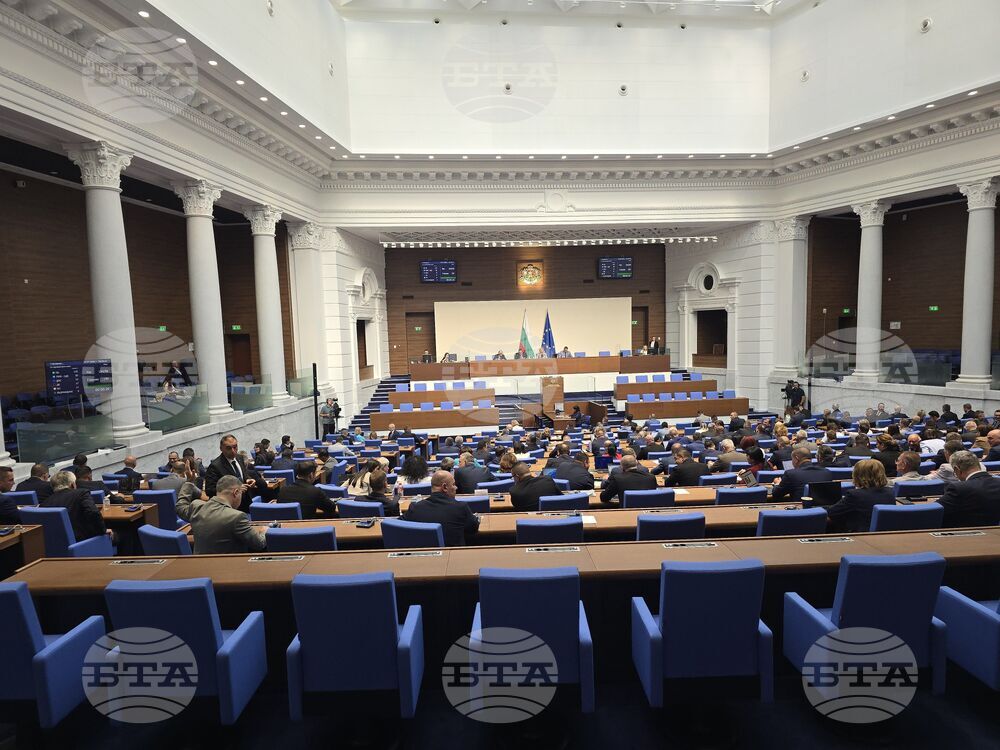
Bulgaria's Parliament on Thursday began the second-reading debate on the 2026 State Budget Bill, which envisages a budget deficit of 5.7%. The MPs voted to extend the sitting until the debate is concluded. Deputy Prime Minister and Finance Minister Galab Donev and other Cabinet ministers are attending the plenary sitting. The vote on the bill is on Friday's agenda.
The Budget and Finance Committee approved the bill on second reading at an over 12-hour extraordinary meeting which ended in the small hours of Wednesday. The committee rejected all proposals submitted between the two readings to increase social benefits and compensations this year.
The bill sets the ceiling for new government debt in 2026 at EUR 10.1 billion, which includes a loan of up to EUR 3.261 billion under the Security Action for Europe (SAFE) instrument to strengthen the defence industry. Government debt is projected to reach EUR 37.7 billion, or 30.1% of GDP.
The State Budget Bill provides for a 10% reduction in personnel expenditure from September 1, excluding municipalities, military personnel, employees of the Interior Ministry and the security services, staff covered by the Implementation of Penal Sanctions and Detention in Custody Act, and certain employees under the Medical Treatment Facilities Act. It also envisages higher revenue from the toll system, a 30% increase in vignette fees, and higher excise duties on tobacco and tobacco products from August 1.
The bill also proposes suspending the automatic mechanisms for determining the remuneration of military personnel and employees of the Interior Ministry and the National Service for Protection. The minimum monthly wage would be set at EUR 620 until a new mechanism for determining it is introduced.
The bill provides for civil servants under the Civil Servants Act and employees covered by the Judicial System Act to begin paying personal social security contributions from August 1. Their basic monthly salaries must be set so that, after deducting mandatory employee social security contributions and income tax, their net pay is no lower than the net amount received as of July 31.
The bill also requires that, by September 15, draft amendments be prepared to abolish the Committee for Disclosing the Documents and Announcing Affiliation of Bulgarian Citizens to State Security and to the Intelligence Services of the Bulgarian National Army (informally known as the Secret Police Files Committee) and its functions to be transferred to the Archives State Agency.
It also proposes reducing the number of members of the management and supervisory boards of public enterprises from five to three. The bill caps the Financial Supervision Commission chairperson's remuneration at 95% of the Bulgarian President's basic monthly salary and repeals the provision allowing the chairperson and other commission members to receive performance-related bonuses under the Commission's internal remuneration rules.
The debate
During the debate, Zdravko Markov of Progressive Bulgaria said that according to Eurostat data, the deficit in the first quarter of 2026 stood at 7.6%. "Some of the expenditure was not incurred by the government of Progressive Bulgaria," he said, adding that the budget implements a large part of the capital expenditure programme planned by the previous government.
Temenuzhka Petkova of GERB-UDF said a 5.7% deficit means that Bulgaria is short of EUR 7.2 billion. In her words, this also means a higher debt and inflation. She said that, as regards the deficit, the government was grossly violating the Public Finance Act and EU regulations. Petkova noted that the government was budgeting higher operating expenditure, part of which it could not justify, as well as increased capital expenditure. According to her, the current priority was fighting civil servants rather than oligarchs.
Hamid Hamid of the Movement for Rights and Freedoms stressed that his party was firmly opposed to the government's intention to abolish the automatic mechanism linking salaries in the security sector to the country's average wage.
Martin Dimitrov of Democratic Bulgaria (DB) said that Thursday was the last chance to reduce the budget deficit to 3%. According to him, if DB's proposals to cut capital expenditure and increase tax rates for gambling operators were adopted, the deficit could fall below 3%. He said the budget provisions opened the door to signing new contracts under municipalities' capital programmes, but the government had not specified the limit or set rules, meaning that Progressive Bulgaria would choose municipalities it considered close to it.
Miroslav Ivanov of Continue the Change commented that Progressive Bulgaria had decided where a large part of the funding would be allocated, while the Finance Minister had decided to direct most of it towards unspecified municipal projects.
Petar Petrov of Vazrazhdane called for EUR 2.9 million earmarked for storing classified US equipment and facilities to be redirected to construction and repair works at the Ogosta dam facilities in Northwestern Bulgaria, which he said were part of national security.
/DS/
news.modal.header
news.modal.text