site.btaJustice Ministry Launches Three-Year Programme for Fighting Corruption and Promoting Integrity
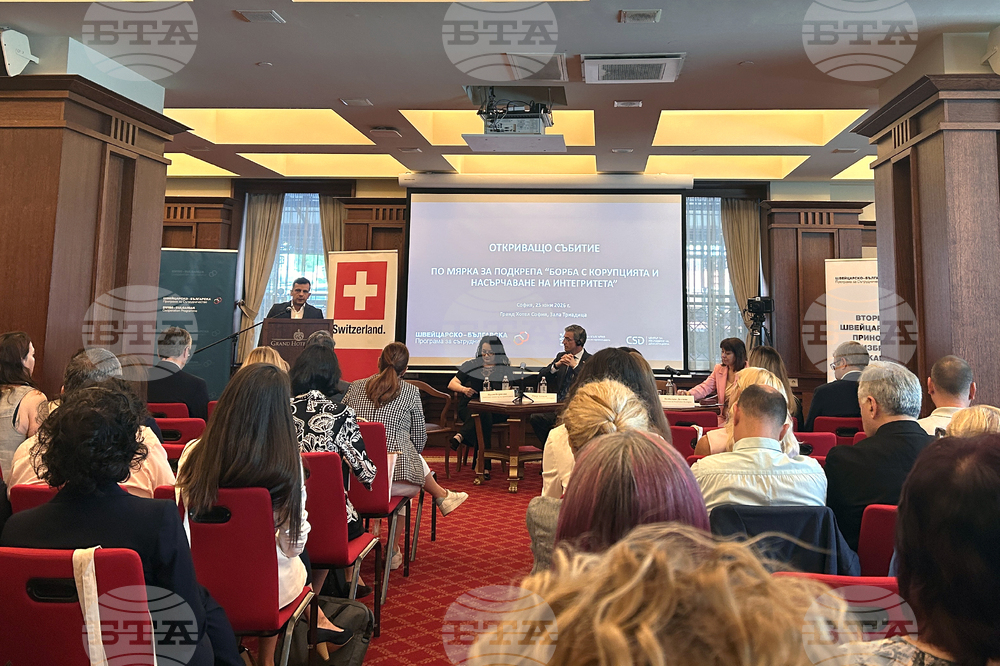
The Justice Ministry is launching a project aimed at strengthening efforts to combat corruption and improving the capacity of the ministry and other state institutions to develop, implement, and maintain effective anti-corruption reforms. The project was presented at a press conference on Thursday.
The three-year programme, titled "Fighting Corruption and Promoting Integrity", is implemented with the support of the Swiss-Bulgarian Cooperation Programme under Switzerland's second contribution to Bulgaria.
The programme foresees actions in three main areas: a sustainable, strategic institutional framework for implementing anti-corruption policy in line with European and international standards; improved institutional and human capacity of the central administration; and increased transparency and civic participation through inclusive communication mechanisms, explained Dimitar Markov.
The project includes the following activities: optimizing the national anti-corruption framework, including an annual review of anti-corruption legislation, analysis of conflict-of-interest rules, and assessment of the legal framework; evaluation of the National Anti-Corruption Strategy (2021-2027) and preparation of a new system; development of a national methodology for integrated collection, analysis, and use of data for anti-corruption efforts; creation and pilot implementation of a methodology for integrity screening of public officials in high-risk positions; strengthening the analytical capacity of the Inspectorate under the Minister of Justice; introduction of new tools and procedures for internal checks and control, along with integrity training programmes; annual surveys on the prevalence of corruption among citizens and businesses; establishment of a sustainable feedback mechanism; monitoring of media coverage and public attitudes, as well as organizing national and international anti-corruption events.
The issue of corruption is at the centre of the public and political agenda, and the government programme clearly states that strengthening state institutions is a condition for modernizing the country, restoring the rule of law, and building a society based on justice, rules, and trust, said Deputy Justice Minister Irena Borisova.
She said that the fight against corruption requires the joint efforts of all stakeholders - legislative, executive, judicial, and local authorities, civil society, the academic community, the media, competent international bodies working on specific cases, and international partners.
The Swiss-Bulgarian Cooperation Programme supports economic development and institutional strengthening through financial assistance of EUR 120 million, co-financing 13 different programmes, as well as through Swiss expertise and knowledge, said Swiss Ambassador to Bulgaria Pierre Hagmann.
Citizens in Bulgaria have repeatedly expressed their desire for transparency, stronger integrity, and more robust anti-corruption measures. The measure aims to strengthen Bulgaria's anti-corruption framework, expand the administrative capacity of state institutions that fight corruption, and promote transparency, accountability, and civic participation, Hagmann added.
The measure for support is ambitious and multi-layered, aiming to offer concrete solutions and effective mechanisms, said Ombudsman Velislava Delcheva.
She noted that, as a member of the Supervisory Committee for this measure, the implementation will be monitored to ensure that it delivers three key needs of Bulgarian citizens: accountable institutions that take responsibility for their actions and consistently apply the principles of good administrative service; functioning mechanisms for public oversight; and more effective channels for reporting signals, especially with regard to protecting whistleblowers.
Poor administration creates a non-transparent, unpredictable, and unaccountable environment in which conditions for the development of corrupt practices are present, the Ombudsman added.
We need to work with the whole society, civil organizations, the media, so that intolerance toward this phenomenon can be achieved. Otherwise, even if we have the strongest institutions, strong control mechanisms, and strong mechanisms for punishing this phenomenon, it will not be enough, said Ivan Ivanov, head of the Central Coordination Unit with the Council of Ministers.
/RD, YV/
Additional
news.modal.image.header
news.modal.image.text
news.modal.download.header
news.modal.download.text
news.modal.header
news.modal.text