site.btaMedia Review: June 19
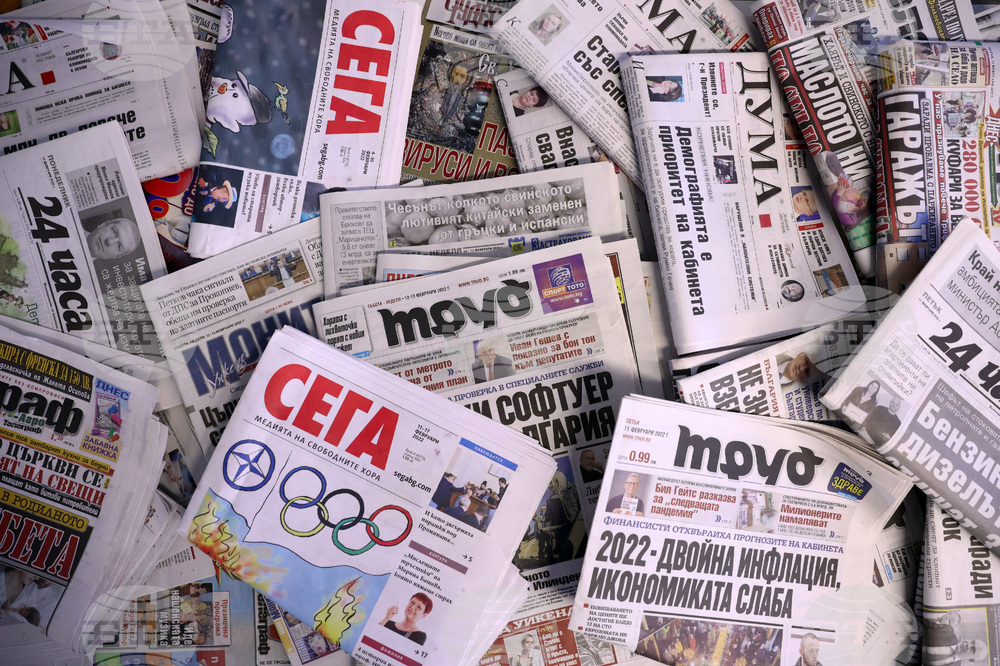
No single topic dominates Friday's media.
POLITICS
The Trud tabloid daily frontpages an article titled „The era of the Crusades is over“, quoting Prime Minister Rumen Radev, who on Thursday, ahead of a European Council meeting of EU heads of state or government, said that Bulgaria will veto the European Commission’s latest proposal to broaden sanctions against Russia unless Russian Orthodox Patriarch Kirill is removed from the proposed sanctions list. Radev’s comment came after Foreign Minister Velislava Petrova said that Bulgaria would not support sanctions against Russian Orthodox Patriarch Kirill.
***
A lead analysis in the Segabg.com online news outlet, titled “Radev’s army – the most trusted plus second-hand cadres from MRF, ABV and GERB”, argues that Bulgarian political life is dominated by informal networks of power rather than clear ideological or party-based governance, with a particular focus on the influence attributed to Prime Minister Rumen Radev. It claims that during his time in office as President and through caretaker governments, he played a central role in appointing key figures across state institutions, especially in security services, ministries, and regulatory agencies, thereby consolidating a durable cadre network that persists across administrations.
According to the author, this system is sustained by a recurring circulation of officials between different parties and governments, including GERB, BSP, ABV and newer political projects such as “Progressive Bulgaria”, which is described as being populated by “shape-shifting” political actors. Key individuals like Nikolay Koprinkov and Plamen Uzunov are portrayed as informal power brokers who influence appointments and access to decision-making, acting as intermediaries within this network of influence.
The conclusion of the piece is that Bulgarian governance suffers from a lack of transparency and genuine institutional independence, with personnel decisions driven by loyalty and informal connections rather than merit or accountability. This, the author argues, results in a blurred line between state institutions and political or personal networks of influence, reinforcing a perception of a “parallel state” that persists regardless of formal changes in government.
***
In Bulgarian National Television’s (BNT) morning talk show, MP Miroslav Ivanov from Continue the Change parliamentary group supports Varna Mayor Blagomir Kotsev, whom he describes as a person who does not conceal ongoing issues in the Baba Alino case and who has brought previously existing problems to light after taking office. Ivanov frames Kotsev’s role as exposing inherited administrative or governance issues rather than creating them. The Baba Alino case first came to public attention following journalistic investigations by the BIRD.bg website and reports from local activists, who raised concerns about extensive construction activity on forest land near the Golden Sands resort. The scandal erupted in May, when a joint operation by police and municipal authorities found 104 buildings allegedly constructed - or under construction - without permits, along with unauthorized roads, sewerage systems, and transformer facilities. Twenty-nine workers from Ukraine and Moldova were detained during the raid. The Appellate Prosecutor’s Office in Varna said four criminal case files have been opened and are underway, involving suspected official misconduct, forged documents, false declarations, and illegal logging.
Ivanov also criticises parliamentary procedure and governance practices, claiming that parts of legislative work in committees, particularly under conditions involving Progressive Bulgaria, lack transparency, including non-public reports that limit stakeholder participation. In addition, he argues that proposals for new state borrowing up to EUR 3.8 billion are irresponsible and reflect a recurring political tendency to present budget shortfalls without clear accountability for their causes.
Finally, Ivanov comments on stalled judicial reform, saying that there is no real progress despite ongoing discussions about prosecutorial powers, judicial career progression, and accountability mechanisms. He also points to administrative instability in the judiciary, citing a large number of resignation requests from magistrates, which he interprets as a symptom of deeper systemic problems rather than isolated personnel issues.
***
Nova TV has an interview with MP Milen Trifonov from Progressive Bulgaria, who comments on fiscal policy, governance reforms, and judicial changes. Trifonov argues that the government’s plans for extending the state budget and potentially taking on new debt should not be seen as an unchecked “blank cheque”, but rather as a capped financing mechanism designed to ensure the functioning of the state and support commitments such as the Recovery and Resilience Plan. He also insists that the governing coalition remains committed to its reform agenda, particularly in public administration and digital transformation.
A significant part of his remarks concerns state efficiency and modernization, where he supports deeper digitalization of public services and highlights institutions like the National Revenue Agency as examples of progress. He also notes that any reform in social contributions for public employees must be accompanied by compensatory salary adjustments to avoid net income losses.
Finally, Trifonov discusses broader political priorities, including possible adjustments to MPs’ salaries, taxation of multiple-property ownership, and judicial reform. He emphasizes the need for a more transparent and independent judicial system and frames upcoming changes to the Supreme Judicial Council as only the beginning of a longer reform process aimed at reducing institutional dependencies.
***
BNT has an interview with MEP Andrey Kovatchev (European People's Party/GERB), who comments on Bulgaria’s defence industry, European security, and foreign policy. He claims that in 2024 the Bulgarian private defence sector generated around EUR 3 billion in exports and that roughly 70,000 people are directly or indirectly employed in the industry, framing it as a significant pillar of the national economy.
Kovatchev also argues that Bulgaria’s security policy has suffered in the past from dependence on external energy and defence resources, particularly from Russia, and that diversification through the EU and learning from Ukraine’s wartime technological development is essential. Regarding the EU sanctions against Russia, he supports their effectiveness and describes the war in Ukraine as extremely destructive and prolonged, comparing it to World War I in terms of attrition and territorial gains.
On the tension with North Macedonia, he criticises what he sees as political manipulation of history and ongoing tensions in bilateral relations. He states that North Macedonia has effectively “self-blocked” its EU accession process by failing to implement agreed constitutional changes, particularly the inclusion of Bulgarians in its constitution, and argues that historical disputes should be resolved based on verified historical documents and within the framework of the EU negotiation process.
TENSION WITH NORTH MACEDONIA
BNR has an interview with Assoc. Prof. Dimitar Tyulekov, member of the Macedonian Scientific Institute, a Bulgarian scientific organization, which studies the region of Macedonia and mostly the Macedonian Bulgarians, and international relations lecturer, who argues that statehood in North Macedonia is at risk due to what he describes as a resurgence of “Macedonism” and external influence from Belgrade. He calls for Bulgaria to pursue a policy of “de-Balkanization” and deeper European integration of the region instead of responding to tensions with hostility.
Tyulekov warns that both internal and external actors are seeking to deteriorate relations between Sofia and Skopje, urging Bulgaria to avoid nationalist rhetoric and instead strengthen public diplomacy through education, culture, and academic cooperation. He stresses the importance of distinguishing between North Macedonia’s political elite and its citizens, and insists that bilateral relations should be improved rather than allowed to deteriorate further, warning that regional divisions serve anti-European interests.
ECONOMY
Trud publishes an interview with Atanas Katsarchev, chief economist of the Podkrepa Confederation of Labour trade union, who argues that civil servants should pay their own social security contributions only if their salaries are increased to offset both the additional cost and inflation. He says state employees have been disadvantaged by past reforms, calls for the restoration of seniority bonuses and equal rights with private-sector workers, and warns that protests are possible if public-sector wages continue to lag behind rising living costs.
Katsarchev criticizes the abolition of COVID-19 supplements for new pensioners, saying it will reduce pensions for some retirees and deepen poverty. He also advocates progressive income taxation, the eventual removal of the maximum social security income threshold, and higher taxation of capital income, arguing that Bulgaria’s tax system disproportionately burdens workers while favouring high earners and businesses. According to him, bringing tax and social security revenues closer to EU averages could eliminate the budget deficit and even generate a surplus. He opposes differentiated regional minimum wages and says further public-sector pay rises will remain necessary as long as inflation persists.
OPAQUE PUBLIC SALARIES
A lead article in Dnevnik.bg explains that the remuneration of senior officials in Bulgarian state-owned enterprises, regulatory bodies, and certain public institutions is often shaped by legal “loopholes” and interpretative internal rules rather than a unified, transparent framework. As a result, monthly salaries in some top positions can exceed EUR 10,000 – EUR 15,000, while the public has limited visibility into how these figures are calculated or justified.
According to the article, although there is a formal legal framework, primarily the Public Enterprises Act and its implementing regulations, executive pay is largely determined through a “point-based” evaluation system tied to business performance indicators such as revenue, profit, investments, and service quality. However, the specific weighting and results of these evaluations are not publicly accessible, and there is no comprehensive public register of salaries for top management in state companies, regulators, or agencies, which significantly limits transparency.
The piece further notes that salary information usually becomes public only indirectly – through political disputes, changes of government, or investigative journalism. Experts cited in the analysis argue that the lack of a unified methodology and reliance on non-public internal rules creates fragmentation and potential risks of external influence. The overall conclusion is that Bulgaria lacks a coherent, transparent system for high-level public sector remuneration, leaving significant gaps in accountability and public oversight.
LOCAL GOVERNMENT
Bulgarian National Radio (BNR) has an interview with Desislava Kalcheva, member of Bulgaria’s Fiscal Council, who argues that fiscal decentralization is urgently needed to give municipalities stronger incentives to attract investment and drive local development. She says local governments should retain a greater share of tax revenues, enabling them to better address community needs such as education, public services, and urban infrastructure.
Kalcheva identifies years of political instability as a key obstacle to decentralization reforms and calls for renewed political will to implement long-delayed changes. At the same time, she warns that greater fiscal autonomy could widen regional disparities unless accompanied by equalization mechanisms to support poorer municipalities. She also urges caution over proposals to update property tax valuations and introduce progressive taxation on multiple-home ownership, stressing the need to avoid excessive bureaucracy and ensure social fairness.
HEALTH
The 24 Chasa daily publishes a frontpage interview with cardiologist Prof. Ivo Petrov, medical director of the Acibadem City Clinic Vitosha multiprofile hospital, who urges mandatory cardiac screening for professional athletes to prevent sudden cardiac death on the field. Petrov says athletes should undergo a comprehensive cardiovascular assessment, including an electrocardiogramme, echocardiography and a stress test, while additional Holter monitoring and genetic testing may be needed in higher-risk cases. He notes that Bulgaria lacks the rigorous screening standards applied in countries such as Italy, contributing to preventable tragedies among young athletes.
The cardiologist explains that sudden cardiac arrest, often caused by ventricular fibrillation rather than a heart attack, can strike seemingly healthy people and may be linked to genetic predispositions triggered by intense physical exertion. He highlights the life-saving role of both implantable and external automated defibrillators, stressing that modern devices can accurately distinguish dangerous arrhythmias from a normal elevated heart rate and cannot deliver unnecessary shocks.
In his interview with 24 Chasa, Petrov also calls for wider deployment of automated external defibrillators (AEDs) and large-scale public training in first aid and resuscitation, warning that irreversible brain damage can occur after eight minutes without circulation. According to him, the first three to five minutes after cardiac arrest are critical for survival and recovery.
JOURNALISM
The 24 Chasa daily publishes a lead interview with veteran TV journalist Tsvetanka Rizova, who reflects on journalism, freedom of speech and the challenges of public visibility after receiving the St. Vlas Award for Television Journalism.
Rizova says journalism’s role is to facilitate a conversation between politicians and citizens, warning that when political parties or institutions refuse to appear in certain media outlets, they are “punishing themselves and the audience, not the journalist”. She argues that one of the most dangerous forms of censorship is self-censorship and stresses that interviews should be judged by their public value rather than by whether viewers approve of a guest’s views.
The journalist also highlights the growing threat of misinformation, noting that fake news is often produced professionally and can mislead even well-informed audiences. She says journalists must counter manipulation with facts and arguments, while maintaining professionalism rather than aggression.
Reflecting on public life, Rizova describes publicity as both an opportunity and a burden: a way to reach people’s minds and hearts, but also an intrusion into private life. She voices concern over what she calls the “irrational hatred” often directed at visible public figures and says social media criticism frequently stems from frustration rather than genuine debate.
Rizova credits the success of her long-running programme to its focus on socially significant issues and meaningful public conversations, adding that curiosity, independence and resistance to manipulation remain essential qualities for journalists today.
/KK/
news.modal.header
news.modal.text