BTA exclusive
![Romanian Foreign Minister: Economic Integration in Southeast Europe Increases Countries' Ability to Handle Global Competition]()
![Romanian Foreign Minister: Economic Integration in Southeast Europe Increases Countries' Ability to Handle Global Competition]() Romanian Foreign Minister Oana Toiu, Sofia, June 10, 2026 (BTA Photo/Milena Stoykova)
Romanian Foreign Minister Oana Toiu, Sofia, June 10, 2026 (BTA Photo/Milena Stoykova)
![Среща на върха на Процеса за сътрудничество в Югоизточна Европа - Оана Цою - интервю]()
![Среща на върха на Процеса за сътрудничество в Югоизточна Европа - Оана Цою - интервю]()
![Среща на върха на Процеса за сътрудничество в Югоизточна Европа - Оана Цою - интервю]()
site.btaRomanian Foreign Minister: Economic Integration in Southeast Europe Increases Countries' Ability to Handle Global Competition
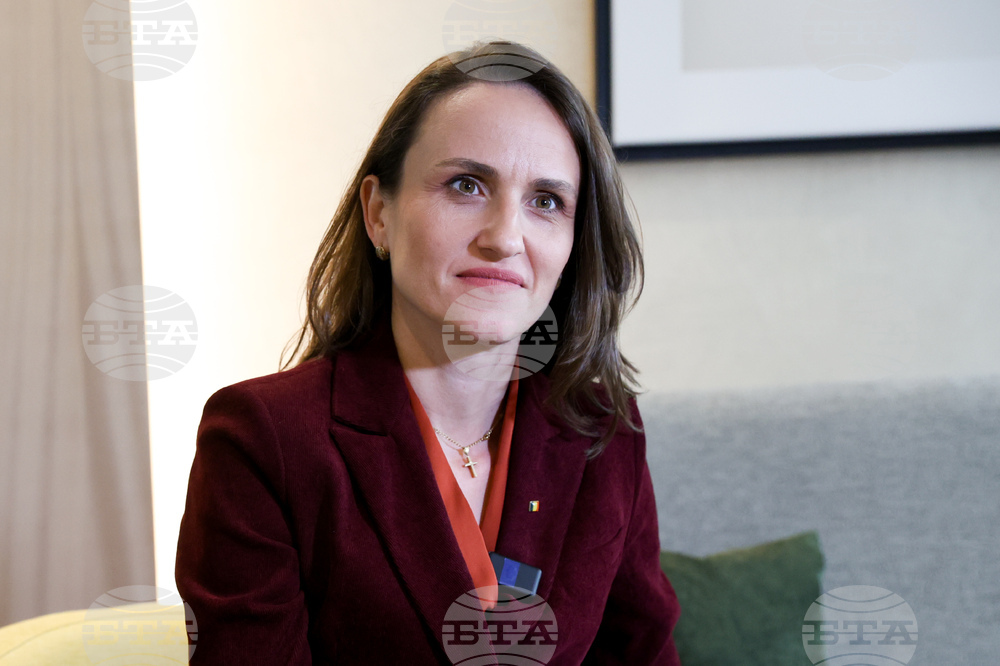
In an interview with BTA here on Wednesday, Romanian Foreign Minister Oana Toiu said that economic integration in Southeast Europe can increase economic opportunities and the regional countries' ability to handle global competition. These states will all benefit more if they succeed in better integrating their economies. Toiu was in Bulgaria for the South-East European Cooperation Process (SEECP) Summit, during which Romania assumed the SEECP Chairmanship-in-Office.
Speaking to BTA, Toiu outlined the three main priorities of the Romanian Chairmanship-in-Office in the fields of politics, economy, and investment in the future, young people, and society as a whole.
Romania and Bulgaria have long supported the EU enlargement process because it directly affects their neighbours, she said. She also emphasized the negotiations on the EU’s Multiannual Financial Framework, as the Union’s budget includes components related to enlargement, infrastructure, connectivity, and border security. According to her, all these areas directly affect the countries of Eastern Europe and the Western Balkans.
The Romanian Foreign Minister also highlighted the benefits for Romania and Bulgaria of economic integration within the EU, noting that bilateral trade has surpassed the EUR 11 billion mark, and that over 3,000 companies in each country operate in the other’s territory.
The Romanian Foreign Minister also spoke about joint initiatives in the field of security, highlighting the joint efforts of Romania, Bulgaria, and Turkiye on demining in the Black Sea and the joint efforts of Bucharest and Sofia to establish a Black Sea Maritime Security Hub within the framework of the European Security Strategy.
Toiu said her country and Bulgaria will continue to work together within this framework of cooperation to promote, within the European Union as well, this shared message from the region regarding connectivity, economic opportunities, collective security, and, above all, a shared aspiration for a European future.
Following is the full translated text of the interview, which was conducted in Romanian.
Romania is picking up the baton from Bulgaria in the SEECP at a time when the initiative is celebrating its 30th anniversary. What will be Romania’s main strategic priorities during its Chairmanship-in-Office?
Thank you for the warm welcome we received today [Wednesday] in Sofia. Earlier, the Bulgarian President made what was perhaps one of the most heartfelt statements regarding Romania. She said that on this side of the Danube there are people who love us. Now is the time to return that kind sentiment. The citizens of Bulgaria should know that across the Danube they have neighbours who are close to them, allies, and whom we love very much.
Our priorities for the coming year are based on three main pillars. The first pillar is political, as it concerns a priority for the countries in the region related to EU enlargement and the accession process.
Romania, like Bulgaria, has long supported this process, primarily because it directly affects our neighbours. We believe that this month we will complete the opening of the negotiation chapters with Moldova and Ukraine. In fact, Prime Minister Alexandru Munteanu of the Republic of Moldova was with us today [Wednesday].
This political coordination also comes at an opportune moment, namely the overlap with the negotiations on the European Union budget - the Multiannual Financial Framework. And I mention this because this budget has a component related to enlargement, a component related to infrastructure, a component for connectivity, and we are certainly also talking about border security.
All of these areas directly affect the countries of Eastern Europe and the Western Balkans, and we want to ensure that, during these negotiations, we take into account the region’s common position and use this format to that end.
All of this is a priority for Romania, as well as for Bulgaria and the entire European Union, for its own connectivity projects - whether we are talking about trains, roads, bridges, or energy and data infrastructure. All of these are essential both for the current economy and for future opportunities, such as those emerging in the field of artificial intelligence, and these future opportunities also require greater energy consumption. In this regard, we must note that Romania is already an energy supplier and producer, and we know that next year we will increase this capacity through our projects in the Black Sea, such as Neptun Deep.
A second important pillar is the economy and society, because we know that we will all gain more if we manage to better integrate our economies.
Between Romania and Bulgaria, of course, this is already working, thanks to our shared membership in the European Union. We have crossed the threshold of EUR 11 billion in bilateral trade. There are over 3,000 companies in each country that operate in the other country, but it is clear that economic expansion in the region and better access for suppliers from neighboring countries to supply chains on the territory of our countries could increase economic opportunities and, ultimately, our ability to handle global competition.
The third pillar is investing in the future. This means investing in the resilience of society, in young people, in civil society, and in jointly strengthening our ability to cope with the challenges we have faced in recent years - challenges that are likely to intensify. Here, we are talking about cyberattacks, the ability to increase society’s resilience to disinformation campaigns, the promotion of independent journalism, and the strengthening of civil society to protect human rights and these essential elements of how democracies function.
How does Romania and Bulgaria’s full membership in the Schengen area change the dynamics of cooperation within the SEECP?
First of all, joining the Schengen area immediately led to a significant acceleration of transit traffic on the one hand. On the other, after all, this is a process that, according to Romania, was unjustifiably delayed. We are having this conversation with countries in the region that want easier border transit, even during accession negotiations, as they view it as a transitional measure that would facilitate their gradual integration.
We also discussed at least two measures that have proven their effectiveness and that we will support this year: integration into the European Union’s single payment system, as well as the Roam Like at Home initiative - roaming that will allow for easier and more affordable calls between the citizens of our countries. This is particularly important for Romania, as we have a Romanian-speaking minority in several countries in the region, and this will facilitate better communication between families.
Given the complex security context in the Black Sea region, how can the SEECP serve as a platform for countering hybrid threats and strengthening regional resilience?
Romania is a country that already participates in common security formats. For example, we led the EUFOR Althea mission and continue to make the largest contribution in Bosnia and Herzegovina; we also participate in the KFOR mission - NATO formats also linked to the broader European contribution.
We have a joint format with Bulgaria and Turkiye in demining efforts, which are essential for security in the Black Sea. We want to expand this to include the protection of undersea cables.
In fact, Romania and Bulgaria are working together on the European Union’s concept for a maritime security hub, and we have good news: after nearly a year of joint work on this initiative, we are ready to incorporate it into the European Security Strategy. And, of course, we expect that beyond funding for our countries, this will also translate into accessible funding opportunities for strategic projects at the European level.
Within this cooperation process, we want the projects we are already implementing in other formats to serve as examples for countries wishing to participate in similar projects or to complement what we are doing in this format.
How do you see the future partnership between Sofia and Bucharest following the official handover of the initiative’s Chairmanship-in-Office?
Romania’s Chairmanship-in-Office begins on July 1 and will continue until July 1, 2027. In June 2027, we will host the summit in Romania, just as it was successfully held here in Sofia today [Wednesday]. We will continue to work together in this format of cooperation, but also, of course, together with Greece, together with Slovenia, together with Croatia, to promote within the European Union this common message of the region regarding connectivity, economic opportunities, collective security, and especially - a shared aspiration for a European future.
During the Romanian Chairmanship-in-Office, by the way, our partnership with Bulgaria also has two important occasions to celebrate - 20 years since we joined the European Union together and 150 years since our countries earned their place on the European map. For Romania, this part of our shared history is very important - Romania’s contribution to Bulgaria’s independence and the shared history linked to the presence of the royal family [Queen Marie of Romania built her summer residence in Balchik in the 1930s, known today as Balchik Palace]. But even among today’s generations, the custom of crossing the Danube to pay tribute to those who, unfortunately, died in those wars and are buried in the other country, continues to exist.
The SEECP Summit marked the 30th anniversary of the establishment of the regional cooperation initiative, launched by Bulgaria in 1996. On this occasion, BTA sought interviews with representatives of all neighbouring countries: Greek Foreign Minister Giorgos Gerapetritis, Romanian Foreign Minister Oana Toiu, North Macedonia's President Gordana Siljanovska-Davkova, Serbian Prime Minister Duro Macut, and Turkish Foreign Minister Hakan Fidan.
/DS/
Additional
news.modal.image.header
news.modal.image.text
news.modal.download.header
news.modal.download.text
news.modal.header
news.modal.text