site.btaEuropean Chief Prosecutor Defends Disciplinary Case Against Bulgaria's European Prosecutor
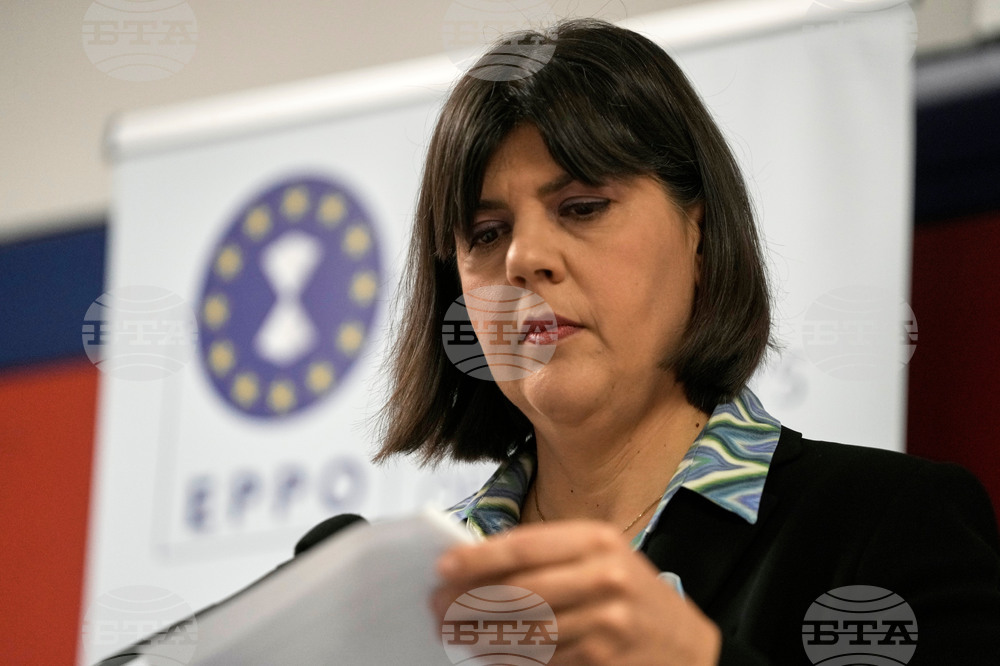
European Chief Prosecutor Laura Kovesi Sunday rejected claims that disciplinary proceedings against Bulgaria's suspended European prosecutor Teodora Georgieva are politically motivated, saying the case is based on evidence and decisions taken unanimously by independent prosecutors from across the European Union. Speaking in an interview on the 120 Minutes programme on bTV, Kovesi said there is a major difference between the "suggestion" surrounding the case and the actual facts.
"There is a narrative that a European prosecutor tried to do her best on a case and, because of that, became the target of intimidation, a discrediting campaign and finally disciplinary proceedings within the European Public Prosecutor’s Office," Kovesi said. She argued that the reality is different: last year a video recording surfaced allegedly showing Georgieva in what Kovesi described as "a situation she should never have been in".
The said video is believed to show Georgieva in an office of a notorious power broker in the judiciary, Pepi "Evroto" Petrov, who is now a fugitive from justice. Remarks the two exchanged suggested that Georgieva's election as European prosecutor was pre-determined by backstage factors in Bulgaria.
The video, reportedly recorded using a hidden camera, showed Petrov as telling another individual, alleged to be Georgieva in a commentary about her appointment: "Anyway, we consider it an important position. We have decided. You take it and so be it."
Kovesi said Georgieva admitted that she appeared in the recording and confirmed that the voice heard was hers.
Kovesi recalled that Georgieva had originally ranked third in the national selection procedure but was ultimately appointed after what she described as intervention by the Bulgarian government at the time.
Georgieva became Bulgaria’s European Prosecutor in July 2020, when the Third Government of Boyko Borisov was in power.
Following Georgieva’s public comments about investigations conducted by the European Public Prosecutor’s Office (EPPO), the office began monitoring the case more closely and identified several issues that eventually led to disciplinary proceedings, Kovesi said.
She noted that the only two disciplinary procedures currently being examined by the EPPO concern Georgieva.
Kovesi stressed that the process is being overseen by five independent European prosecutors from different EU member states, arguing this disproves allegations of outside interference.
"Subsequently, indications of violations committed by Georgieva were established," she said. "There was a unanimous decision by 24 independent prosecutors from different countries who concluded that the violations were serious enough for us to ask the European Commission and the European Parliament to activate the procedure for her dismissal."
The European Chief Prosecutor added that after Georgieva’s suspension, the Bulgarian EPPO team was coordinated by two other European prosecutors who achieved “very good results” compared with the previous period.
Kovesi also criticized what she described as obstacles faced by EPPO investigations in Bulgaria, saying the office had encountered difficulties from national institutions, similar to challenges in other EU member states.
She cited an investigation linked to a public procurement contract for electric buses. According to Kovesi, police were instructed to search offices belonging to a company that had contracts with Bulgaria’s Interior Ministry. "The company had five or six offices. Police entered two of them and refused to search the others," she said, adding that she had requested disciplinary proceedings against the officers involved from the then interior minister.
Kovesi further argued that Bulgaria’s lack of major investigations into VAT and customs fraud was concerning given that the country guards one of the European Union’s external borders.
The top European prosecutor warned that a prolonged absence of a Bulgarian representative in the EPPO would negatively affect the institution’s work.
"It would be very unfavorable for the European Prosecutor’s Office not to have a prosecutor from Bulgaria and for this transitional period to continue," she said. "This person must be independent and professional."
She added that it is up to Bulgaria to decide how to organize the selection procedure but noted that all other EU member states have already completed their appointments.
According to her, Bulgaria’s new justice minister should clarify what happened with the current procedure and decide whether a new selection process will begin or the previous one will continue.
/NF/
news.modal.header
news.modal.text