52nd National Assembly: inaugural sitting
![GERB-UDF to Back Progressive Bulgaria Candidate for Parliament Chair]()
![GERB-UDF to Back Progressive Bulgaria Candidate for Parliament Chair]() MP Toma Bikov delivers a declaration on behalf of the GERB-UDF parliamentary group during the inaugural sitting of the 52nd National Assembly, Sofia, April 30, 2026 (BTA Photo/Blagoy Kirilov)
MP Toma Bikov delivers a declaration on behalf of the GERB-UDF parliamentary group during the inaugural sitting of the 52nd National Assembly, Sofia, April 30, 2026 (BTA Photo/Blagoy Kirilov)
site.btaUPDATED GERB-UDF to Back Progressive Bulgaria Candidate for Parliament Chair
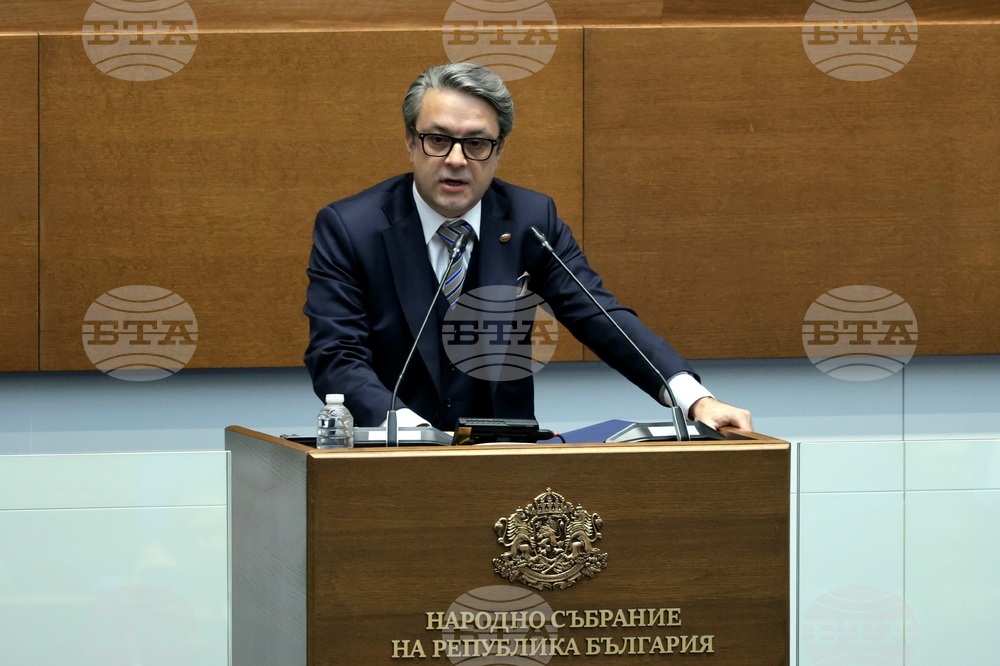
The GERB-UDF parliamentary group will support a representative of Progressive Bulgaria for Chair of the new, 52nd National Assembly, because Progressive Bulgaria won the latest elections and deserve to fill that post, MP Toma Bikov said in a declaration on behalf of GERB-UDF during the Assembly's inaugural sitting on Thursday. This, he said, "should not be interpreted as an attempt at negotiation or as a particular political message, but as an effort to revive a somewhat forgotten parliamentary tradition and an opportunity to establish a higher political standard in this parliament."
Bikov noted: "A higher political standard does not exclude political disputes; rather, it implies the opposition’s duty to represent citizens who hold views different from those of the parliamentary majority, and to ensure their right to express them freely and openly. This will be our main task in the present parliament, and we believe we will carry it out in the best possible way."
GERB-UDF said that over the past 12 years, Bulgaria has been governed by coalition governments, while in the last five years the country has fallen into a chronic political crisis and an inability of parliamentary forces to form a stable government. "This has taken place despite the need for stable decisions in an unstable geopolitical environment, the requirement for reforms across various public systems, and against the backdrop of a fiscal policy that has come to treat budget deficits as normality," said Bikov on behalf of the group.
“In recent years, we have called for raising the level of political debate and have warned that personal attacks and scandals destroy trust in the entire political system and its institutions,” he added.
The declaration read out by Bikov further noted that in the recent elections, a large majority voted to end the fragmented coalition model and grant Progressive Bulgaria full control. "GERB–UDF accepts the result and is ready to act as a constructive, centre-right opposition, defending national interests and exercising parliamentary oversight," it said. According to GERB-UDF, the outcome reflects not only a mandate to govern, but also strong public expectations for broad structural reforms.
Bikov argued that many voters backed the Progressive Bulgaria leader Rumen Radev personally, giving him the tools to meet public expectations without coalition constraints. This, Bikov said, carries significant responsibility requiring swift and precise action.
Bikov noted that GERB–UDF had previously made compromises to preserve political dialogue and stability, often at the cost of their voters' preferences. Coalition participation and repeated failures to form stable governments, he added, had negatively affected the party's electoral performance.
He stressed that while political dialogue had been necessary in a fragmented parliament, it is no longer essential under a single-party majority. "Instead, the priority now is delivering reforms, and failure to do so could lead to public disappointment and renewed political instability."
Recalling that Bulgaria has not seen such a majority since 1997, Bikov said this places the ruling party before a clear choice: pursue difficult reforms or risk failure.
He added that the upcoming 2026 budget will be a key test of the government's readiness to undertake fiscal consolidation, reduce the deficit and implement reforms.
Despite ongoing challenges—from global instability to domestic fragmentation—GERB–UDF will remain engaged in political debate while avoiding personal attacks, and expects the same from other parties, the group said in the declaration.
/VL/
news.modal.header
news.modal.text