site.btaResearchers Develop System for 3D Digitization of Traditional Bulgarian Dances as Part of Country's Intangible Cultural Heritage
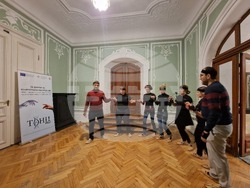
An interdisciplinary team of researchers at the Institute of Ethnology and Folklore Studies with Ethnographic Museum at the Bulgarian Academy of Sciences (IEFSEM – BAS) is developing a system for 3D digitization of traditional Bulgarian dance as part of the country’s intangible cultural heritage. The project combines approaches from information technologies, ethnochoreology, ethnomusicology, and medicine, and is funded by the European Union under the Recovery and Resilience Plan, the team told the Bulgarian News Agency (BTA).
THE TEAM
From IEFSEM – BAS, the project team includes PhD Ivailo Parvanov (project lead, ethnochoreologist), Assoc. Prof. PhD Anna Shtarbanova (ethnochoreologist), Assoc. Prof. PhD Veselka Toncheva (ethnomusicologist), and PhD Julia Popcheva (ethnologist). Participants from other fields and institutions include Dr. Yoana Cholakova (physician), Prof. PhD Antoniya Yanakieva (Medical University of Sofia), Assoc. Prof. Vanina Mihaylova-Alakidi (Medical University of Sofia), and programmer Petar Toshev.
PROJECT GOAL
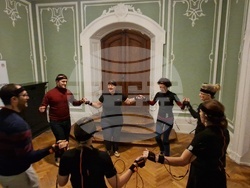
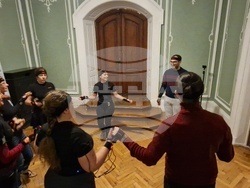
The goal of the project is to create a comprehensive system for 3D documentation of movement-based cultural practices. “This interdisciplinarity allows us to examine our research object from multiple perspectives - namely traditional dance, or what we call a group movement cultural practice,” Parvanov said.
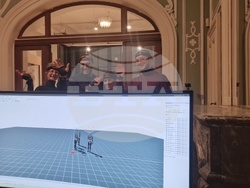
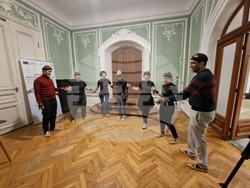
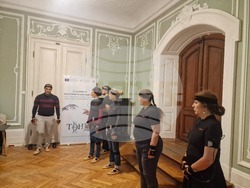
The system is based on Internet of Things (IoT) technology and includes inertial motion-capture sensors as well as single-channel ECG sensors. “All the data we digitize will be stored in a specialized module of a computer-based information system currently being developed here at the Institute of Ethnology and Folklore Studies with Ethnographic Museum at BAS,” the project lead explained.
The project aligns with current European digitalization policies. “In this programming period, particular emphasis is placed on three-dimensional digitization, both of intangible cultural heritage and elements of tangible cultural heritage,” Parvanov noted, expressing hope that “the standardized digitization protocol we are creating will evolve into a European practice.”
He added that the technology has applications across multiple fields, including the creative industries, medicine, and sports, and already has strong scientific relevance. In the creative industries, it has been used in the production of the film Avatar and the FIFA football video game, and it is also increasingly applied in robotics.
TECHNOLOGY AND FOLKLORE
Anna Shtarbanova pointed out that folk dance is particularly difficult to document. “Folk dance, as an expression of folk culture and part of a syncretic art form combining word, music, and movement, is far more complex and much harder to document and preserve,” she said. She recalled that when she began her work in the 1980s, she documented dance movements “with lines and marks in a notebook” due to a lack of technical means.
Historically, documentation relied on film cameras, she noted, and any existing archival footage today is largely thanks to cinema. According to her, new technologies fundamentally change the research approach. “Modern equipment allows us to observe movement in much greater detail and from multiple perspectives, without interfering in the dance process,” she said, adding that this requires a shift in methodology. “The way we have collected contextual data about dance must change.”
Shtarbanova also highlighted a conceptual difference between traditional and contemporary thinking as reflected in villagers’ language. “Older people I worked with always said ‘the horo dances,’ not ‘I dance.’ The traditional person has a more communal consciousness, whereas modern people place the individual self at the center. This is a major difference we must take into account,” she explained.
Veselka Toncheva emphasized the project’s potential for music research using sensor gloves already available to the team. “For the first time in Bulgarian ethnomusicology, we will be able to observe a 3D model of musicians’ finger movements,” she said. This will make it possible to trace regional differences in instrumental technique. “It turns out that a kaval player in Thrace moves his fingers differently from one in the Shopluk region,” Toncheva noted.
She explained that music-dance interaction involves communication between musician and dancer. “Who accelerates - the musicians to energize the dancers, or vice versa? We will be able to observe this through 3D movement data, both from the gloves and from the dancers’ figures. This opens new research possibilities not only in instrumental performance, but also in the relationship between music and dance,” she said.
HEALTH AND TECHNOLOGICAL CHALLENGES
The project also has a medical dimension. Dr. Yoana Cholakova noted that “there is substantial scientific evidence that dance functions as individual therapy,” including for depressive conditions and Parkinson’s disease. However, she added that “there is less reliable and objective data regarding group dance as therapy,” which is one reason it is included in the study.
“We are using technology that can most objectively demonstrate synchronization between people in terms of movement, motor behavior, and physiology,” Cholakova said.
From a technical standpoint, the system uses existing motion-capture solutions. “The 3D prototype represents the human body positioned in space, but digitized,” explained programmer Petar Toshev. He highlighted the system’s mobility. “We can have a mobile laboratory in an environment suitable for participants - at their home or community center,” he said.
Toshev also outlined several technical challenges, including device synchronization, magnetic field interference, and unstable performance during simultaneous recordings. An additional difficulty is the large volume of data generated by seven high-frequency systems combined with video and audio materials. To address this, a specialized data-storage module has been developed and is already being used successfully.
The team added that during the initial experimental phase of the sensor systems, colleagues from IEFSEM – BAS - PhD Milena Lyubenova and PhD Stella Nenova - joined the research team, while Kiril Valkov (Technical University of Sofia) joined as a voluntary collaborator in computer technologies.
/YV/
Additional
news.modal.image.header
news.modal.image.text
news.modal.download.header
news.modal.download.text
news.modal.header
news.modal.text