site.bta110th Birth Anniversary of Dobri Djourov, Bulgaria's Longest Serving Defence Minister
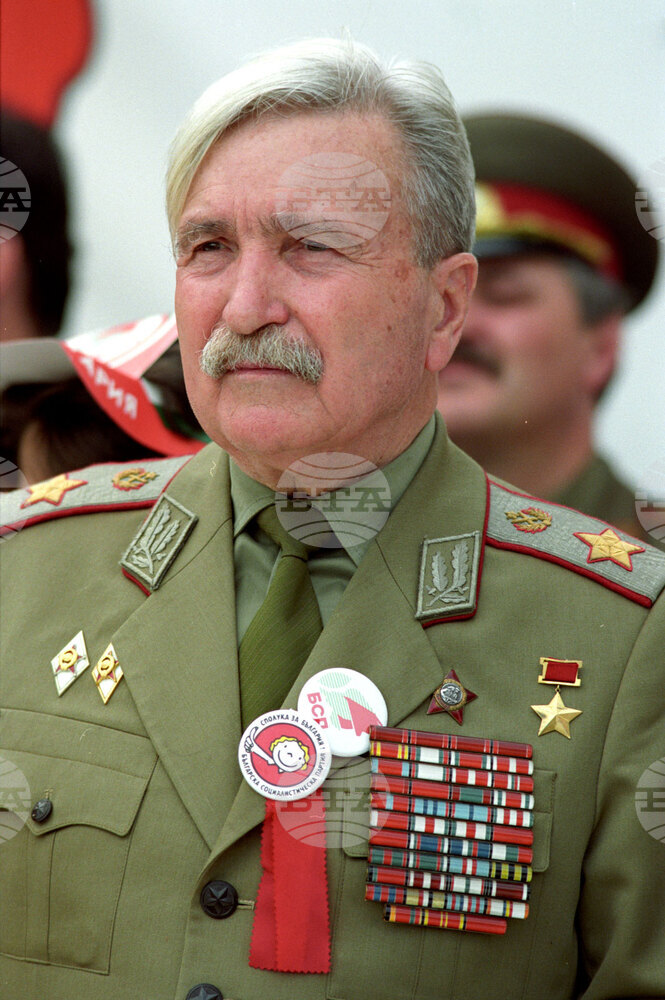
Dobri Djourov, the longest serving defence minister in modern Bulgarian history, was born 110 years ago on Monday.
Born in the village of Vrabevo near Troyan (North Central Bulgaria) on January 5, 1916, he studied at the Sofia Theological Seminary but was expelled for political activism. Djourov later joined the Workers' Youth Union in 1932 and the Bulgarian Workers' Party (Communists) in 1938. After serving a year at Sliven Prison and doing conscription service (1939-1942), he participated in the resistance movement during World War II. In 1942, he was confined as a political prisoner to the Krasto Pole Concentration Camp near Xanthi, from which he escaped. He was sentenced to death in his absence. In June 1942 he was among the initiators of the Chavdar Partisan Brigade, in which he was first political commissar and then commander until the communist takeover on September 9, 1944.
Until June 1945, he held senior positions at the Ministry of Interior, and then he transferred to the Bulgarian People's Army. He advanced from colonel to major general (February 1950), lieutenant general (May 1955), colonel general (April 1962), and army general (September 1964). Djourov graduated from the Frunze Military Academy in Moscow in 1947 and from the Military Academy at the General Staff of the Soviet Armed Forces in 1959.
After successively serving as commander of two infantry divisions between December 1947 and January 1949), he was promoted to chief of staff of the 2nd Army and then commander of the army (1949-1951) before taking the position of Commander of the 3rd Army in September 1951.
Appointed Deputy Minister of National Defence in 1956, Djourov became Minister of National Defence on March 16, 1962 and remained in office without interruption until September 20, 1990. His tenure of 28 years, 8 months and 5 days makes him the longest serving holder of this cabinet portfolio in Bulgarian history.
In the all-powerful Bulgarian Communist Party (BCP), Djourov was member of the policy-making Central Committee (November 1962 - February 1990) and candidate member (July 1974 - December 1977) and full member (December 1977 - February 1990) of the decision-making Politburo. In the Bulgarian Socialist Party (the BCP successor), the general was member of the Supreme Party Council (February 2 - September 25, 1990).
Djourov served as MP in six ordinary National Assemblies (1962–1990) and in the Seventh Grand National Assembly (1990–9 January 1991).
Djourov was believed to be one of the three top communist functionaries (along with Petar Mladenov and Andrei Lukanov) who prepared the ouster of Communist Party leader Todor Zhivkov at the party's Central Committee Plenum on November 10, 1989, which ushered in democratic changes in Bulgaria.
He wrote military and political articles and books of reminiscences and military science and policy.
Dobri Djourov passed away in Sofia on June 17, 2002 at age 86. Several thousand people attended his funeral with full military honours. He was survived by his wife, daughter and younger son. His elder son, an air force pilot, had been killed during a training flight.
The general was awarded three Orders of Georgi Dimitrov, two Orders of Lenin, and the Order of 13 Centuries of Bulgaria, a Marshal Star for army generalship, and the honorary titles of Hero of the People's Republic of Bulgaria and Hero of Socialist Labour.
Covering Djourov's passing on June 18, 2002, the BTA External News Service quoted then President Georgi Parvanov as writing in his cable of condolences to the bereaved family "Bulgaria has lost a worthy son and warrior," acknowledging the general's role in strengthening Bulgaria's defence potential, modernizing the Bulgarian army and training the Bulgarian military. The cable also stressed Djourov's active participation in the changes of November 10, 1989 and Bulgaria's progress on the road to democracy.
/LG/
Additional


news.modal.image.header
news.modal.image.text
news.modal.download.header
news.modal.download.text
news.modal.header
news.modal.text