site.btaMapping Antarctic Glaciers Defines Future Research Scope, Says Physicist Oleg Vasilev
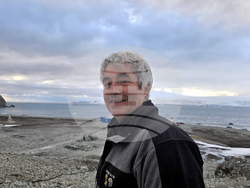
By mapping Antarctic glaciers in a timely manner, Bulgarian scientists are defining the scope of their future research activities, physicist Oleg Vasilev from the Bulgarian Antarctic Institute told BTA. Vasilev is part of the 34th Bulgarian Antarctic Expedition and is producing a detailed map of the coastline in the bays around the Bulgarian Antarctic base St Kliment Ohridski.
Vasilev explained that research on Antarctic glaciers is especially relevant at a time when temperatures are rising. Higher temperatures lead to glacier retreat, particularly in coastal areas, exposing terrain features that no human has seen before. Mapping them in time would open up opportunities for a wide range of projects, from biology and geology to physics and mathematics, thus helping to define the field of scientific activity.
Vasilev has been part of Bulgarian Antarctic expeditions for six years and also has experience from two foreign expeditions in the region. His interest in glacier photogrammetry began earlier, as he had worked on glacier photogrammetry in Nepal and, since 2025, in Iceland.
He noted that this is his sixth participation in the Bulgarian programme. Most of his work has been related to photogrammetry, though he has also conducted radar measurements of glaciers. This method involves a radar antenna flying over the glacier surface. Because the glacier is transparent to the radar beam, the approach makes it possible to see where the glacier bed is located, which allows researchers to determine the glacier’s true thickness. It also enables observation of glacier movement and whether its volume is increasing.
According to the physicist, this approach does not put human life at risk and makes it possible to monitor glacier changes in critical zones, such as contact areas with water, where glaciers meet the sea.
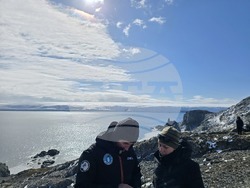
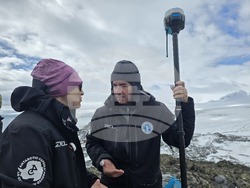
Vasilev and geophysicist Kiril Velkovski are working on a navigation map that will cover both terrestrial and underwater topography. Photogrammetry is used for land mapping and bathymetry for underwater mapping. Their aim is to cover the bay of the Bulgarian base, the so-called South Bay, and the neighbouring False Bay.
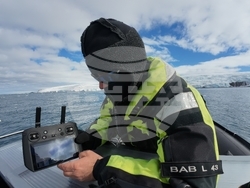
Vasilev is creating a terrain model by processing drone images, applying photogrammetric analysis and producing a detailed map.
He added that this cartographic base, apart from being useful for navigation, is part of a project launched in 2019 to create a geographic database showing the locations where projects under the Bulgarian Antarctic Programme have been carried out.
Vasilev further noted that in this information system anyone can see details about the scientists’ projects and when and where exactly they were conducted.
Vasilev and Velkovski are nearing the end of their project. Out of a total coastline length of 48 km, only 3 km remain to be completed, and they are likely to finish the mapping before leaving aboard the research vessel Sv. Sv. Kiril i Metodii (RSV 421) later in February.
Vasilev also works on monitoring coastal glaciers and determining changes in their volume, as well as on penguin monitoring. Using photogrammetry again, he observes colonies and tracks trends in their reproduction.
He also reported that in 2026, while processing photogrammetric data, he found parts of a crashed aircraft – an Argentine military plane that went down in 1976. These parts were first discovered by the Bulgarian programme in 2024, but this year’s find was located in an unusual place compared with previous discoveries.
BTA has had a national press club on board the RSV 421 since 2022. In February 2024, the national news agency also opened one at the Bulgarian Antarctic Base on Livingston Island. The two press clubs exist thanks to the free support of the RSV 421 crew and of the Bulgarian base, which have provided the necessary premises. These are added to BTA's other 41 press clubs (33 in Bulgaria, seven abroad in neighbouring countries and countries with large Bulgarian communities, and one mobile called National Book Press Club).
The reports of BTA’s special correspondents from RSV 421 and from Antarctica are freely accessible in a special thematic section of the news agency’s website, entitled “Bulgaria-Antarctica BTA's Log,” in Bulgarian and English, and may be used freely by all media with attribution to BTA.
/KK/
Additional
news.modal.image.header
news.modal.image.text
news.modal.download.header
news.modal.download.text
news.modal.header
news.modal.text