site.btaUPDATED EC, Bulgarian PM to Organize Regional Connectivity Summit
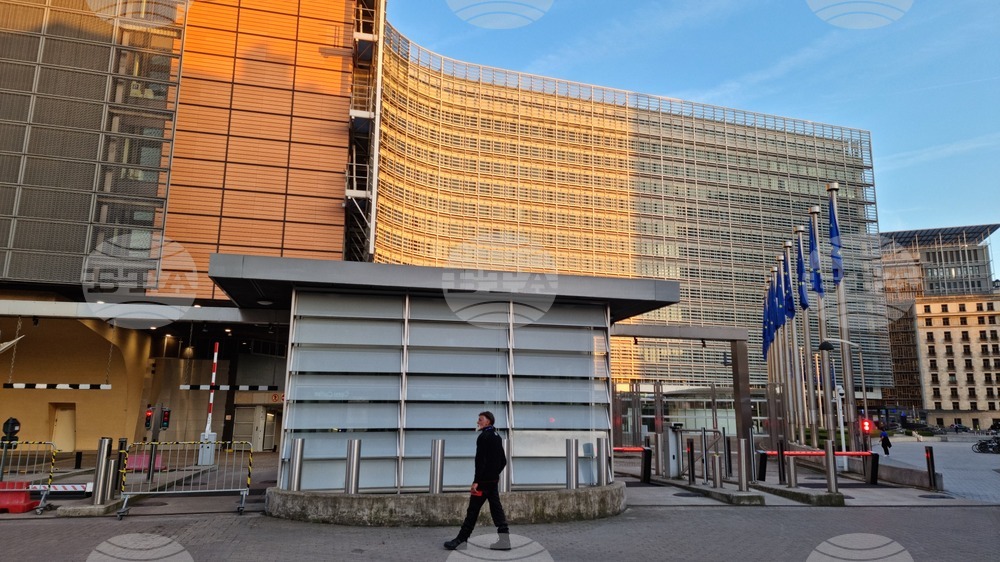
European Commission President Ursula von der Leyen said during her annual State of the European Union address Wednesday that a Regional Connectivity Summit would be organized with the Prime Minister of Bulgaria.
She announced a new international connectivity project that will directly link the South Caucasus and Central Asia with the European market, in what is known as the Middle Corridor. Through the Global Gateway initiative, the EU will seek to attract up to EUR 12 billion in public and private investment, she said.
The aim is to diversify routes, triple trade flows and significantly reduce transit times for goods by 2030, von der Leyen said. In an era of profound change, Europe's prosperity and security cannot be built at home alone, she added.
Von der Leyen noted that this year agreements had been concluded with India, Mercosur, Mexico, Australia and Indonesia. She said the EU now had trade agreements with more than 80 countries, more than any other entity in the world, and that European businesses were seeking further opportunities.
Concept of Connectivity and the Pan-European Transport Corridors
The concept of connectivity was first enshrined in the Maastricht Treaty, signed on February 7, 1992, and entering into force on November 1, 1993. The treaty provided for the European Union to establish and develop trans-European networks in the fields of transport, telecommunications and energy, with the aim of developing the internal market, strengthening economic and social cohesion, connecting landlocked and peripheral regions with the EU's central regions, and bringing the territories of EU member states closer to neighbouring countries.
Two Pan-European Conferences of European transport ministers – the first held in Crete from March 14 to 16, 1994, and the second in Helsinki, Finland, from June 23 to 25, 1997 – were the main basis for defining the 10 Pan-European Transport Corridors, five of which – Corridors 4, 7, 8, 9 and 10 – pass through Bulgarian territory.
The First Pan-European Transport Conference of Ministers was held in Prague from October 29 to 31, 1991, jointly organized by the European Parliament and the European Commission under the auspices of then Czechoslovak President Vaclav Havel. Representatives of nearly 30 European countries from the Community, the European Free Trade Association (EFTA) and Central and Eastern Europe took part in the conference, which discussed the current and future development of transport in Europe, as well as the problems that needed to be addressed to facilitate exchanges in the context of the new situation in Europe following the political changes.
The Second Pan-European Transport Conference was held in Crete from March 14 to 16, 1994, bringing together more than 700 representatives from 42 European and Mediterranean countries. Participants included representatives of various EU institutions, European governments and parliaments, international transport organizations, the transport industry and financial institutions, as well as delegations from Central and Eastern European, Mediterranean and Black Sea countries. The conference focused on congestion at border crossings and the need to improve transport routes linking Eastern Europe with EU countries. The Crete Conference identified nine priority transport corridors as the basis for further work.
The aim of the Third Pan-European Transport Conference, organized by the European Parliament and the European Commission in Helsinki, Finland, from June 23 to 25, 1997, was to take stock of developments in transport since the Second Conference in Crete on March 14-16, 1994, and to focus on the development and use of trans-European transport systems and networks. The conference built on the work of the Prague and Crete conferences in 1991 and 1994, which recognized the importance of joint efforts to address congestion, safety and environmental damage, as well as the interoperability of networks. The 10 Pan-European Corridors were formally established at the conference. Agreement was also reached on the need for cooperation in evaluating and implementing research findings and in developing new information and traffic-management systems.
Pan-European Transport Corridors Linked to Bulgaria
Pan-European Transport Corridor No. 4 is the main road and rail axis linking Central and Southeastern Europe, passing through Czechia, Austria or Slovakia, Hungary, Romania and Bulgaria, with branches to Greece (Thessaloniki) and Turkiye (Istanbul). A significant share of north-south transit flows in the region passes along the corridor, making it important for planning delivery times, costs and capacity for shipments between Central Europe, Romania and Bulgaria and onward routes to Thessaloniki and Istanbul. The corridor carries international flows between Romania, Bulgaria and Greece along the Bulgarian section from Vidin to Sofia and the Kulata border crossing, while transit flows to Turkiye follow the Sofia-Plovdiv-Svilengrad-Kapitan Andreevo border crossing route. Its route is Dresden/Nuremberg – Prague–Vienna/Bratislava – Gyor – Budapest – Arad – Constanta/Craiova – Sofia – Thessaloniki/Plovdiv – Istanbul.
The corridor is being used increasingly as the shortest link between the Danube and the Aegean Sea, while also providing a convenient connection between Europe and Asia. This is expected to have the greatest impact on the development of Bulgaria's Northwest Planning Region, as it will facilitate its integration into the national transport network and, consequently, into the broader regional development process. The Southwest and South-Central planning regions are also expected to benefit in this respect.
Pan-European Transport Corridor No. 7 links the North Sea with the Black Sea via the Rhine-Main-Danube waterway. The Danube, as an inland continental link between Western, Central and Eastern Europe, provides a connection between Europe and Asia, while the Black Sea offers a direct link to the inland waterway networks of Russia and the countries of the Caspian basin. The corridor covers almost the entire northern border of Bulgaria, along the country's border with Romania. Through its established port complexes, it enables Bulgaria to become more extensively integrated into international freight transport by water and also provides an additional boost to intra-regional development in the Northwest, North Central and Northeast planning regions. The Bulgarian section of the corridor is 471 kilometres long.
Pan-European Transport Corridor No. 8 defines a new east-west transcontinental transport route aimed at reviving the “Silk Road” and connecting Europe and Asia. International flows to and from the Balkans and Central and Western Europe pass through the Bulgarian section from the Gyueshevo border crossing to Kyustendil, Sofia, Plovdiv, Burgas and Varna. The port complexes in Burgas and Varna will continue to serve as comprehensive border-crossing facilities, while in the western part of the country the Sofia-Gyueshevo route will serve solely as a road connection. This is the longest section of the corridor on Bulgarian territory, and its operation will affect all planning regions in the southern part of the country – the Southwest, South Central and Southeast planning regions. Its route is Durres – Tirana – Skopje – Sofia – Plovdiv – Burgas – Varna.
Pan-European Transport Corridor No. 9 provides a connection between Romania, Bulgaria and Greece via the Bulgarian section from Ruse through Veliko Tarnovo, Stara Zagora, Dimitrovgrad and Svilengrad to the Novo Selo border crossing. The corridor's passage through Bulgaria's southern border is expected to have the greatest impact on regional development in the South-Central Planning Region, as well as the North Central Planning Region. Its route is Helsinki – St Petersburg – Moscow/Pskov – Kyiv – Liubashevka – Chisinau – Bucharest – Ruse – Dimitrovgrad – Makaza Pass – Alexandroupolis.
Pan-European Transport Corridor No. 10 connects Europe, Bulgaria and Turkiye via the Bulgarian section from the Kalotina border crossing through Sofia, Plovdiv and Svilengrad to the Kapitan Andreevo border crossing, providing a link between Europe and Asia. The corridor's route through Bulgarian territory is one of the busiest and has long been established as an international transit route. It largely meets international standards but still requires further construction and modernization of its infrastructure, particularly along the Sofia-western border section, where its impact is expected to be most significant in the Southwest Planning Region. Its route is Salzburg – Ljubljana – Zagreb – Belgrade – Nis – Sofia.
BTA's archive shows that Bulgaria has been mentioned several times in the annual State of the Union addresses delivered by European Commission presidents over the 19-year period since the speeches were introduced, excluding years in which European Parliament elections were held.
In 2016, then European Commission President Jean-Claude Juncker mentioned Bulgaria in his State of the Union address, delivered in Strasbourg on September 14, in the context of protecting the EU's external borders and the migration crisis.
In 2017, Juncker again mentioned Bulgaria in his annual address, in the context of the country's accession to the Schengen area and the euro area. He said it was high time for Bulgaria and Romania to be admitted to the Schengen area of free movement and called for all EU countries to share responsibility for protecting the bloc's external borders.
In her State of the Union address to the European Parliament on September 13, 2023, Ursula von der Leyen called for Bulgaria and Romania to join the Schengen area without further delay. She also thanked the two countries for demonstrating good practices in granting asylum and returning migrants who had entered the EU illegally.
/NF/
news.modal.header
news.modal.text