Wrap-up
![Green Transition Forum 6.0: Day Two]()
![Green Transition Forum 6.0: Day Two]() The sixth edition of the Green Transition Forum is taking place in Sofia, June 1 - 5, under the motto "Europe's Next Chapter – Competitive. Innovative. Secure" (BTA Photo/Blagoy Kirilov)
The sixth edition of the Green Transition Forum is taking place in Sofia, June 1 - 5, under the motto "Europe's Next Chapter – Competitive. Innovative. Secure" (BTA Photo/Blagoy Kirilov)
site.btaUPDATED Green Transition Forum 6.0: Day Two
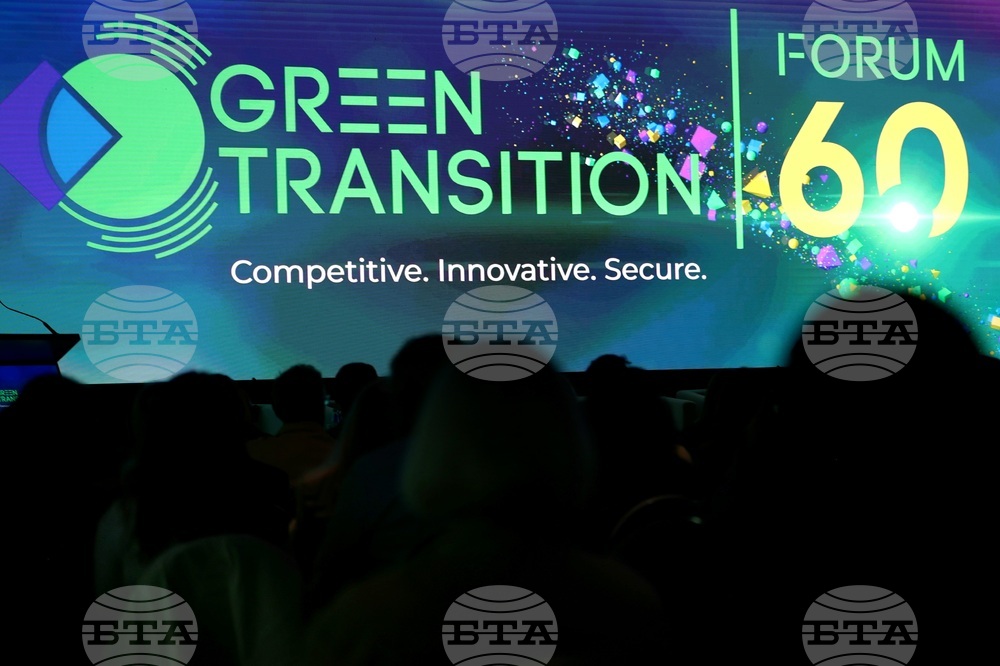
The Green Transition Forum 6.0 went into its second day at the Sofia Event Center on Tuesday.
The sixth edition of the Forum is taking place from June 1 to 5 under the motto "Europe's Next Chapter – Competitive. Innovative. Secure". The 2026 edition focuses on Europe's new strategic agenda and examines how the European Union can translate its long-term priorities into concrete action through stronger competitiveness, faster innovation, and enhanced security in an increasingly dynamic global environment. The forum is organized by Dir.bg in cooperation with the Bulgarian-Hellenic Chamber of Commerce and Industry. BTA is a media partner of the event.
Following is a summary of Tuesday's discussions:
National Assembly Chair Mihaela Dotsova: In my role, I understand how important is for businesses to have a predictable state. Efforts will be made during the legislative process to ensure that all stakeholders are heard and that decision-making remains transparent. Creating a more favourable administrative environment for small and medium-sized enterprises is among the priorities set out in the government's programme.
Labour and Social Policy Minister Nataliya Efremova: A more comprehensive statistical assessment of labour market forecasts is being prepared to better align future training policies with economic needs. The analysis will help identify which professions are likely to disappear and which will remain, in order to better target future training opportunities. Green and digital skills, as well as competencies related to artificial intelligence, will be a key focus of upcoming training programmes. The Ministry of Labour and Social Policy applies differentiated approaches depending on social groups, including young professionals, people with disabilities, and those with limited access to education, as well as individuals seeking higher qualifications.
Andriana Sukova, Deputy Director-General at the European Commission’s Directorate-General for Employment, Social Affairs and Inclusion: Labour mobility in the European Union remains relatively low: around 18% of people express interest in working abroad, while only 4% actually do so. Over 17 million people out of 450 million Europeans work in a country other than their own. Around 3.5 million are posted workers, and about two million people commute daily across borders for work.
Economic and Social Council Chair Zornitsa Roussinova: Europe has record-high employment levels. While inclusion of more women, reduced inequalities, and faster convergence appear positive in statistics, employers continue to report labour shortages, young people struggle to enter the labour market, and workers face multiple challenges.
Eurofound Executive Director Ivailo Kalfin: Around 30 million additional jobs have been created in Europe over the past 25 years, while at the same time the population is ageing and more people are leaving the labour market than entering it. One of the main challenges across sectors is recruitment, with shortages most acute in transport, healthcare, construction, agriculture and tourism. Many of these sectors are considered unattractive, and workers have increasingly moved into other fields. There are significant gender disparities in labour market participation, as in many places public services are insufficient to provide childcare and care for the elderly or people with disabilities, leaving women more likely to stay at home. The cost of excluding women from the labour market is estimated at around EUR 290 billion annually, or over 2% of EU GDP. A gender pay gap of 13-14% exists for the same positions, and many young people are unable to afford independent living and remain in parental homes well into their 30s.
Economist and professor of economic geography Andres Rodriguez-Pose: The rise of artificial intelligence is transforming the nature of work.
SIS Credit CEO Martina Grigorova: Europe must invest in skills development. Social entrepreneurship is important.
Country Operations Head of Adecco Bulgaria Nadezhda Vasileva: Employee interest in artificial intelligence has surged, but employers are struggling to meet expectations for rapid adaptation. Companies that fail to remain competitive in AI implementation risk losing skilled workers. More needs to be invested in workforce training.
Francesca Cristea, Head of Policy and Programmes at Europuls: Integrating young people into the labour market is important.
Bulgarian Industrial Capital Association (BICA) Secretary General Milena Angelova: The biggest challenge that enterprises face when it comes to responsible business behaviour is the low level at which they are informed about the necessary actions, followed by the lack of specialists in sustainable management. Other main challenges are the lack of financial resources, the absence of a clear plan, and the lack of time to implement sustainable policies and reforms. A nationally representative survey has been conducted in collaboration with the Economic Research Institute at the Bulgarian Academy of Sciences. The survey covers 17 economic sectors and 78 occupational groups, identified as key to the competitiveness of the respective industries.
Yordanka Chobanova, Head of the European Commission (EC) Representation in Bulgaria: Sustainable business practices are no longer a matter of choice but an absolute necessity for the development of the economy and the world. The EC and its delegations are actively working to foster dialogue between business, institutions, and civil society regarding responsible business conduct, so that there is a continuous process of consultation and exchange of best practices. The EC supports responsible business conduct in three steps, with legislation being the most fundamental element, followed by trade agreements.
Bulgarian Industrial Association - Union of the Bulgarian Business (BIA) Vice President Stanislav Popdonchev: Responsible Business Conduct (RBC) standards should be viewed as an opportunity rather than as an administrative burden. The implementation of the RBC standards of the Organisation for Economic Co-operation and Development brings at least three strategic benefits to Bulgarian companies. These include access to global value chains, an improvement of the ESG (Environmental, Social, and Governance) rating, and easier access to investments, as well as better risk management and confidence building, the speaker said. Despite the potential benefits, the situation for small and medium-sized enterprises in Bulgaria remains complicated. The major problems include regulatory overload and administrative pressure, a lack of administrative and expert capacity, certification and audit costs, and the risk of sanctions, unpredictable requirements, and abuse of complaint mechanisms.
/KK/
news.modal.header
news.modal.text