site.btaMedia Review: October 23
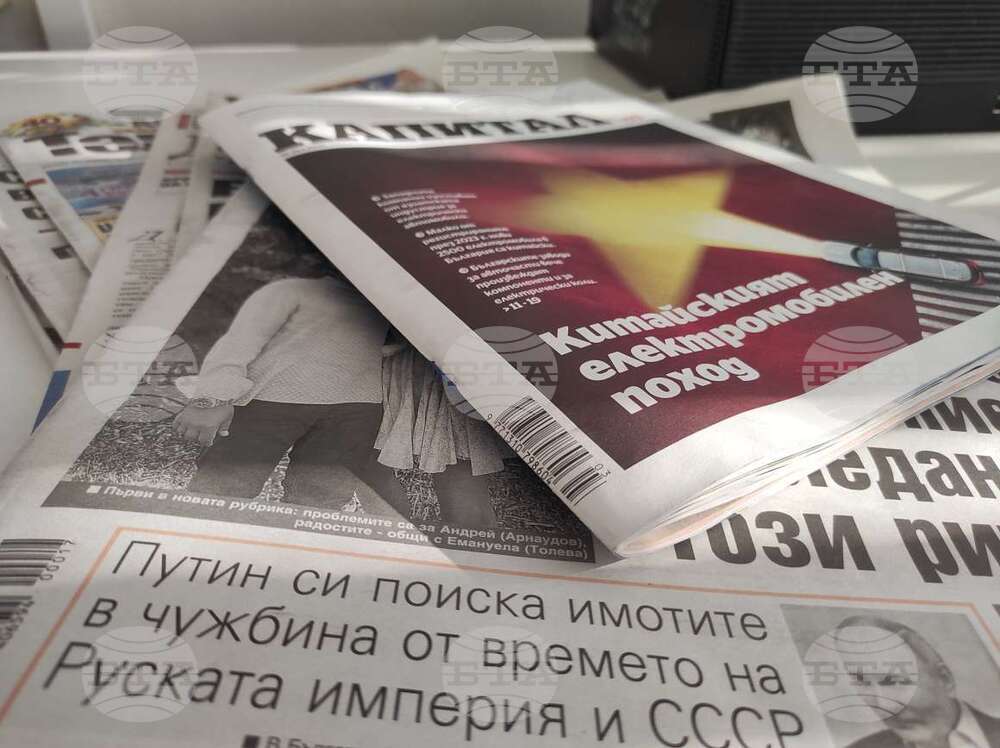
BULGARIA VOTES FOR PRESIDENT ON OCTOBER 25
The election campaign ahead of Sunday's presidential elections in Bulgaria concludes at midnight on Friday, October 23. Saturday, October 24, is the official day of reflection, during which election campaigning is prohibited.
Voting on Sunday will begin at exactly 7:00 a.m. Polling stations are scheduled to close at 8:00 p.m., but voting may be extended until 9:00 p.m. if there are still voters waiting in line outside polling stations.
The campaign to elect Bulgaria’s seventh president officially began at midnight on September 25. The Central Election Commission (CEC) registered 27 presidential and vice-presidential tickets.
Rather than producing a winner in the first round, Bulgarian presidential elections traditionally go to a runoff, which will be held on October 1.
Throughout the whole campaign polls have favoured the ticket of current president Iliana Iotova and Kiril Valchev, measuring their support near the end at 41.4%-45.9%, followed by the tickets of Andrey Gurov and Georgi Kandev (27.9 %-28.3%) and Kostadin Kostadinov and Petar Volgin (10.9%-12.8%).
***
The presidential election campaign has been shaped more by symbolic battles and external events than by substantive political messages, while the perception that the outcome is already decided could prove problematic for frontrunner Iliana Iotova. These are among the key observations made by political analyst Parvan Simeonov in an interview with Mediapool.bg, two days before Bulgaria's presidential election.
According to Simeonov, one of the campaign's main flashpoints was the series of strikes in the Black Sea, apparently linked to Russia's war against Ukraine. The escalation was particularly significant because, for the first time, it affected Bulgaria's exclusive economic zone. Another contentious issue was presidential pardons, against a backdrop of broader public concerns about rising prices, living standards and the performance of the current government.
Yet the campaign has largely failed to address these everyday concerns. Instead, it has become a contest between two competing visions of Bulgaria and its place on the geopolitical map.
"What we are witnessing are two competing narratives about Bulgaria. Within such a framework, it is difficult to focus on prices and budgets," Simeonov said, arguing that the campaign has been dominated by symbolic issues rather than substantive political proposals.
External circumstances have largely dictated the agenda, leaving candidates little opportunity to shape the debate themselves. Rather than setting the terms of the campaign, they have been forced to react to events.
The strikes in the Black Sea may have mobilized supporters of Andrey Gurov, but Simeonov cautioned that increased political engagement on one side could also energize the other.
This is particularly relevant for Iotova's supporters, some of whom may believe that her victory is inevitable. According to Simeonov, such complacency could discourage voter turnout and represents one of the less visible vulnerabilities of her campaign.
Looking beyond the election, Simeonov believes a Iotova victory would consolidate an ongoing transformation of Bulgaria's political landscape, marked by the decline of GERB's dominant role and the emergence of a stable, centrist, traditionalist and somewhat eastward-looking political force.
However, he argues that developments elsewhere in Europe could ultimately prove more consequential for Bulgaria's future. Political changes in France and Germany in the coming months and years could fundamentally reshape the European Union.
"Those who continue to draw dividing lines between Russia and the European Union are not showing much foresight, simply because the division now runs through the EU itself," he said.
Simeonov suggests that both President Rumen Radev and Iotova appear to be positioning themselves for a Europe that could look very different from today's.
A victory for Gurov, meanwhile, would be a surprise, though not an impossible one. It would provide a counterweight to the current government and reinforce the emergence of a new political polarization in Bulgaria.
Even if Gurov loses, Simeonov sees considerable potential for his political future. He could emerge as an influential figure within the reformist political space currently occupied by Continue the Change and Democratic Bulgaria, potentially becoming a catalyst for political renewal.
***
Several vice-presidential candidates have admitted they had little or no control over how their state-funded media packages, worth approximately EUR 20,000 each, were spent, raising questions about transparency in Bulgaria's presidential election campaign, according to an investigation by 24 Chasa.
The investigation found that nine of the 27 presidential tickets allocated more than EUR 124,000 in public funds to TV Spravedliva Bulgariya, a little-known television station with a very limited audience. Four tickets reportedly directed their entire media budgets to the outlet.
Vice-presidential candidate Galya Ivanova alleged that her campaign had faced "administrative harassment", claiming that her EUR 20,451 media package was directed to TV Spravedliva Bulgariya without her having any say in how the money would be spent.
"We were subjected to administrative harassment and obstruction of our campaign by the associate responsible for managing it," Ivanova said.
According to her, the package consisted of 14 pre-recorded interviews that were not broadcast until the 20th day of the campaign. "We had no opportunity to decide how the funds would be used," she complained.
Other candidates also acknowledged having little knowledge of their campaign finances.
"I don't know how much the package is worth. The nomination committee deals with that," vice-presidential candidate Panayot Kyuchukov said during a debate on Bulgarian National Television.
He insisted that he had personally covered his campaign travel expenses and had received no money from the state-funded package.
"I haven't received a single euro for hotels or travel. I'm not running because of that money," he said, adding that he did not personally know the 22 members of his nomination committee.
Asked how her campaign's EUR 20,000 media package was being spent, another vice-presidential candidate, Nina Lambova, replied: "You should probably ask the nomination committee."
TV Spravedliva Bulgariya broadcasts mainly online and is carried by just one television provider. It also uploads videos of its programmes to YouTube, where most attract fewer than 100 views.
Its most popular video over the past five days had been viewed 316 times, while its Facebook posts since the start of the election campaign had received around 10 likes.
The investigation has uncovered connections between the television station and political organizations associated with some of the candidates.
This raises questions about who actually controls public funds allocated for election advertising and whether taxpayer money is being channeled to politically connected media outlets with minimal audiences, in some cases without the candidates' knowledge or meaningful involvement.
BATLLE FOR DOMINANCE OVER NEW SUPREME JUDICIAL COUNCIL
An analysis, published by Mediapool.bg, examines whether an informal network of court presidents or former chief prosecutor Sotir Tsatsarov will dominate the new Supreme Judicial Council (SJC).
The formation of Bulgaria's new Supreme Judicial Council is revealing a familiar paradox within the country's judiciary: the promise to dismantle the old system may turn out to be a cover for simply rearranging it. This is what happened with GERB after 2009.
Judges elect six members of the SJC. These representatives play a decisive role in forming majorities not only within the Council's Judges Chamber but also in the SJC Plenum, which is responsible for electing the prosecutor general and the presidents of the supreme courts.
To be elected to the SJC through the judicial quota, a candidate needs the support of approximately 600 judges.
Behind the candidates nominated by the ruling Progressive Bulgaria party lie overlapping centers of influence — the circle surrounding former Prosecutor General Sotir Tsatsarov, the informal Network of Court Presidents within the judiciary, and various factions within the party itself.
This does not necessarily mean there is a single center of command. Rather, it is a network of professional dependencies, personal connections and competing interests that may converge where decisions are made about who will control appointments within the judiciary in the years ahead.
According to magistrates who spoke to Mediapool, Tsatsarov is expected to regain a significant degree of influence over the Supreme Judicial Council. This time, however, it will not be through the same unquestioned majority he enjoyed as prosecutor general between 2012 and 2019, but through contacts and alliances with individuals whose careers have been associated with his circle.
At the same time, the Network of Court Presidents, which has developed over the past decade around the heads of various courts, appears well positioned to secure its own representatives on the new council.
The selection of the SJC's members is thus becoming a crucial test of the government's promised judicial reform. Will Progressive Bulgaria dismantle the old networks of dependency, or will it reproduce them under a new political umbrella?
Mediapool's conversations with magistrates and its examination of the nominees' professional backgrounds paint a troubling picture in which promises of change collide with well-established mechanisms of influence.
The question of whether formet Prosecutor General Sotir Tsatsarov is President Rumen Radev's trusted figure in judicial affairs first arose when the Progressive Bulgaria government was formed this spring.
The first indication came with the prime minister's decision to appoint Nikolay Naydenov as justice minister. Naydenov had served as secretary-general of the Counter-Corruption Commission during Tsatsarov's tenure.
Further indications of Tsatsarov's influence over personnel decisions emerged in Progressive Bulgaria's nominations for the Supreme Judicial Council.
The Network of Court Presidents
The informal network of senior figures within the judiciary expects to dominate the elections for the judicial quota of the Supreme Judicial Council.
This network includes presidents of district and appellate courts who have advanced significantly in their careers over the past 15 years - a period during which judicial reform in Bulgaria went sharply into reverse and the SJC's appointment practices became deeply compromised.
Many of those believed to be associated with the Network are now among the leading candidates for membership of the next Supreme Judicial Council.
Some have also been nominated by the ruling Progressive Bulgaria party, which promised voters judicial reform and the dismantling of the oligarchic model.
NATIONAL PROTECTION SERVICE OFFICER ASSAULTS JOURNALIST
"What we are seeing is a series of cascading errors on the part of the security officers and the head of the security detail," said security expert Milen Ivanov on National Radio, commenting on an incident involving journalist Sonya Koltuklieva, who was injured following a physical confrontation with an officer from the National Protection Service from the security detail of Parliament chair Mihaela Dotsova.
The expert also pointed to another mistake made by the security officer.
"Once he realized he had made a serious mistake, he reacted very roughly," Associate Professor Ivanov added.
The former deputy rector of the Interior Ministry Academy is adamant that the security guard had a duty to provide first aid to the injured person.
"Under the law, failing to provide first aid to a person in a helpless condition is a criminal offence. If you are the one who caused that condition, then providing assistance is simply your duty. Clearly, what we have here is either negligence in the performance of official duties or recklessness. It will be up to the prosecution to determine how these actions should be legally classified.
According to him, restricting people's movement falls within the authority of the National Protection Service.
"That is part of their job. They undoubtedly encounter situations like this on a regular basis. However, we should not judge the overall state of the NSO on the basis of a single incident. What we are seeing is an incident involving clearly unprofessional conduct, but this should not be taken as a reflection of the work of the entire service," Ivanov commented.
/PP/
news.modal.header
news.modal.text