site.btaMedia Review: September 9
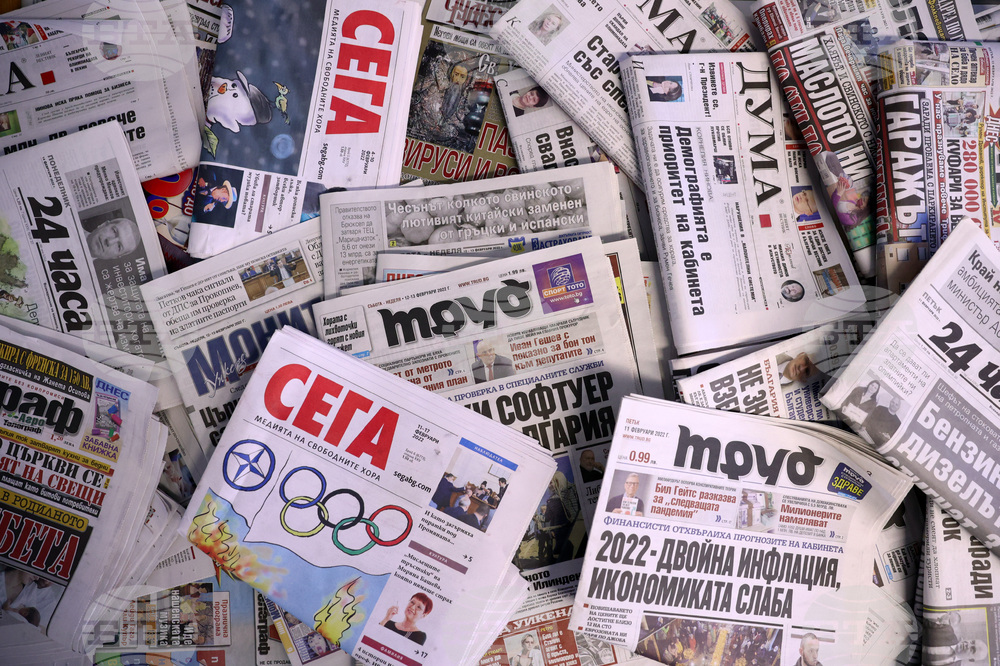
Discussions on the candidates in the October 25 presidential elections dominate the media on Wednesday.
PRESIDENTIAL ELECTIONS
On Nova Television’s morning show, Prof. Georgi Lozanov, a member of Gurov and Kandev’s initiative committee, and cultural studies and media expert Prof. Lyubomir Stoykov discussed the upcoming presidential elections. Lozanov described the composition of the group supporting President Iliana Iotova in the upcoming election as “colourful”. “It is about the axis of the Bulgarian Communist Party - the Bulgarian Socialist Party - Moscow. Iotova had moved away from it with the appointment of Andrey Gurov as caretaker prime minister - a revolutionary gesture. She is relying on an electorate that has created a majority around pro-Russian Euroscepticism turned into State policy. Iotova is the lighter and more acceptable version of this way of thinking, but she is part of it. The question is for an alternative to emerge,” Lozanov commented. In his words, GERB’s neutral stance on the presidential election benefits Iotova. “Gurov has to reverse the Eurosceptic attitude. She announced her candidacy, after which Radev endorsed her. She will rely on his electorate. Those who voted for him were misled into believing that the EU threatened our sovereignty, when in fact, thanks to the Bloc, we received assistance to become a democracy. Russia is a threat to Europe. Our interests do not coincide with its interests. People need to be taken out of this trap, but Iotova will not do it. Gurov and Kandev gained my trust during the caretaker government. As prime minister, he showed himself to be a European politician,” Lozanov said. Stoykov described the President as a mature, wise and experienced politician who stands out for her honesty, competence, intelligence, determination and ability to engage in dialogue. “She has demonstrated these qualities repeatedly, while the support from non-party figures is an indication that the unifying element is the possibility of highlighting an independent candidacy. Iotova said that the President would have her own voice and would pursue her own goals and responsibilities. She and Kiril Valchev are journalists. He is active, has international standing and is very well received abroad. For the first time, we have a chance to have a woman become president,” Prof. Stoykov noted. He acknowledged that he only knows Gurov superficially but said he had made a good impression on him. “One of the problems with the presidential ticket is that they declared themselves very late and little is known about them,” the media expert said.
On bTV’s morning show, actress Eli Skorcheva, a member of Gurov and Kandev’s initiative committee, and archaeologist Prof. Nikolay Ovcharov, a member of Iotova and Valchev’s initiative committee, discussed the upcoming presidential elections. According to Skorcheva, the upcoming campaign will be dominated both by the geopolitical divide between East and West and by domestic political issues. “We simply need to orient ourselves more towards Europe. Again,” Skorcheva said. Prof. Ovcharov also described foreign-policy orientation as very important in choosing a president. Skorcheva was asked whether she saw a difference between Andrey Gurov and Iliana Iotova in terms of their Euro-Atlantic orientation. According to her, there is such a difference in terms of what they say, but the picture is different when it comes to their actions. “First, in recent months, since Mrs Iotova has been acting president, I have not seen her take action,” Skorcheva said. As an example, she cited the lack of a consultative council and the absence of a veto on the budget. Prof. Ovcharov, for his part, said he did not believe that Iotova could correct any mistakes during the short period for which she has been acting president. “She is, of course, President, but she was not elected by the people, which we hope will happen in a month,” he said.
In an interview with the Bulgarian National Radio (BNR), political scientist Petar Cholakov commented on GERB’s decision not to nominate a candidate for president in the upcoming election. He said the move indicated serious concern and showed that the party was worried about the result it had achieved in the previous parliamentary elections. “The question remains who they would support. On the other hand, there are figures from GERB who have been well known over the years, and now we see them alongside Iliana Iotova. These include MEP Emil Radev, former Speaker of Parliament Vejdi Rashidov and prominent scientist Prof. Christo Pimpirev. In jest, GERB already has its own candidate,” Cholakov said. The political scientist saw the move as an attempt by Iotova to broaden her reach among a potential electorate that has been associated with GERB over the years. “This strategy, however, could prove to be a double-edged sword, because Progressive Bulgaria, the main party supporting her, came forward with a pledge to dismantle the ‘GERB - Movement for Rights and Freedoms’ model,” he stressed. Cholakov also noted that Iotova was not relying on hardline Euroscepticism. “Her rhetoric is quite moderate. This is a campaign seeking to be open to the broadest possible range of potential voters.” The political scientist expressed certain reservations about the way Gurov and Kandev’s campaign was being conducted. “There are videos in which the characters look like they are from video games, as well as some slips that are prompting less than favourable reactions on key issues. They are being widely circulated on social media.” Cholakov, however, is convinced that GERB leader Boyko Borissov will manage to find his own contribution to the victory of the successful candidate, whoever that may be.
On Nova Television’s morning show, sociologist Parvan Simeonov also commented on GERB’s decision not to nominate its own candidate, describing it as an attempt to minimise the damage. “If they participate, they could end up much lower. Borissov is in a difficult situation in which there is practically no good option,” he said. According to him, the decision marks the beginning of a new political situation, with two major centres emerging - Progressive Bulgaria and Continue the Change - Democratic Bulgaria. In this configuration, GERB retains the opportunity to position itself between the two blocs and wait for political developments. “GERB is in a somewhat privileged position - to switch between the two and wait for the normal, standard erosion of the government over the years. To position itself between the two blocs and act as a balancing force,” Simeonov said. The question of where GERB voters would turn in a potential runoff between Iliana Iotova and Andrey Gurov is also difficult to predict. Simeonov, however, referred to opinion polls conducted in recent months. “If Iotova and Gurov reach the runoff, we have always seen over time that around two-thirds of GERB’s electorate become hesitant and say either ‘I won’t vote’, ‘I support neither’, or ‘I don’t know’,” he said. According to Simeonov, the remaining third would be divided between the two candidates, with Gurov having the advantage.
Trud presents the results of a poll among its readers on the issue. Asked whether GERB’s decision not to nominate a presidential candidate was a political mistake, 46.28% of respondents answered “No”, while 43.27% said it was a political mistake. Another 10.44% selected “I don’t know”. “The difference of just 3.01 percentage points does not allow GERB’s decision to be defined as categorically approved or rejected among the Trud News readers. The issue clearly divides readers and shows that a significant share of them see a serious political risk in the absence of a candidate from one of the country’s largest parties,” the article says.
On Nova News, Tsvetelina Peneva of the Public Council to the Central Election Commission (CEC) and political scientist Vanya Nusheva discussed the fairness of the presidential campaign. Nusheva pointed to shortcomings in the election legislation, particularly regarding campaign financing and the period before the official start of the campaign. “One of the blind spots, for example, is the period when participants, or at least those who have expressed a desire to participate in the electoral process, conduct intensive campaigning through billboards,” Nusheva said. She noted that the CEC has limited ability to respond effectively in such cases. “We saw a series of billboards and the inability of the Central Election Commission to effectively sanction what was not a particularly fair way of initially starting the election campaign,” she said. Nusheva recalled that the Electoral Code prohibits candidates holding public office from using public resources free of charge for campaign purposes. Peneva highlighted the frequent amendments to the election legislation. She called on Parliament to analyze problems with the election rules after the presidential vote, particularly ahead of next year’s local elections. “I strongly hope that after this presidential campaign, Parliament will learn its lessons, as we know that local elections are coming next year,” she said. Peneva also cited the organization of sectional election commissions as an example. “The goal is to avoid phenomena such as having nine members in a sectional election commission where, say, 20 people vote,” she said, arguing that this results in unnecessary expenditure of public funds. A total of 12,800 voting machines will be prepared for the upcoming election. According to Nusheva, their refurbishment is necessary to ensure their trouble-free operation. She recalled that around 1% of machines had technical problems in previous elections, including with printers and the printing of receipts. Peneva explained that the CEC’s public procurement combines the refurbishment and maintenance of the 12,800 machines with their preparation for the presidential election. Batteries and USB drives will be replaced, while 3,000 spare printers will be supplied because of previous problems with printing machine receipts. Peneva, however, expressed concern that the latest amendments to the Electoral Code do not provide for the machines to be tested in advance with the paper that will be used on election day. “Once again, we will order paper that will be placed in the machines on election day and hope that this paper will work properly,” she said.
ECONOMY
On Bulgarian National Television’s (BNT) morning show, Chair of the Commission on Commodity Exchanges and Wholesale Markets Vladimir Ivanov said that food wholesale prices in Bulgaria reached their lowest levels of the year at the end of August. He described the market as stable for the past four months, with good seasonal supply. Dairy prices, including kashkaval and yoghurt, have risen by around 3-5% year-on-year, while fresh milk prices have declined due to increased supply. Butter is currently selling for around EUR 3.50-4, compared with about EUR 5.50 two years ago. Ivanov said pork has shown some larger fluctuations but has been the most stable product over the past five years amid the various crises. Retail cooking oil prices have remained almost unchanged for about a year and a half, with some promotional prices even lower than two years ago. Fruit supply is also good, with production higher than last year, although Bulgarian apple growers are reporting a poor harvest due to spring frosts.
***
On bTV’s morning show, Nikolay Valkanov, Executive Director of the Modern Trade Association, commented on the new methodology for calculating the so-called “fair value” of food. He said the methodology was difficult to explain in simple terms because the Government itself had failed to clearly explain how the formula would work. According to Valkanov, during a meeting at the Ministry of Economy, even the authors of the formula acknowledged that it contained errors and that the underlying data were not sufficiently relevant to current market conditions. He also questioned the prices from wholesale markets and import data used in the calculations, noting that Agriculture Minister Abrovski himself had said that import prices were not particularly relevant because some imports were allegedly recorded at artificially low prices. Valkanov argued that the debate on food prices should not focus only on producers, processors and consumers, as retailers also incur costs. He cited agriculture and compared Bulgaria with Greece, where he said significantly more land is cultivated and irrigated. According to him, less than 2% of agricultural land in Bulgaria is irrigated, which has a major impact on production and agricultural prices. Valkanov also warned that administrative measures create additional costs for businesses, including the need to develop IT systems and allocate staff time. He said retailers had been submitting data to the Consumer Protection Commission since August last year, which had required special integration of their information systems, adding that these costs ultimately feed into food prices.
CULTURE
24 Chasa features an article by Svetoslav Spasov arguing that the controversy over pop-folk singer Maria being barred from performing at Plovdiv’s Ancient Theatre illustrates a broader shift in Bulgaria’s music industry. While hundreds of people applauded the decision to exclude her, Spasov argues that such restrictions have little impact on a genre whose leading performers command huge audiences on social media. He points to the rise of younger artists such as Medi, who has achieved major success with little television exposure, and cites Spotify data showing that pop-folk songs dominated the most-streamed tracks in Bulgaria in August. According to the article, social media has reduced the importance of television and traditional music-industry gatekeepers, allowing new performers to build audiences and careers directly. Spasov concludes that attempts to marginalise pop-folk are unlikely to succeed and argues that greater acceptance and competition could eventually lead to higher standards within the genre.
WORLD
In an interview with BNR, international security expert Ivaylo Ivanov commented on the reasons why far-right policies are gaining increasing support in Europe. “The main factors giving strength to populist and far-right movements are economic insecurity and the increasingly difficult task of maintaining European citizens’ standard of living,” he said. “Future generations will have to make much greater efforts to achieve the standard of their parents, if it is possible to maintain it at all, which creates tension. These issues cannot be resolved with the overly simplistic answers offered by far-right populist parties. If there is any good news, speaking about the victory of Alternative for Germany, it is that it will be useful to see what happens when similar parties come to power, if they decide to implement their election programmes, both economically and socially. I think people will be quite disappointed if the stated actions and goals are implemented,” the expert added. He recalled that a number of radical ideas had also circulated around Giorgia Meloni’s political formation in Italy, but after it came to power, most of them were removed from the political agenda. “We saw something similar happen over the years in France. Marine Le Pen, who also made quite radical statements, including about leaving the euro area, changed her messages after seeing that this was alienating a large part of the electorate,” he said.
***
On Bulgarian National Television’s morning show, diplomat and former deputy foreign minister Lyubomir Kyuchukov discussed developments in the war in Ukraine. He said that regardless of whether actual peace talks begin in the near future or the diplomatic process is blocked again, the prospect of escalation remains serious. He described the recent contacts between the United States, Russia and Ukraine as important, noting the visits by US representatives to Moscow and Kyiv, followed by a conversation between US President Donald Trump and Russian President Vladimir Putin. According to Kyuchukov, all three sides have shown some cautious optimism and spoken of new ideas, but this does not yet mean that a path towards an actual end to the war has been found. He stressed that substantive negotiations on such complex international issues are usually not conducted publicly, while society nevertheless needs information because it creates the environment and context in which diplomatic talks take place.
/MR/
news.modal.header
news.modal.text