site.btaMedia Review: August 19
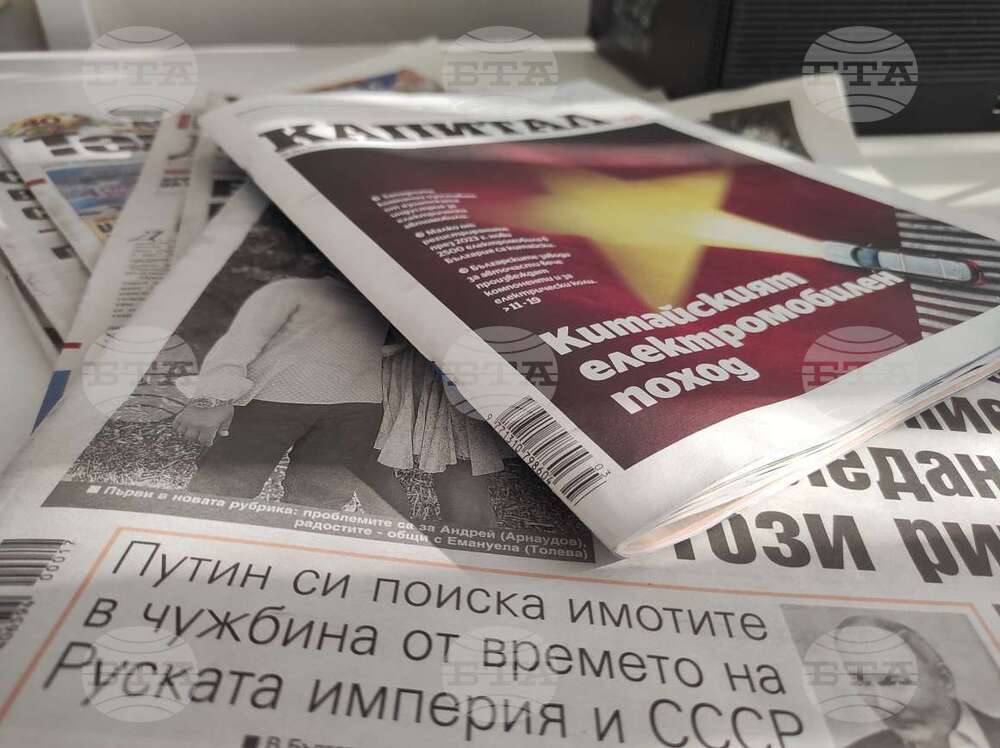
FINANCIAL TIMES: IRAN EYES TARGETING US MILITARY ASSETS IN EUROPE IF TENSIONS ESCALATE
Dnevnik.bg and 24 Chasa reproduce a Financial Times report, citing people close to the Iranian regime, according to which Iranian officials and military planners have examined potential targets at American military facilities in southeastern Europe, including Bulgaria.
Bulgaria is explicitly mentioned in the article, which refers to U.S. facilities, or local military infrastructure, used by the Pentagon in Southeastern Europe. Sources cited by the Financial Times clarify that this involves only preliminary assessments and evaluations, rather than decisions having been made to launch attacks in Europe.
Bulgaria falls within the range of Iran's long- and medium-range ballistic missiles, although a significant number of these missiles were destroyed in Israeli-American strikes after February 28. To reach Bulgarian territory, they would have to pass through the territory of NATO member states—unlike a similar strike against Jordan. Moreover, as the distance from Iran increases, there are additional challenges involving warhead size and the accuracy of the missiles.
For this reason, analysts quoted by the FT point to groups in Iraq, Lebanon, and Yemen that are supported, armed, and trained by Iran. Their members could potentially attempt acts of sabotage from a closer distance.
Bulgaria has allowed up to eight U.S. aerial refueling aircraft to be stationed at Bezmer Air Base from July 24 to October 1.
On Sunday, the Wall Street Journal also cited Iranian and Arab sources in an extensive report saying that the two-month ceasefire, which expired on Monday, had been used by Tehran to prepare for and adopt an even harder-line position, rather than pursuing negotiations to end the war.
LAW ENFORCERS DETECT 56,000 CASES OF CHILD SEXUAL EXPLOITATION ONLINE IN SEVEN MONTHS
Dnevnik.bg writes that more than 56,000 pieces of material related to child sexual exploitation were reported and removed from the internet during the first seven months of 2026. During the same period, the Ministry of Interior registered 811 cases of online threats and 129 reports of sexual extortion.
The data were provided by the Interior Ministry in response to an inquiry from Dnevnik.bg following the killing of 37-year-old Georgi Kuzev in Plovdiv, allegedly carried out by a group of minors, who styled themselves after paedophile hunters. The case sparked intense public debate about the role of social media, online content, and the digital environment in shaping teenagers' behavior.
In response to the questions, the Interior Ministry said that officers from its Cybercrime Directorate continuously monitor the online environment, tracking content related to sensitive topics on social networks, file-sharing platforms, and applications most commonly used by teenagers.
The police response did not identify any specific platforms, social networks, or applications, nor did it explain how the content on these platforms is monitored or reviewed.
Following the cases involving minors in Plovdiv in recent weeks, the ministry said it had expanded the scope of its checks and strengthened cooperation with other institutions and partner organizations. The ministry said this was done on the orders of Interior Minister Ivan Demerdzhiev, who called for stricter monitoring of unlawful activities and the distribution of illegal content online.
The head of the Cybercrime Directorate, Senior Commissioner Vladimir Dimitrov, also took part in a meeting at the Council of Ministers devoted to measures to prevent juvenile crime.
The data provided to Dnevnik.bg show that the largest share of the violations detected involved material constituting child sexual exploitation.
For the period from January 1 to July 31, 2026, the Ministry of Interior reported that the following content and incidents had been reported and removed:
· Illegal content from social networks and websites, including Facebook pages and profiles (involving violence, harassment, and other types of prohibited content) – 170
· Online threats – 811
· Online sexual extortion – 129
· Materials constituting child sexual exploitation - 56,067
· Distribution of fake news – 65
· Materials constituting terrorist propaganda online, including religious extremism and ethnic hatred – 62
· Platforms distributing phishing scams and advertisements intended to defame or discredit individuals – 36.
The ministry's response does not clearly indicate whether these figures refer to removed profiles, individual posts or pieces of content, or the total number of cases handled by the General Directorate for Combating Organized Crime.
The Ministry of Interior said that officers from its Cybercrime Directorate regularly send inquiries to foreign companies that operate various social networks and applications whenever illegal content is identified. However, some of these requests go unanswered, which makes the police's work more difficult.
BULGARIA UNABLE TO TAKE ADVANTAGE OF e-EVIDENCE REGULATION
Sega.bg writes that Bulgaria is missing out on the digital revolution in criminal investigations, as it has made no meaningful progress in adopting the legislation needed to implement the e-Evidence Regulation (2023/1543), which entered into force on August 18. The issue was highlighted by the newly established Association of Independent Prosecutors.
Under these rules, law enforcement authorities in EU member states gain two powerful tools: a European Production Order, which allows investigators to request electronic evidence directly from service providers; and a European Preservation Order, which requires service providers to preserve data, preventing it from being deleted or altered until a formal request for its disclosure is made.
The standard deadline for receiving the requested data is 10 days, while in urgent cases it is 8 hours. By comparison, the previous procedures typically took between four months and nearly a year.
Authorities may request: subscriber information, user identity data, traffic (metadata) records, and the content of communications. For requests involving traffic data and content, prior judicial authorization is required.
Although EU Member States had three years to prepare for the new framework, Bulgaria is not ready for the change. The country has not adopted the necessary legislation, has not implemented the JUDEX digital IT system, and has not trained judges and prosecutors to use it.
Sega.bg reports that the European Commission recently organized training on JUDEX, but only a small—and wholly insufficient—number of Bulgarian prosecutors took part. As for the legal aspects of the new framework, no training has been provided at all.
A recent example of where these new tools could prove valuable is the investigation into the murder of 37-year old Georgi Kuzev in Plovdiv, as well as investigations involving various radical and neo-Nazi groups and so-called "paedophile hunters."
The European Commission has already launched infringement proceedings against Bulgaria over the delay. As a result, not only are Bulgarian citizens deprived of the additional protections offered by the new framework, but the country also faces the risk of financial penalties for failing to comply with EU law.
The European Union gave Member States a three-year transition period to prepare. In Bulgaria, the Council of Ministers proposed amendments to the Criminal Procedure Code only in May 2026, but no law has yet been adopted. Bulgaria is not alone in its delay, however: nine other Member States are in a similar position, while only ten countries are fully prepared to implement the new framework.
PROGRAMME ENCOURAGES RELOCATION TO SMALLER TOWNS
Segabg.com and Trud.bg report that starting this autumn, Bulgaria will introduce financial incentives for people who relocate from large cities to smaller towns and municipalities under the second stage of the I Choose Bulgaria programme, which already provides financial support and bonuses to Bulgarians returning from abroad.
The project is funded by the European Union and is expected to begin this autumn, Labour Minister Nataliya Efremova announced on Tuesday in an interview with BGNES. The measure will not be limited to young people. Instead, its aim is to encourage internal migration from larger cities to smaller communities by offering targeted financial incentives to those willing to relocate.
According to the minister, the initiative is not intended solely to address labor shortages. Smaller towns can also offer cleaner air, better conditions for raising children, a more peaceful lifestyle, and closer access to nature, she said.
A review by Sega.bg of Bulgaria's ISUN (Information System for Management and Monitoring of EU Funds) shows that the incentives will be largely similar to those offered under the programme for Bulgarians returning from abroad. The second component of I Choose Bulgaria is expected to benefit around 1,200 people.
The programme will provide labor market services to people already living in Bulgaria who wish to relocate and start work in municipalities with a population of fewer than 50,000 residents.
The Employment Agency will assist participants by assessing their skills and helping the find suitable employment. Financial assistance will also be available for transportation of household belongings to the new place of residence; housing costs for up to 12 months; commuting expenses.
Perhaps the most notable feature of the programme is that participants will once again be eligible for one-time financial bonuses after six months and again after twelve months of continuous employment in Bulgaria, including for those who become self-employed.
In addition, the programme will provide subsidized employment for up to 12 months.
The Ministry of Labour and Social Affairs said that priority in the approval process will be given to professions that are in critical shortage in particular regions, such as teachers, doctors, and nurses.
BUSINESS CALLS FOR REOPENING OF URANIUM MINES
Sega.bg reports that the Bulgarian Chamber of Mining and Geology has developed proposals to restart the extraction of critical raw materials and rare earth metals and is seeking government support. According to the Chamber, it has already discussed the future development of uranium, tungsten, and manganese mining in Bulgaria with Prime Minister Rumen Radev.
The announcement was made by Nikolay Valkanov, Chairman of the Bulgarian Chamber of Mining and Geology, during an event marking Miner's Day.
"The European Union is providing funding for the development of critical raw material deposits, but Bulgaria is not taking advantage of these opportunities. I hope that together with Energy Minister Iva Petrova and Prime Minister Rumen Radev we can begin working in this direction," Valkanov said.
Energy Minister Iva Petrova responded that the government is prepared to work jointly with the industry to develop a national programme for exploring and assessing Bulgaria's potential for extracting strategic and critical raw materials, including rare earth elements.
She added that the government intends to encourage exploration for new mineral deposits as well as opportunities for the extraction of high-value by-products.“ Geological surveys and assessments of the economic potential for extracting critical raw materials are already underway in the East Maritsa Coal Basin,” said Minister Iva Petrova.
Coal samples are being analyzed to determine the quantities and feasibility of extracting valuable elements such as germanium, lithium, gallium, and graphite.
At the beginning of the year, a cooperation agreement was signed for this type of research between the Bulgarian Energy Holding, the Bulgarian Academy of Sciences, and Mini Maritsa-Iztok.
Some of the samples will be sent to the University of North Dakota (USA), where an innovative technology is being tested to extract a concentrate of rare earth elements and produce purified, high-calorific-value coal.
According to the Chamber of Mining and Geology, Bulgaria's most important critical raw materials at present are uranium, tungsten, and manganese.
"Bulgaria possesses uranium deposits, but uranium mining was halted by a government decision more than 30 years ago. At the time, the reasons were low economic viability and environmental concerns. Today, however, technological advances make it possible to mine uranium safely, both for the environment and for workers," Valkanov said.
For this reason, the mining industry is urging the government to reconsider the long-standing ban on uranium mining and to reopen the sector through a system of mining concessions.
During the 1980s, more than 40 uranium mines were in operation across Bulgaria.
Another important critical metal is tungsten, which is used in electronics, advanced technologies, and the defense industry. In Bulgaria, the main deposits are located in the Western Rhodopes. The Bulgarian Chamber of Mining and Geology also pointed out that Bulgaria is home to one of the largest manganese deposits in Europe.
NEW FORMULA FOR SETTING MINIMUM WAGE
"The current formula is certainly a positive improvement. The social partners and the government have attempted to reflect economic developments more objectively. There is now a component for labor productivity and one for the cost of living," said Georgi Vuldzhev of the Expert Club for Economics and Politics (EKIP) in an interview on Bulgarian National Radio.
He commented on the new formula for and the indicators used to calculate the minimum wage, the 2027 state budget, the government's programme, and whether cash will be enshrined in the Constitution.
Of the four indicators used to determine the minimum wage, he said he would give priority to the median wage as the objective component, rather than the arithmetic average wage used previously.
"This is the most positive change, and perhaps it would be better if the calculation were based solely on the median wage, but that is a technical detail," he explained.
However, he criticized the inflation component. "My concern, which is also shared by the trade unions, is that the formula uses inflation from a previous period. In my view, it would be better to use forecast inflation figures, because during economic shocks such as the current one, this can result in a lag. If forecasts are used, an average of the projections by the IMF, the European Commission, or the Ministry of Finance could be taken."
He commented that the government's program lacks specific details, despite its positive pledges regarding investment and a high-tech economy, as well as some good ideas for reforms:
"But it is set out without any specifics. They list reforms and indicate that they will be implemented over the full term of the government, but there are no quantitative targets linked to these intentions. As for the deficit, the aim will be to keep it below 3% of GDP. In my view, that is not ambitious enough."
Under the new mechanism changes in four equally weighted indicators will determine how much the minimum wage may increase. The Price Index of a Small Basket will be used to determine the purchasing power of the minimum wage while taking the cost of living into account. The gross median wage will determine overall wage levels and their distribution, while the average gross wage will determine the rate of wage growth. Gross value added per person employed over the past 10 years will determine the country's long-term labour productivity levels.
/PP/
news.modal.header
news.modal.text