site.btaMedia Review: August 18
HEADLINES
Bulgarian media on Tuesday focus on economic and social issues, including pensions, the minimum wage and consumer prices, alongside assessments of the Government's first 100 days in office. Other prominent topics include public safety, infrastructure, the activities of the Blood & Honour organisation, preparations for Eurovision 2027 in Burgas, and environmental issues.
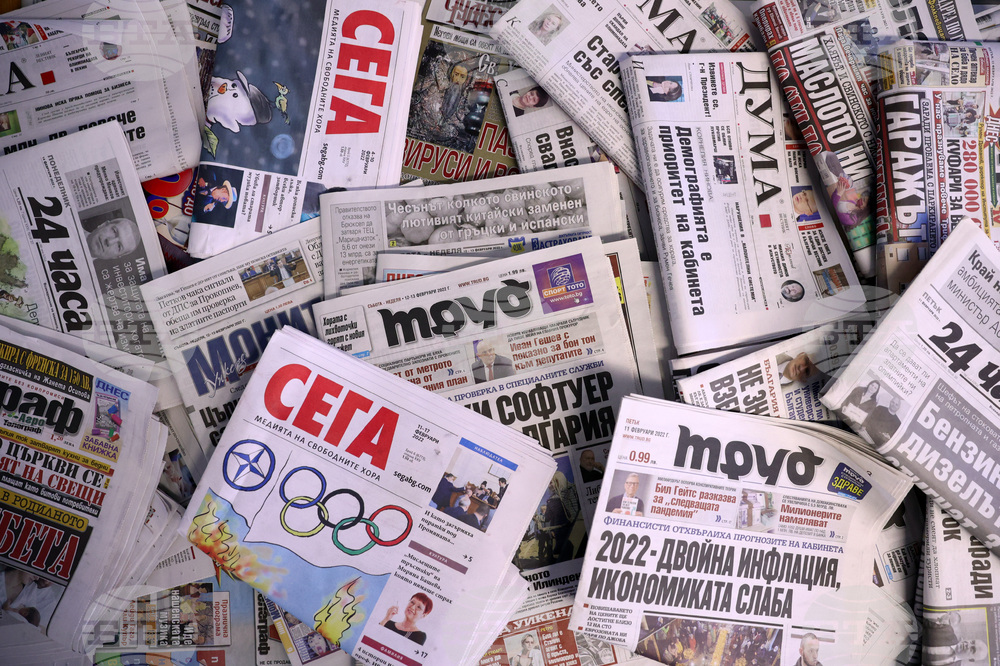
Print media focus on consumer prices and pensions, with the three newspapers leading on different aspects of household finances and living standards. 24 Chasa's main front-page story is headlined "End to Tricks with Product Weight - EUR 2.90 for 450 g Is More Expensive than EUR 3 for 500 g". Trud leads with "EUR 1,030 Pensions Needed for Quality Life", while Telegraph's main headline reads "800,000 Pensioners Receive State Subsidies".
Among the main interviews in Tuesday's print media, 24 Chasa talks to Irina Dakova, who says the Bulgarian National Television (BNT) should explain why Burgas was considered the better choice for Eurovision and that an official letter has been sent on the matter. Trud interviews Nikolay Valkanov, who calls for state-level decisions concerning the extraction of strategic raw materials such as uranium, tungsten and manganese. Telegraph features former Sofia police drug officer Petar Petkov, who discusses the ease with which drugs can be ordered online.
Tuesday's morning programmes focus on the first 100 days of the Radev Cabinet, the minimum wage, consumer prices and preparations for Eurovision 2027 in Burgas. Other topics include international security, wildfires, road accidents and criminal incidents.
Bulgarian National Television (BNT) reports on new sanctions of up to EUR 100,000 for unjustified price increases and the continuing high wildfire risk. Its morning coverage also includes the military objectives of ongoing conflicts, archaeological finds along dried-up sections of the Danube, preparations for Eurovision 2027 in Burgas, and Bulgaria's rhythmic gymnastics ensemble.
bTV discusses the first 100 days of the Radev Cabinet, with assessments of the budget, foreign policy and reforms, as well as the role of labour productivity in determining the minimum wage. The programme also looks at the Blood and Honour group and features the "Euroseagull", a proposed mascot for Eurovision 2027 in Burgas.
Nova TV also examines the Radev Cabinet's first 100 days and the expected level of the 2027 minimum wage. Other reports cover a crash near Burgas that left several people injured, an investigation into the death of an unborn baby in Varna, and the beating of a child at a stadium in Sofia.
The morning interviews of the Bulgarian National Radio (BNR) discuss the mechanism for setting the minimum wage and the requirement to assess its adequacy every three years. The programme also looks at Bulgaria's removal from the US Special 301 Watch List following the shutdown of Zamunda, ArenaBG and Zelka, the management of the Bulgarian section of the Danube, and preparations for Eurovision, with a focus on attracting visitors and encouraging them to return.
ECONOMY
The minimum wage and the mechanism for determining it are among the economic topics discussed by the broadcast media on Tuesday. bTV focuses on the role that labour productivity should play in setting the minimum wage, while Nova TV reports that the minimum monthly wage for 2027 is expected to be between EUR 620.20 and EUR 677. Bulgarian National Radio looks at the mechanism itself, reporting that the minimum wage will be determined annually, while its adequacy will be reviewed every three years.
bTV's morning programme reported that trade unions and employers have made progress in negotiations on a new formula for setting the minimum wage, reaching agreement on criteria including purchasing power, wage growth and labour productivity, although talks are continuing over the weight to be given to each factor. Economists Nikola Filipov and Petar Ganev argued that labour productivity should play a leading role in the mechanism. They also pointed to significant differences between sectors and regions, warning that a uniform national formula could create distortions. Ganev additionally highlighted insufficient representation of some sectors in negotiations between employers and trade unions.
Nova TV's morning programme focused on the parameters being discussed for 2027. Association of Industrial Capital in Bulgaria Executive Director Dobrin Ivanov said the minimum wage would be negotiated within a range of EUR 620.20 to EUR 677, with the Government determining the amount if employers and trade unions fail to reach agreement. Under the proposed mechanism, the current minimum wage would form the lower threshold, while the upper threshold would be calculated using four indicators. Former Podkrepa economic adviser Vanya Grigorova argued that the cost of living should be among those indicators.
The Bulgarian National Radio discussed the proposed mechanism with former social minister Hristina Hristova. She stressed that the minimum wage would continue to be determined annually, while the adequacy of the mechanism would be reviewed every three years. Hristova said the four indicators under discussion include the purchasing power of the minimum wage relative to the cost of living, measured through inflation for the lowest-income households. She also highlighted the comparatively large proportion of workers receiving the minimum wage in Bulgaria, which she put at 20%-25%, and suggested that the figure may partly reflect undeclared employment.
* * *
24 Chasa's front-page story focuses on new rules for assessing whether increases in the prices of goods and services are justified. A methodology published for public consultation by the Economy, Investment and Industry Ministry sets out the factors that traders may use to justify higher prices, including increased supply, production, labour, energy and raw-material costs, while general references to inflation, higher profit margins or competitors' prices will not suffice. Traders will have to document the specific effect of higher costs on the price of the product concerned. The daily notes that changes in a product's name, packaging or quantity will not circumvent the checks: for example, reducing a product from 500 g at EUR 3 to 450 g at EUR 2.90 would constitute a price increase when calculated per unit of weight.
The issue is also covered by BNT, where acting Consumer Protection Commission (CPC) Chair Aleksandar Kolyachev discusses ongoing checks on traders. He said the main violations identified in connection with the introduction of the euro concern labelling, insufficient consumer information and unjustified price increases, although the Commission has not observed an alarming overall trend. The CPC is currently examining around 1,000 goods at 140 retail outlets where prices have increased, with particular attention being paid to food and pharmaceutical products. Kolyachev said the Commission has observed significant increases in the prices of some medicines and food supplements in a particular pharmacy chain, prompting further scrutiny. Under recently expanded powers, sanctions for unjustified price increases range from EUR 10,000 to EUR 100,000 per product and retail outlet.
CRITICAL RAW MATERIALS
Mediapool devotes a series of articles on Tuesday to Bulgaria's mining industry and the growing importance of critical raw materials. The coverage looks at the industry's performance in 2025, Bulgaria's increasing reliance on imported mineral resources and the potential of resources that remain unexplored in the country. Other articles examine the state's interest in tellurium, antimony and other rare elements, Europe's efforts to turn its critical-resources ambitions into industrial results, and the role of technology and decarbonisation in the future of mining. The series also looks at technological developments at the Asarel and Chelopech mines and at the wider impact that mining operations can have beyond the extraction of resources.
Trud carries an interview with Bulgarian Chamber of Mining and Geology Chair Nikolay Valkanov, who argues that Bulgaria needs state-level decisions to develop domestic deposits of strategic raw materials. He identifies uranium, tungsten and manganese as particularly important resources and calls for a comprehensive assessment of the country's deposits and a national list of strategic raw materials reflecting Bulgaria's resources and economic needs. According to Valkanov, legislative changes may also be necessary to facilitate exploration and extraction while complying with existing requirements.
Valkanov argues that the 1992 decision to discontinue uranium mining should be reconsidered in light of technological advances and stricter environmental standards, while recalling that a tungsten mining project near Velingrad was blocked following a Supreme Administrative Court decision in 2018. More broadly, he warns that many European deposits could be exhausted by 2035-2040 unless new ones are developed and says Europe needs to give greater priority to securing long-term supplies of mineral resources. He points to Africa as a region with significant reserves where China and Russia have already established a strong presence.
RADEV CABINET FIRST 100 DAYS
The first 100 days of Prime Minister Rumen Radev's government receive considerable media attention on Tuesday. 24 Chasa describes the adoption of Bulgaria's first euro-denominated budget as the cabinet's biggest achievement, while noting its record 5.7% deficit and criticism from the opposition. The daily also highlights extensive personnel changes in state institutions, measures against unjustified price increases and a foreign policy it describes as "multi-vector", including Radev's positions on Ukraine and Russia and relations with Türkiye. It notes that despite several controversies, Radev has retained relatively strong public support.
Commentators on bTV and Nova TV offer differing assessments. On bTV, political scientist Tsvetanka Andreeva criticises the budget, lack of reforms and what she describes as a pro-Russian foreign-policy turn, while VMRO's Aleksandar Sidi credits the government with bringing some political stability but says it has failed to curb rising prices. Georgi Lozanov argues that the government is distancing Bulgaria from its European and Atlantic partners. On Nova TV, sociologist Andrey Raychev gives the government's start a positive assessment, pointing to efforts to change the previous governance model, while political scientists Petar Cholakov and Rosen Stoyanov are more cautious about claims that entrenched oligarchic influence has been dismantled and criticise aspects of the government's public communication.
EUROVISION 2027
Bulgaria's preparations to host Eurovision 2027 also receive media attention on Tuesday. 24 Chasa interviews Sofia Municipality Culture Director Irina Dakova after Burgas was selected over Sofia, Plovdiv and Varna as host city. Dakova says the municipality has formally asked BNT for feedback on Sofia's bid and argues that greater transparency about the selection would help prevent speculation over the decision. She nevertheless stresses that Eurovision should be treated as a national rather than an inter-city competition and says Sofia is ready to support Burgas and plans to use the international attention surrounding the contest to attract visitors throughout 2027.
Speaking on BNR, Bulgarian Association of Hotel Management Professionals Executive Director Georgi Duchev focuses on the tourism opportunity, saying Bulgaria needs a strategy to turn the thousands of Eurovision visitors into returning tourists. He says the country has the necessary hotel capacity but stresses that the overall visitor experience, including restaurants, taxis and hospitality, will be important.
BNT looks at preparations in Burgas, where museums and galleries are planning exhibitions and activities to introduce visitors to the history and culture of the southern Black Sea region. The Regional History Museum is also considering rescheduling its Night of Museums programme, currently set for the day after the Eurovision final, to allow international visitors to attend.
bTV reports on proposals for the contest's mascot, focusing on the "Eurogull" put forward by the Burgas State Puppet Theatre, which has attracted attention on social media and from Eurovision-related media abroad.
/YV/
news.modal.header
news.modal.text