site.btaMedia Review: August 3
OVERVIEW
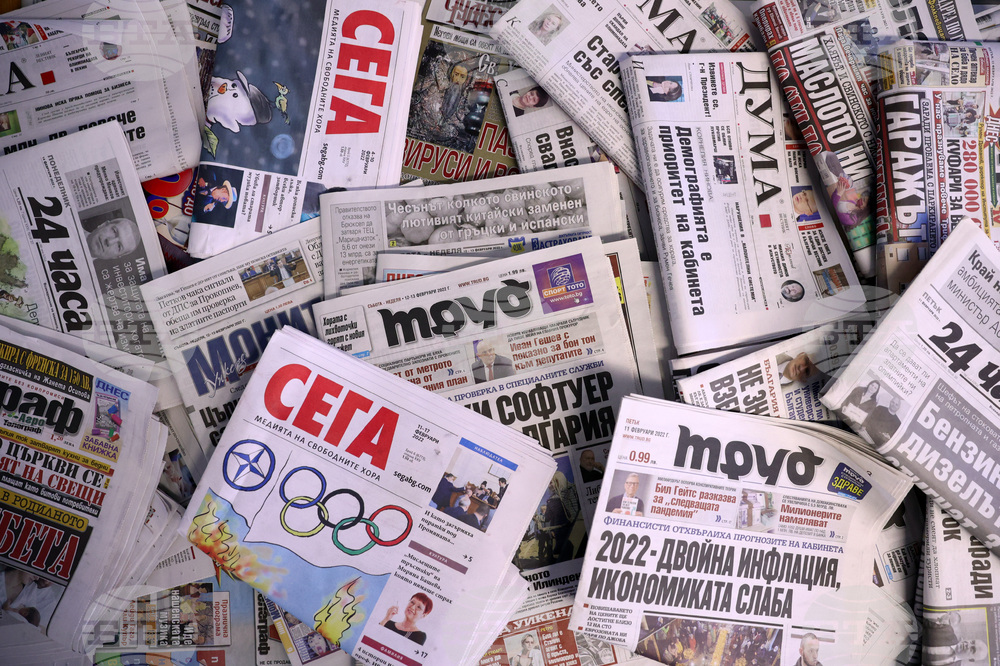
Monday’s media coverage focuses on the upcoming October 25 presidential election, with attention centred on possible candidates, divisions on the right and the shortened campaign period. Economic coverage highlights EU funding, planned changes to the pension and minimum-wage systems, while reports from the Black Sea coast point to weak tourist demand, falling accommodation prices and problems affecting the seaside environment.
PRESIDENTIAL RACE
Telegraph writes that the right-wing parties remain far from agreeing on a common candidate for the presidential election. Democratic Bulgaria (DB) MP Ivaylo Mirchev ruled out a joint DB-GERB nomination and says the candidate should probably be put forward by an initiative committee. The daily cites GERB leader Boyko Borissov who said GERB has potential candidates capable of reaching and winning the second round, but added that the party wants broader unity on important issues rather than a party-based arrangement. According to Borissov, GERB will discuss the presidential election in September. The daily adds that both Mirchev and Borissov criticize the Government over the Budget, with Mirchev warning that protests could follow in the autumn.
In an interview for Bulgarian National Television (BNT), Sofia University Faculty of Law Dean Daniel Valchev said he will not be running for president. "Since my name has also been thrown around in all sorts of configurations, my original plan was to announce in early September what I intended to do, but since there is too much talk about that, it seems right to say clearly what my intention is: I will not participate in the upcoming presidential elections either as president or as vice president", he said. He described President Iliana Iotova as the natural candidate backed by Prime Minister Rumen Radev and suggested that former caretaker prime minister Andrey Gurov could also enter the race. Valchev also said machine voting substantially reduces the risk of incorrect vote counting, but argued that the deeper problem is declining trust in the electoral process and representative democracy.
Mediapool.bg also covers Valchev’s decision, noting that GERB MP Vladislav Goranov recently said he would vote for him if he entered the race, while the Union of Democratic Forces (UDF) had publicly floated Valchev as a possible candidate. The site adds that his name had also been discussed as a possible option for Progressive Bulgaria, although the formation has since backed President Iotova.
Speaking on BNT’s morning programme, journalists Ruzha Raycheva and Veselin Stoynev also commented on the elections. Raycheva said the fact that only one candidate from the major parties had emerged so far showed “chaos on the right”. Stoynev noted that candidates reaching presidential run-offs in Bulgaria have historically been party nominees or candidates backed by political parties, making success considerably harder for genuinely independent contenders.
On bTV’s morning show, election experts Rumiana Decheva and Mihail Konstantinov discussed the latest changes to the Election Code, including machine voting in larger polling stations, paper ballots by exception, more polling stations abroad without a separate Abroad constituency, and higher fines for media violations. “I do not expect surprises,” Decheva said, arguing that the latest amendments are largely an attempt to return to earlier rules after years of frequent changes to the electoral framework. She said that over the past five or six years the rules had repeatedly been altered shortly before elections, sometimes in ways that distorted the system. Konstantinov was also critical of the constant revisions, saying voters would in practice cast their ballots in much the same way as five years ago.
Bulgarian National Radio aired an interview with political scientist Georgi Prodanov, who said the October 25 presidential election date substantially shortens the opposition’s effective campaign period. “With these dynamics, we could fix the situation for another term with Iliana Iotova as president,” Prodanov said. He expects a more politically tense autumn and says GERB-UDF remains important to whether a broadly backed right-wing candidate can reach the run-off. Prodanov also commented on Interior Minister Ivan Demerdzhiev’s focus on Movement for Rights and Freedoms Chair Delyan Peevski, saying that greater scrutiny of Peevski’s role could affect political and economic balances, although he is sceptical that the process will go far.
ECONOMY
24 Chasa features an interview with Deputy Prime Minister Atanas Pekanov, who said Bulgaria has received nearly EUR 900 million under the fourth payment from the Recovery and Resilience Plan, with another EUR 109 million linked to the accountability mechanism for the prosecutor general to follow. The funding covers 52 projects, including the completed HEMS medical helicopter system, STEM classrooms in 2,000 schools, stroke emergency treatment centres, new locomotives and metro trains. Pekanov said the Government also secured changes to the planned water-sector reform so that municipal consolidation will be encouraged rather than compulsory and the proposed water-meter fee will not be introduced. Pekanov adds that Bulgaria should see the proposed EUR 450 billion EU competitiveness fund as an opportunity, particularly in defence, artificial intelligence and space technologies, although he warns that concentrating funding among companies in Europe’s economic core could deepen regional disparities. He said Bulgaria will resist cuts to cohesion funding and supports simplifying European and national administrative procedures. Pekanov also says the next Bulgarian funding plan should prioritize industrial capacity, transport connectivity, skills, healthcare and incentives for medical specialists to work in underserved regions.
***
Trud writes that the Government is preparing a significant change to the pension system by removing payments that are not linked to recipients’ social-security contributions from the Public Social Insurance budget and converting them into social-support payments. The plan is outlined in a written parliamentary answer by Deputy Prime Minister and Minister of Finance Galab Donev, who says the Government wants to preserve the contribution-rights principle. The daily notes that pension expenditure is projected to increase by EUR 1.062 billion in 2027 and another EUR 1.037 billion in 2028, while the Public Social Insurance budget deficit is expected to reach EUR 6.739 billion and EUR 6.768 billion respectively. Donev says demographic ageing, longer life expectancy and a shrinking working-age population will place increasing pressure on the system.
Trud also publishes an analysis proposing a new mechanism for setting the minimum wage after the National Assembly decided to keep it at the 2026 level of EUR 620.20 until a replacement formula is developed. The article proposes combining the median wage and poverty line with changes in productivity and employment. Applied to 2027, the proposed mechanism would produce a minimum wage of between EUR 658 and EUR 721, depending on the economic scenario. The daily notes that the Labour Ministry has proposed sector-level minimum-wage bargaining, arguing that differences between sectors make a single national threshold uneven in its effects. The analysis nevertheless says a national floor and transparent statutory criteria would still be necessary, together with annual publication of median-wage data.
BLACK SEA COAST
24 Chasa writes that weak demand at Bulgaria’s Black Sea resorts has pushed hotels to launch discounts unusually early in August, with reductions commonly reaching 30–40%. Around 40 hotels in Sunny Beach, Ravda, Nessebar and the surrounding area did not open this summer, while hotels across both the northern and southern coast are offering sharply reduced all-inclusive packages and last-minute deals. Georgi Duchev, Executive Director of the Bulgarian Association of Hotel Management Professionals, says hotels are using a “Black Friday” approach to attract customers, but rising operating costs and the downturn in the German market are the larger problems. A terminated charter arrangement following the surge in kerosene prices cost the Bulgarian Black Sea coast about 120,000 German tourists in June, while National Statistical Institute data show a 15% year-on-year fall in that market. More than 70% of over 800 hotel managers surveyed by the association report worsening business conditions. Eight EU Member States, including Bulgaria, have asked the European Commission for support for tourism businesses affected by falling demand.
***
Telegraph reports sharp contrasts in prices along the Black Sea coast, with a doner in Old Nessebar costing as much as EUR 18 and some fast-food purchases reaching EUR 25, while an entire apartment near the beach in Pomorie can be booked for EUR 45 per night. The daily says accommodation providers in Pomorie and Varna are cutting prices or offering free upgrades in an effort to attract visitors. Telegraph adds that Bulgarian tourists continue to head to Greece despite the domestic discounts, reporting a 7-kilometre queue of cars at the Makaza border crossing on Saturday.
***
Nova TV reported that four dead dolphins were found along the coast near Shabla after tourists repeatedly alerted the authorities. A Romanian tourist said he had called the emergency number but the animals remained on the beach. Sanyal Krasteva of the Varna Regional Inspectorate of Environment and Water said an inspection found the dolphins in an advanced state of decomposition and no signs of human intervention that could have caused their deaths. The municipality was expected to remove and dispose of the carcasses under veterinary requirements. Nova TV reported that alerts concerning dolphins washed ashore along the Bulgarian Black Sea coast have increased since the start of the summer.
/MY/
news.modal.header
news.modal.text