Wrap-up
![PM Warns Bulgaria Faces EU Sanctions under Excessive Deficit Procedure, Opposition Reacts]()
![PM Warns Bulgaria Faces EU Sanctions under Excessive Deficit Procedure, Opposition Reacts]() Prime Minister Rumen Radev attends a government meeting in Sofia, May 29, 2026 (BTA Photo/Blagoy Kirilov)
Prime Minister Rumen Radev attends a government meeting in Sofia, May 29, 2026 (BTA Photo/Blagoy Kirilov)
site.btaPM Warns Bulgaria Faces EU Sanctions under Excessive Deficit Procedure, Opposition Reacts
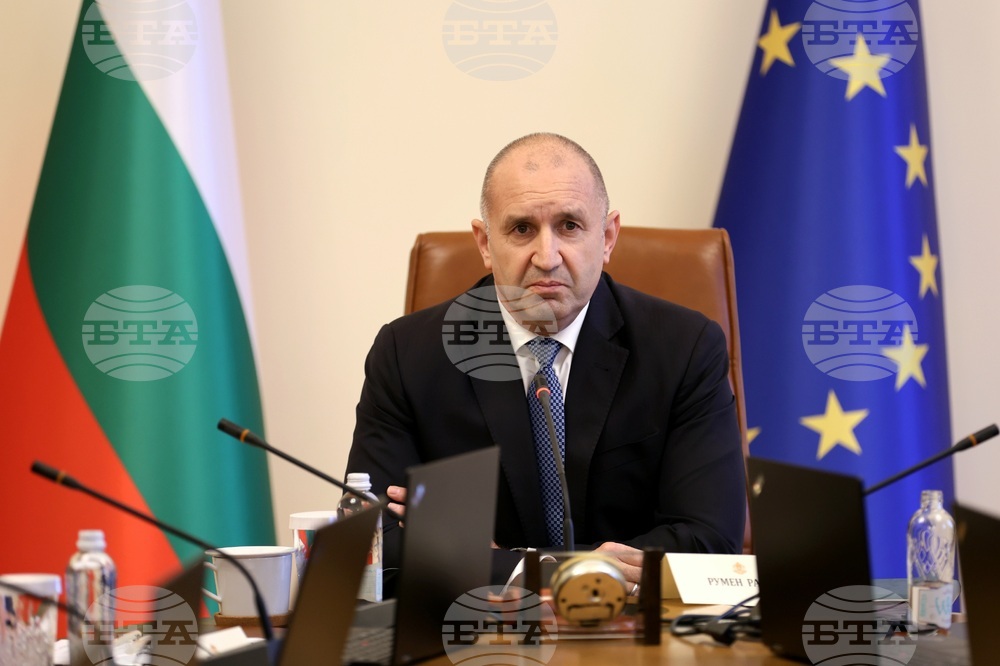
Prime Minister Rumen Radev Friday said that the European Commission would publish a report on June 3, launching an excessive deficit procedure against Bulgaria, which would lead to regular monitoring, restrictive measures and possible sanctions. "According to calculations and actual data submitted to the European Commission, last year's deficit was well above 3%, despite attempts to conceal it to achieve the goal of joining the euro area. This year, the deficit will be even larger,” Radev said at the start of a Council of Ministers' meeting.
He described the situation as a “difficult legacy” resulting from “negligence, incompetence, voluntarism, populism and financial misconduct.” According to the Prime Minister, financial manipulations had been carried out, state-owned companies had been decapitalized and liquidity had been withdrawn from businesses through advance tax collection. He also said public spending had been increased through public procurement contracts awarded at inflated prices.
He added that the government would do everything possible to return the budget to “normal parameters” in the coming years, although he acknowledged that the task would not be easy.
Temenuzhka Petkova, MP of GERB-UDF and former finance minister, urged Radev not to resort to "misinterpretations of facts", emphasizing that the claims regarding the state of public finances do not correspond to the actual data or to how they are assessed by European institutions. According to her, the focus of the procedure is not on current performance for 2025, but on the risks emerging in the medium term, including 2026, when there is no approved budget or comprehensive fiscal framework. Petkova noted that the deficit for 2025 is 3.5% of the gross domestic product, with Bulgaria applying a EU derogation related to defence spending. According to her, this allows the country to meet the requirement for a deficit of up to 3%, despite increased spending. She added that the data for 2025 has been officially reported and coordinated with the National Statistical Institute and Eurostat, so there can be no question of manipulation or differing interpretations of the underlying fiscal indicators.
Continue the Change (CC) Chair and former finance minister Assen Vassilev told journalists that as early as February, he had said that "with the revenues projected in this way, the 3% deficit target certainly would not be met - the budget was designed to prevent us from entering the eurozone and to bring down the government." He pointed out that the EC is reacting to facts that have already occurred. The way out of this situation is not taking on debt, but adopting this year's budget with realistic parameters and a 3% deficit. "Accordingly, the procedure will be terminated and there will be no consequences for Bulgaria. Realistic spending must be introduced and salaries in the public sector should not be increased by 50-60%, as was done with Budget 2025," he added. Asked whether Bulgaria had entered the eurozone through deception, Vassilev replied: "No, the eurozone report examines the deficit for 2024, since that is already a fact. The report was published in June 2025 and there was no way of knowing what the deficit for 2025 would be," he added. "The warnings were made not only by us, and we are now seeing the results of the reckless governance of the Zhelyazkov cabinet and GERB," Vassilev pointed out.
Ivaylo Mirchev MP of Democratic Bulgaria commented that everything different from keeping the deficit at 3% this year is an excuse to avoid real reforms and the need to take on more debt. He recalled that as early as 2025, DB warned that Bulgaria was likely to enter such a procedure because the budget deficit would exceed 3%. He added that the expectation now was for Progressive Bulgaria to propose a budget that would bring the deficit within that limit. Radev's remarks appeared to justify another year of a deficit above 3% and the accumulation of additional debt instead of implementing reforms and working towards a balanced budget in the coming years. Democratic Bulgaria proposes a package of centre-right measures aimed at preventing an excessive deficit. These include gradually removing pensioners from the Ministry of Interior system, requiring civil servants to pay their own social security contributions, and introducing electronic government while restructuring what he described as an oversized public administration.
Tsoncho Ganev MP of Vazrazhdane commented that his party had warned that joining the eurozone would be very difficult. Vazrazhdane pointed out to Radev at the time when he was president of Bulgaria that the country was entering the eurozone based on false data, but he paid no attention then, Ganev told reporters. The MP said that the Prime Minister must go and renegotiate Bulgaria's membership in the eurozone and cut spending related to Ukraine.
/DS/
news.modal.header
news.modal.text