site.btaMedia Review: February 11
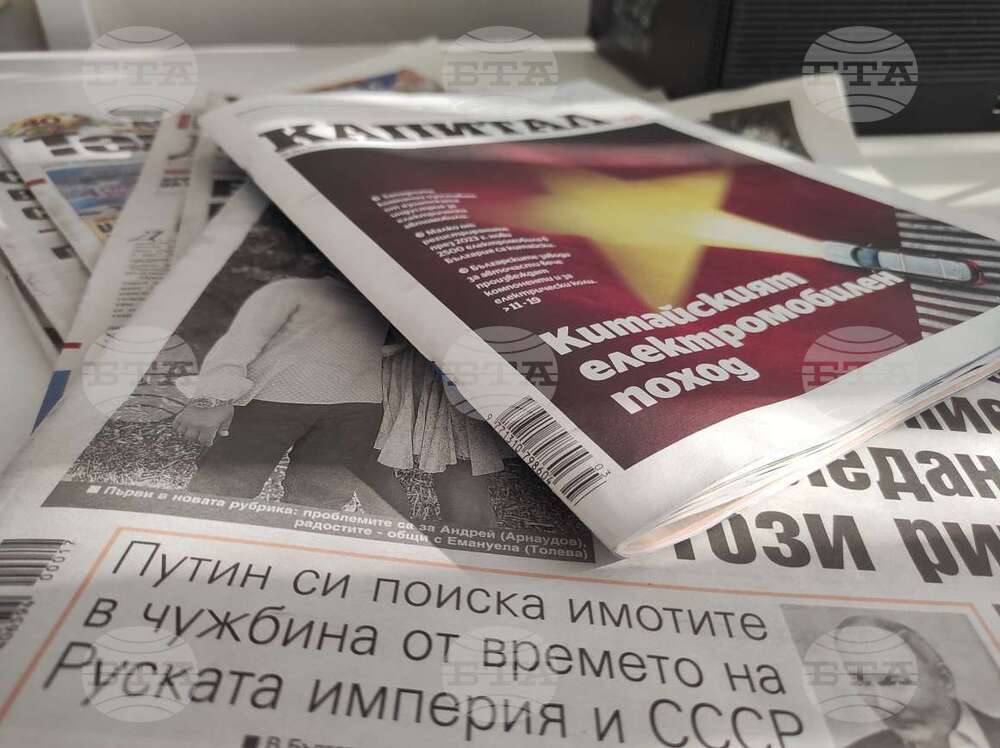
Wednesday's media is dominated by developments in the case of two triple murders, linked to an environmental group (the Petrohan case) and the run-up to the appointment of a caretaker cabinet.
THE PETROHAN CASE
Here is a summary of the most recent disclosures in relation to the case:
24 Chasa: 51-one year old Ivaylo Kalushev, the formal leader of the environmental organization, owned 21 properties across Bulgaria. In 2021, he purchased 0.5 ha of land near the Petrohan mountain lodge from the Ministry of Agriculture for BGN 4,918 (EUR 2,514). The deal was officially registered on December 13, 2021 - the first day in office for Ivan Ivanov from BSP, who was then minister and is now the outgoing Minister of Regional Development.
Sega.bg: The Bulgarian Registry Agency is launching an investigation into how companies and legal entities manage to register themselves with names containing “national agency” or similar terms that suggest they are state institutions.
The inquiry was prompted by the National Protected Areas Control Agency association linked to the Petrohan lodge and its residents, six of whom were recently found dead.
Outgoing Justice Minister Georgi Georgiev ordered the investigation to examine both the registration process of this particular association and other organizations, foundations, and companies whose names include phrases like “national agency” or “control agency,” which could create the impression that they perform government functions.
Sega.bg: The Prosecutor’s Office released data on the firearms registered in the names of the victims in the Petrohan case.
On November 1, 2021, a permit was issued in the name of Ivaylo Kalushev for the possession of two combat pistols, which were later found at the crime scene near Okolchitsa Peak.
In the name of Ivaylo Ivanov (who was found dead near the lodge along with Decho Vasilev and Plamen Statev), the Ministry of Interior issued a permit for the possession of 16 firearms, all on August 23, 2021.
On February 24, 2023, the Ministry of Interior issued a permit for the possession of one combat pistol to Nikolay Zlatkov.
Sega.bg: Democrats for Strong Bulgaria (DSB) leader Atanas Atanassov submitted a request for a joint closed-door meeting of the parliamentary Internal Security and Public Order Committee and the Security Services Control Committee over the case. He proposed hearing from Interior Ministry Secretary General Miroslav Rashkov and acting SANS chair Denyo Denev “given the sensitivity of the information and the need for institutional clarity,” arguing the hearing is necessary amid “growing public distrust” and Parliament’s duty to exercise “effective parliamentary control” in high-stakes cases.
Mediapool.bg: Stella Dimitrova-Maistorova, the mother of Ivaylo Kalushev, whose body was found near Okolchitsa Peak, told Bulgarian National Television that she is convinced of her son’s innocence and cannot believe he could have committed the acts reported in the media.
She expressed shock and regret, saying she had been happy when he returned from Mexico to live in Bulgaria and lamented the tragic outcome.
TrudNews.bg: Outgoing Environment Minister Manol Genov said on Bulgarian National Television that Ivaylo Ivanov, one of the members of the environmental organization, entered the Ministry of Environment and Waters building armed in 2022.
“We fund NGOs and carry out joint activities with them. With this so-called National Protected Areas Control Agency, there is a complete paradox. This agreement with them was concluded entirely against all rules, without an opinion from the ministry’s legal department, without an initiating letter. Someone just decided, and concluded the agreement. They were not members of Europarc – their registration came six months after this agreement. It is misleading for them to carry the name ‘national,’” he added.
“We have no information that this organization used funds under operational programmes, implemented by the Ministry. I heard speculation that this disappointed them,” the outgoing minister added.
“In our records, we do not have a single submitted report about an environmental violation from the organization,” he emphasized, adding that since 2022 no logging permits have been issued in the area of the Petrohan lodge, as the area itself is difficult to access.
“All subsequent ministers after the signing of the agreement tried to terminate the agreement with NAKZT. In the ministry there is tals that when they were invited, they surprisingly entered armed. I think this was in the summer of 2022. Eyewitnesses recount this. I believe Ivaylo Ivanov entered armed, and there were other people with him as well,” Genov further said.
TrudNews.bg: Speaking on bTV, former investigator Andrey Tsvetanov said that the motive for the deaths in the Petrohan case is still unclear, and that focusing on only one version of events eads nowhere.
He criticized the selective release of information and video footage, suggesting that what “the cameras did not show” could be important and that the public is being presented with a curated narrative.
Tsvetanov stressed that external involvement should not be ruled out and should be a leading line of investigation. He described eliminating this possibility as a biased approach.
RUN-UP TO CARETAKER CABINET
The Bulgarian National Radio reports that after completing consultations with parliamentary parties, President Iliana Iotova is expected to name a caretaker prime minister by the end of the week.
Over the span of two weeks, she met with all 10 potential candidates eligible to serve as caretaker prime minister, and then held talks with representatives of parliamentary groups in the 51st National Assembly.
Five candidates have confirmed their willingness to organize the upcoming elections: Bulgarian National Bank Deputy Governor Andrey Gurov, Deputy Ombudsman Maria Filipova, Chair of the National Audit Office Dimitar Glavchev, and his deputies Margarita Nikolova and Silvia Kadreva.
Once Iotova selects a candidate, she will grant them a mandate to form a caretaker cabinet. The nominee must then propose a government lineup for presidential approval.
The president’s decree appointing the caretaker government will also determine the date of the parliamentary elections for the 52nd National Assembly. A possible date is April 19, which would require the caretaker cabinet to be appointed by February 19 in order to organize the elections within the two-month legal timeframe.
***
24 Chasa writes that speaking on the morning programme of the Bulgarian National Television, former Bulgarian President Georgi Parvanov (2002–2012) described the current political landscape as dominated by a “triple model” represented by GERB leader Boyko Borisov, MRF-New Beginning leader Delyan Peevski, and ex-president Rumen Radev. He said that while they do not work together, they similarly hinder the development of Bulgarian politics and governance.
Parvanov noted that President Radev has not indicated an intention to represent left-leaning voters. He suggested that Radev’s anti-oligarchy and anti-mafia platform could have been more effective from the position of head of state, which provides more leverage than that of an emerging party leader.
Asked whom he would support in the upcoming elections, Parvanov said firmly that he would vote for the Bulgarian Socialist Party (BSP – United Left) and not for Radev. He expressed optimism about the new BSP leader, Krum Zarkov, describing him as young, energetic, intelligent, and principled, praising his past resignations as civil and dignified actions.
Regarding BSP’s past leadership, Parvanov commented that previous internal compromises and informal agreements with other political leaders, particularly with GERB, had negatively affected the party.
BULGARIA AND THE GAZA PEACE BOARD
Mediapool.bg writes that Bulgaria will miss the first meeting of President Donald Trump’s Gaza Peace Board. The outgoing cabinet has declassified its decision to join the initiative but is distancing itself from further steps, effectively passing responsibility to the upcoming caretaker government.
It has now become clear that outgoing Prime Minister Rosen Zhelyazkov was authorized to sign the organization’s charter while simultaneously notifying the United States that Bulgaria would not apply it temporarily. However, for the decision to take effect, it must be ratified by parliament. The outgoing government has refused to submit it for ratification, leaving the matter to the next National Assembly.
The Peace Board is expected to hold its first meeting in Washington on February 19. Although Bulgaria and Hungary were the only two EU countries to support Trump’s initiative, Bulgaria will not be represented at a high level. Meanwhile, Romania and Greece, which are not founding members, have been invited to attend.
According to MEP Radan Kanev, European People’s Party leader Manfred Weber said that GERB leader Boyko Borissov had explained that “special issues” between the US and Bulgaria led to the signing, but that the charter would not be ratified.
The government emphasized that signing the document does not create binding obligations for Bulgaria to participate in specific peace operations, nor does it grant the Peace Board jurisdiction over Bulgarian territory without explicit consent and constitutional procedures. Until ratification, the charter will not be applied, and Bulgaria may only participate in the Peace Council with an advisory (non-voting) role.
ECONOMY
Capital.bg reports that Bulgarian goods exports have declined for a third consecutive year. In 2025, exports totaled EUR 42.9 billion, which is 3.2% lower than the previous year, according to preliminary data from the National Statistical Institute. The weaker performance is mainly due to a significant drop in fuel and metal exports, although most other product categories also recorded decreases.
After a record year for Bulgarian exports in 2022, exports fell by 6.5% in 2023 and by a further 0.2% in 2024. However, the 2025 data are preliminary and may be revised upward as more information becomes available. For example, the initial estimates for 2024 showed a much larger decline than the final figures.
According to Sega.bg, a worrying trend in 2025 is that Bulgarian exports to EU countries, Bulgaria’s main trading partners, declined more sharply than exports to non-EU markets. According to National Statistical Institute data (available through November), exports to the EU fell by 4.6% year-on-year to about BGN 50 billion, while exports to countries outside the EU decreased by 2.2%.
Overall, exports to non-EU countries dropped by 2.2% in 2025, totaling BGN 30 billion.
The largest decline was recorded in fuels, down by 26. This was mainly due to reduced production and exports from the Burgas-based Lukoil Neftochim refinery. In effect, Parliament banned the refinery from exporting diesel starting in the summer of 2025 as a measure against what was described as “speculative” fuel price increases ahead of the introduction of the euro.
***
Speaking on Bulgarian National Radio, Georgi Parvanov, a board member of the Bulgarian Association for People Management and the Bulgarian Employment Confederation, said there is a clear trend of the middle class shrinking in Bulgaria. According to him, many people have run out of money after the holidays, restaurants are becoming emptier, poverty is becoming more visible, and more people are turning to quick loans.
He does not expect wage growth to reach last year’s 13–14%, although inflationary pressure is very strong. Unemployment may rise by 1–2%.
Compared to the same period last year, job postings have declined by about 6–7%, both on employment websites and at labor offices. There has been no significant economic effect beyond psychological concerns about prices and salaries in euros, and there is no notable influx of foreign investors.
There are still serious labor shortages in logistics and transport, as well as in manufacturing, industry, tourism, hospitality, healthcare, social services, education, and construction. Demand is strongest for mid-level technical and expert positions, while openings for top-level roles are decreasing. The labor market is short by fewer than 200,000 workers.
He also predicted that the number of foreign workers will remain similar to last year’s level of around 50,000. Most workers come from Kyrgyzstan, Uzbekistan, Nepal, and India, though recruitment is expanding to Africa, Vietnam, the Philippines, Indonesia, and even South America.
CABINET REDEFINES ENERGY POVERTY
TrudNews.bg writes that a new ordinance setting the criteria for identifying energy-poor households and vulnerable electricity consumers has been published for public consultation.
The previous regulation, adopted at the end of 2023, was never implemented in practice. The new draft is part of the steps toward full liberalization of the household electricity market. If the transition to market-based electricity prices for households had not been postponed, electricity bills would now be significantly higher.
Under the new rules, households will be classified as energy-poor if, after paying their energy expenses, their per capita income falls below the poverty line. For this year, the government has set the poverty line at EUR 390.63 (BGN 764) per person.
Energy costs will not be calculated based on actual electricity, heating, firewood, or pellet bills. Instead, they will be determined according to standardized energy consumption estimates, taking into account the energy characteristics of the home and the number of household members.
The draft regulation enables authorities to decide administratively each year which households qualify for energy poverty assistance and which do not.
NO PLANS TO INCREASE RETIREMENT AGE BEYOND 65
According to a 24 Chasa analysis, Bulgaria has no plans to increase the retirement age beyond 65 despite recommendations first by the International Monetary Fund and more recently by OECD Secretary-General Mathias Cormann. Many countries are increasing retirement ages due to aging populations, rising life expectancy, and growing pension costs. Denmark, for example, plans to raise its retirement age to 70 by 2040.
Bulgaria currently has 2,070,472 pensioners, with an average basic pension of EUR 466.04 as of February. Among OECD countries, only Greece and Luxembourg retire earlier than Bulgaria, at age 62.
Although the pension reform was supposed to be addressed in a government roadmap, political instability and the resignation of the government delayed the process. The outgoing social minister had guaranteed that the retirement age would not be increased, and given the ongoing cycle of elections, no political party is likely to propose such a measure.
There are two main reasons why Bulgaria is unlikely to follow the OECD’s recommendation. First, the country has not yet completed the pension reforms adopted in 2015, which envisage gradual increases in retirement age and required years of service. By 2037, the retirement age for men and women is expected to equalize at 65, after which it should automatically adjust based on life expectancy.
Second, life expectancy in Bulgaria remains relatively low compared to other European countries where retirement ages exceed 65. At age 65, Bulgarian men are expected to live another 14.6 years and women 18.8 years, compared to the EU averages of 18.3 years for men and 21.8 years for women.
At the same time, Bulgaria’s working-age population declined by 19.1% between 2011 and 2021. The median age of the workforce has risen significantly — from 41.5 years in 2010 to 45.7 years in 2024 - one of the fastest increases in the EU.
SOCIETY
Referring to Eurostat data, 24 Chasa writes that only 38% of Bulgarians have read at least one book in the past year. This places Bulgaria almost at the bottom of the ranking by this indicator, alongside Italy (35.4%), Cyprus (33.1%), and Romania (29.5%).
According to a national survey by Trend, nearly 43% of Bulgarians admit that they don’t read at all. In effect, this means that non-readers outnumber active book readers.
In the lead are Luxembourg (75.2%), Denmark (72.1%), Estonia (70.1%), Sweden (69.7%), and Finland (69.6%), where more than two-thirds of the population value books, and reading is a far more widespread habit than in our country.
Mid-ranking are countries such as France, Germany, Spain, Lithuania, and Hungary, where every second person read at least one book last year.
/PP/
news.modal.header
news.modal.text