site.btaTsar Samuel in History and Memory
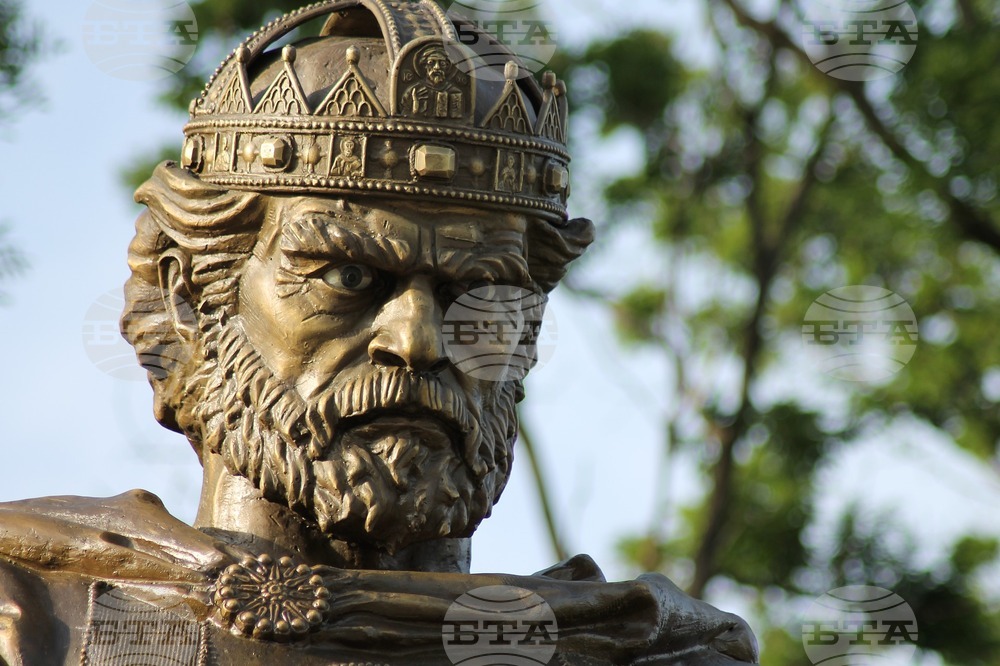
Tsar Samuel was one of the leading figures in the final decades of the First Bulgarian Empire and the first ruler of the Cometopuli dynasty.
He ruled Bulgaria in the late 10th and early 11th centuries, reigning as tsar from 997 to 1014.
Born between approximately 950 and 960, Samuel was the youngest son of Count Nikola and his wife Ripsimia. His three brothers, David, Moses and Aaron, were the other Cometopuli.
After the death of Tsar Peter in 970, Samuel governed Bulgaria jointly with his three brothers. When Tsar Boris II (970–971) returned from Constantinople, the four brothers recognized his authority. After Byzantium conquered northeastern Bulgaria and took Boris II prisoner in 971, they again assumed control of the free Bulgarian territories west of the Iskar River. Under this arrangement, Samuel governed the northernmost part of the country, centred on Vidin. In 976, he played an active role in overthrowing Byzantine rule, campaigning north of the Balkan Range. After the deaths of David and Moses, Samuel assumed leadership of the Bulgarian state. In 977, he welcomed Peter's son Roman to Vidin after his escape from Byzantium, recognized him as the legitimate Bulgarian tsar and became his commander-in-chief. The capital was moved to Skopje.
Between 977 and 983, Bulgarian forces under Samuel's command took control of Thessaly and captured Larissa after a three-year siege. On August 17, 986, his army routed the invading Byzantine forces at the Gates of Trajan Pass. His brother Aaron and Peter's son Roman also fought in the battle. Byzantine Emperor Basil II fled to Philippopolis (Plovdiv). According to chroniclers, his flight was so panicked that the imperial tent and regalia were abandoned and fell into Bulgarian hands. The victory strengthened Samuel's confidence in his army and consolidated his position as leader of the Bulgarian people.
In 991, Samuel fought another campaign against Byzantium, during which Roman was captured. In 996, he advanced as far as Thermopylae but was defeated at the Spercheios River on his return. After Roman's death in 997, Samuel was elected tsar because there were no direct heirs from Simeon's dynasty. He probably moved the capital to Prespa around this time and later to Ohrid.
Samuel's reign was marked by a prolonged struggle to preserve Bulgarian statehood against the Byzantine Empire. During his nearly 20 years on the throne, he resisted Basil II's attacks and inflicted serious defeats on him.
In 998, seeking to prevent Byzantium from securing Serbian allies behind Bulgarian lines, Samuel attacked the Serbian principality, subjugated the regions of Zeta, Duklja and Trebinje, and captured Serbian Prince Ivan Vladimir. Through diplomacy, Samuel secured recognition of his crown from the Holy See and an alliance with Hungary. He arranged the marriage of his son Gavril Radomir to a daughter of Hungarian King Geza. His daughter Kosara married Ivan Vladimir, whom Samuel reinstated as ruler of Zeta, while his daughter Miroslava married the captured Byzantine commander Ashot Taronites, whom he appointed governor of Dyrrachium.
Relations between Bulgaria and Byzantium deteriorated at the beginning of the 11th century. Byzantium reconquered northeastern Bulgaria in 1001 and Thessaly in 1002. In 1003–1004, Byzantine forces besieged and captured Vidin. To draw them away, Samuel campaigned in Eastern Thrace and seized Adrianople. Basil II captured Skopje but was repelled at Pernik with heavy losses. Samuel launched two campaigns against Thessaloniki. Hostilities continued until 1013 without a decisive battle.
To halt the Byzantine advance, Samuel's army built a broad defensive barrier, known as a dema, across the gorge between the Belasitsa and Ograzhden mountains, at the site of present-day Klyuch village near Petrich. On July 29, 1014, Byzantine troops outflanked the barrier and attacked the Bulgarians from the rear at the northern foot of Belasitsa, forcing Samuel to retreat. On Basil II's orders, some 14,000 captured Bulgarian soldiers were blinded and sent back to their tsar, with one man in every 100 left with one eye to guide the others. This cruelty earned Basil II the epithet Bulgar-Slayer.
Samuel died on October 6, 1014, after suffering a heart attack at the sight of his soldiers, who had been blinded following the battle near Klyuch.
Throughout his life, Samuel remained a steadfast defender of Bulgarian independence, statehood and the spiritual heritage inherited from his predecessors Krum, Boris and Simeon. His contemporaries described him as unmatched in strength and courage, a man who never knew rest.
The Only Medieval Bulgarian Ruler Whose Tomb and Remains Survive
Samuel is the only medieval Bulgarian ruler whose tomb and remains have survived. Greek scholar Nikolaos Moutsopoulos discovered his tomb in 1969 in the Basilica of St Achillios on the island of the same name in Small Prespa Lake, Greece. His remains have since been kept at the Museum of Byzantine Culture in Thessaloniki. Historians, archaeologists and Bulgarian institutions have periodically raised the question of their return to Bulgaria.
In December 2003, footage shot by a Bulgarian television crew on St Achillios Island in Small Prespa Lake, northwestern Greece, was shown for the first time in The Island of Tsar Samuel, a documentary by Goran Blagoev and director Ralitsa Dimitrova. In the film, Moutsopoulos, an archaeologist and Byzantine scholar, recounted the chance discovery of Samuel's tomb during excavations in Prespa in which he had taken part in the mid-20th century. He said Samuel was a Bulgarian tsar who died in 1014 on seeing his blinded soldiers. During excavations at the Basilica of St Achillios in 1969, Moutsopoulos uncovered four sarcophagi and suggested that one belonged to Samuel. Anthropological analysis of the bones believed to be his indicated that the man was about 1.60 metres tall and approximately 70 years old when he died.
At the end of the ninth century, one of the largest churches in newly Christianized Bulgaria was built on St Achillios Island on the orders of Prince Boris I the Baptizer. A century later, the island became Samuel's favourite residence, where he built his palaces. Around the same time, the church became the cathedral of the Bulgarian patriarch, who had been forced to seek refuge in the western reaches of the empire after the Byzantine conquest of Veliki Preslav. The island thus witnessed some of the most dramatic events marking the end of the First Bulgarian Empire. It is also notable as the burial place of another Bulgarian tsar, Samuel's son Gavril Radomir.
On March 15, 2004, a stone slab measuring approximately 65 by 70 centimetres was discovered in the courtyard of Stamen Vasilev's house in Samuilovo village near Petrich. It bore a three-line inscription identifying Samuel as tsar and autocrat of all Bulgarians, with a larger cross to the right of the text. Senior research fellow Stefan Smyadovski, one of Bulgaria's leading specialists in epigraphy, deciphered the inscription. He said the slab contained exceptionally valuable historical information despite the brevity of its text. Ten days later, it was donated to the History Museum in Blagoevgrad.
On February 13, 2007, Moutsopoulos presented the Bulgarian edition of his latest monograph, The Basilica of St Achillios at Prespa, at the Sts Cyril and Methodius National Library in Sofia. The book sets out his hypotheses concerning Samuel's tomb and includes a foreword by Vasilka Tapkova-Zaimova.
Published in Greek and other languages in 1999, the extensively illustrated monograph runs to more than 300 pages and brings together Moutsopoulos's research on Prespa. It examines the inscriptions in the central apse in detail, paying particular attention to a Greek inscription containing text from a psalm. Earlier researchers had dated and deciphered this inscription. Evidence from written sources led Moutsopoulos to suggest that the tomb belonged to Samuel. He also concluded that scattered bones in another tomb indicated that Gavril Radomir, who was killed in 1015, and his children had been buried there.
On October 6, 2014, President Rosen Plevneliev paid his respects before Samuel's remains at the Museum of Byzantine Culture in Thessaloniki and laid a wreath to honour one of Bulgaria's most remarkable medieval rulers. At Bulgaria's request, the remains were put on public display for the first time so that people could pay their respects on the 1,000th anniversary of his death. Plevneliev and his delegation toured the museum's exhibition, which included the Bulgarian ruler's shroud, woven with gold thread. Plevneliev said the event reflected the efforts of many Bulgarian politicians to build on the good relations between Bulgaria and Greece. He was accompanied during the visit by Greek Culture and Sports Minister Konstantinos Tasoulas and Macedonia and Thrace Minister Georgios Orfanos.
The Bulgarian delegation also included Culture Minister Martin Ivanov, former prime minister Simeon Saxe-Coburg-Gotha and Bulgarian Academy of Sciences President Stefan Vodenicharov.
A Council of Ministers decision of November 27, 2013 established a national committee and an organizing committee to prepare the 2014 commemorations marking 1,000 years since Samuel's death.
The commemorations culminated in October 2014 with a series of events exploring Samuel's life and times. The national campaign's main events took place on October 6, 2014, with Sofia hosting the central events in the national programme marking the millennium of the death of Samuel, who reigned from 997 to 1014. The campaign was organized by the national committee under then prime minister Georgi Bliznashki.
The Bulgarian Academy of Sciences (BAS) hosted a three-day international conference, The European Southeast in the Second Half of the 10th and the Beginning of the 11th Century: History and Culture, in its Great Hall. It brought together 65 scholars from Bulgaria and abroad, including prominent specialists in Byzantine and medieval studies from Europe and the United States. Near St Sophia Church in the capital, the site of a future monument to Samuel was blessed and its foundation stone laid in the presence of Bliznashki and Plevneliev. Patriarch Neophyte and clergy of the Bulgarian Orthodox Church held a memorial prayer service for Samuel at St Alexander Nevsky Cathedral. Book launches and other events across the country devoted to Samuel's era also marked the anniversary.
An issue of Za Bukvite – O Pismeneh, a newspaper devoted to Cyril and Methodius studies, was dedicated to the millennium of Samuel's death. It featured miniatures from the Manasses Chronicle and the Chronicle of John Skylitzes, assessments of Samuel's era by foreign historians, and articles by Tapkova-Zaimova, Petar Petrov, Plamen Pavlov, Anissava Miltenova, Iliya Iliev, Georgi N. Nikolov and Krasimir Krastev.
The national campaign concluded in Petrich on October 6, 2014, with a conference, the historical pageant Unblinded Memory at Samuel's Fortress National Park-Museum, and the premiere of 1014: The Last Year of Tsar Samuel, a documentary produced by the Radio and Television Centre in Blagoevgrad. A memorial service for the late ruler was held at the park-museum near Klyuch village. Participants included Neophyte, who was also Metropolitan of Sofia, and metropolitans of the Bulgarian Orthodox Church's Holy Synod. The commemoration of 1,000 years since Samuel's reign continued with a ceremonial military roll call and fireworks. Plevneliev reviewed the guard of honour formed by Bulgarian Armed Forces units and delivered an address on Samuel's achievements.
On June 8, 2015, a monument to Samuel (997–1014) was unveiled at a ceremony in the garden in front of St Sophia Basilica in the capital. Its location had been approved by the second caretaker government appointed by Plevneliev and headed by Bliznashki. The sculpture formed part of the programme marking 1,000 years since Samuel's death. The site was chosen on the basis of historical evidence that his father, Nikola, had been count of the Sredets region. Neophyte blessed the monument.
On October 3, 2024, President Rumen Radev awarded the Presidential Badge of Honour to historians Nikolov and Peter Schreiner for their overall contribution to the study of medieval Bulgarian history and Bulgaria under Samuel. Nikolov was also recognized for his role in consolidating and developing modern Bulgarian historical scholarship and its academic tradition. Schreiner was additionally honoured for his contribution to scholarly relations between Bulgaria and the Federal Republic of Germany. The ceremony formed part of the national commemoration of 1,010 years since Samuel's death, held under Radev's patronage.
On October 5 and 6, 2024, Petrich marked 1,010 years since Samuel's death with a series of events.
"It has been 1,010 years since the deeds of Tsar Samuel, a time of unprecedented, resounding victories for Bulgarian arms and a time of defeat, a time of heroism and upheaval. Yet that entire age is embodied in one of the most vivid figures of our past, a great and devoted defender of his homeland and the Bulgarian people," Radev said in an address at the ceremony commemorating 1,010 years since Samuel's reign at Samuel's Fortress National Park-Museum near Klyuch.
On October 5, 2024, a ceremonial military roll call and fireworks at the park-museum near Petrich marked 1,010 years since Samuel's reign. Radev reviewed the guard of honour and delivered an address in the presence of Bulgarian Patriarch and Metropolitan of Sofia Daniil, Petrich Mayor Dimitar Bruchkov, MPs, and MEPs Andrey Novakov and Andrey Kovatchev. Others attending included Blagoevgrad Regional Governor Georgi Dinev, Metropolitan Seraphim of Nevrokop, Metropolitan Naum of Strumica, mayors, municipal councillors and representatives of Bulgaria's research and academic community.
On October 6, 2024, the commemorations continued with an international conference at the History Museum in Petrich, entitled 1,010 Years since the Death of Bulgarian Tsar Samuel: Samuel's Bulgaria, History and Culture. It was organized by BAS, Sofia University St Kliment Ohridski, Petrich Municipality and the Macedonian Scientific Institute. Participants came from Bulgaria, Greece, Poland and Russia. A message from Radev conveying his greetings was read at the opening.
On September 29, 2026, Radev, by then prime minister, said at the start of a Cabinet meeting that a historic agreement had been reached on the return of Samuel's remains following intensive negotiations between Bulgaria and Greece. That same day in Athens, Greek Culture Minister Lina Mendoni and Bulgarian Culture Minister Evtim Miloshev signed a memorandum of understanding on the reciprocal transfer of relics of historical significance to the two countries. Under the memorandum, Greece will receive 48 ecclesiastical treasures originating from the Holy Mother of God Eikosifoinissa Monastery (Panagia Eikosifoinissa), the St John the Forerunner Monastery (Timios Prodromos) near Serres, and the Holy Metropolis of Serres and Nigrita. They were brought to Sofia in 1917 during the First World War and have been displayed or stored at Bulgaria's National History Museum. The relics returning to Greece will be exhibited at the Museum of Byzantine Culture until November 5, 2026, after which they will be handed over to their respective places of origin.
/KT/

news.modal.header
news.modal.text