site.btaOctober 2, 1996: Ex-PM Andrei Lukanov Is Assassinated
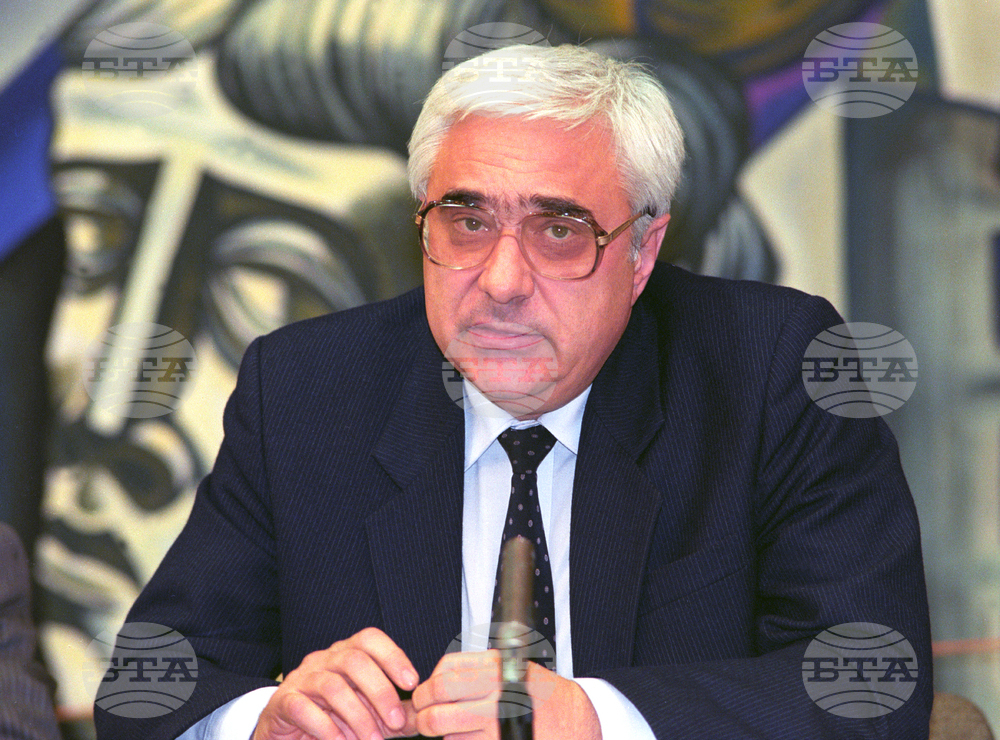
October 2, 2026, marks the 30th anniversary of the assassination of former Prime Minister, member of parliament and influential businessman Andrei Lukanov. The killer was never identified, and the case remains one of the emblematic unsolved crimes of Bulgaria's post-communist transition.
Andrei Lukanov was born on September 26, 1938, in Moscow, where his father, the communist emigre Karlo Lukanov, was living in exile. The family returned to Bulgaria after the communist coup of 1944, when Andrei was six, and his father later served as foreign minister from 1956 to 1961. Andrei studied at Moscow's Institute of International Relations, spoke Russian, English, French and Spanish, joined the party in 1963, and made his career in the foreign service and in the management of Bulgaria's foreign trade and credit relations, rising to deputy prime minister and minister of foreign economic relations.
On November 10, 1989, he was among the party insiders who removed long-time leader Todor Zhivkov from the leadership of the Bulgarian Communist Party. On February 3, 1990, he became prime minister. In March 1990, barely a month into office, his government declared a moratorium on the repayment of roughly USD 11 billion in foreign debt, a decision that cut Bulgaria off from Western credit. The communist party renamed itself as the Bulgarian Socialist Party (BSP) that spring and won the country's first free elections in June 1990, but the economy was collapsing. After weeks of student protests and a general strike called by the Podkrepa trade union, Lukanov announced his resignation on November 29, 1990. On July 7, 1992, Lukanov was arrested by the UDF government of the day on charges of misappropriating public funds, accused in connection with decisions taken in the 1980s to grant aid and loans to developing countries, among them Cuba and Afghanistan. He was held until December 30, 1992, and the case never produced a verdict.
By 1996 Lukanov sat in parliament as a BSP MP and was a leading critic of his own party's prime minister, Zhan Videnov, in office since January 1995. The economy was in free fall. A grain crisis in 1995 had been followed in 1996 by a collapsing lev and soaring inflation, and a run on the banks. In the last week of September, the Financial Times reported, the government had been forced to triple interest rates to 300%, to put nine loss-making banks under special administration and to speed up the sale of state companies.
From May 1995 he chaired Topenergy, a Bulgarian-Russian joint venture to transport Russian gas and oil through Bulgaria to Turkiye and the southern Balkans, with a planned investment of around USD 500 million. In July 1996 he left the post abruptly and without public explanation. His successor, was Ilya Pavlov, head of Multigroup, the largest of the business groups then controlling large parts of the Bulgarian economy.
On October 2, 1996, Lukanov was due at the Topenergy office but was running late, and on that day, unusually, he had no bodyguard. According to a 2020 retrospective in the Bulgarian newspaper Telegraph, his usual guard, a former counter-terrorism commando, was not at work. He left the apartment building where he lived. The killer, disguised as a vagrant and hidden behind a rubbish container, fired from a distance of under two metres. Early press reports spoke of two shots to the head, or to the head and heart. Investigators later said an autopsy had found four wounds: three bullets in the back and one in the head. Nobody heard the shots clearly, and few saw anything beyond the body. Within a week Boyko Rashkov, chair of the National Investigation Service, told reporters that the killer had acted alone, using a nine-millimetre calibre weapon, and that one witness had seen his face clearly enough for a computer composite. Lukanov's close friend and political ally Andrey Raychev publicly blamed Videnov's circle in the BSP. Others pointed to Lukanov's links with the private business groups then dominating oil, construction, insurance, casinos and private security.
On November 7, 1996, according to the later court record as summarized by Telegraph, an 88-year-old pensioner checking his post box in a residential building in Sofia's Iztok borough found a canvas-wrapped Makarov pistol with a silencer hidden behind a radiator. Experts established that the silencer had been specially fitted to the Makarov, and probably not made in Bulgaria. The ballistics produced a surprise: the same weapon had been used to kill a Ukrainian, Sergey Shanin, in Sofia's Nadezhda district on March 6, 1996. Investigators began what they called "operational interviews" with Ukrainians in Bulgaria.
The breakthrough came almost three years later. On May 23, 1999, two Ukrainians, Aleksandr Akimov and Vladimir Shevchuk, were detained at the Kapitan Andreevo border crossing and named by the Interior Ministry as suspects. They in turn pointed to two compatriots, Aleksey Kichatov and Aleksandr Rusov. Further arrests followed: Yuriy Lenev, a driver working for the construction entrepreneur Angel Vassilev, on June 1, 1999, and Vassilev himself, arrested in Prague on June 4, 1999, and later extradited to Bulgaria. Vassilev's company, Kolonel, was described in the press as part of the Orion group of businesses which had close ties to Videnov. Vassilev's nephew, Georgi Georgiev, was also charged. Ukraine extradited Rusov and Kichatov in 2000.
Several of the suspects were held and questioned in a house in the town of Koprivshtitsa that the media dubbed the "House of Horrors". Lenev's account, later accepted by Bulgarian courts and by the European Court of Human Rights, was that after his arrest he was bundled into a minivan, handcuffed and hooded, and driven overnight to Koprivshtitsa, where he was questioned and confessed to acting as an intermediary in a plot to kill Lukanov.
The trial of the five opened in the Sofia City Court on November 14, 2001. All pleaded not guilty. During the proceedings, former president Zhelyu Zhelev testified in 2002 that he believed the killing had been organized by people from Videnov's circle. On November 28, 2003, the court found all five guilty and sentenced them to life imprisonment, relying heavily on the confessions. On appeal, the story reversed. The court heard expert evidence about how the confessions had been obtained, and on June 8, 2006, the Sofia Court of Appeal quashed the verdicts and acquitted all five, finding that Lenev had been subjected to torture. On March 15, 2007, the Supreme Court of Cassation confirmed the acquittals definitively.
The following are original news item from the Bulgarian News Agency (BTA)'s Home News Desk and English News Service:
MP Andrei Lukanov was shot in front of his home
Sofia, October 2, 1996 /BTA/ - The announcement of the murder of Andrei Lukanov, a member of parliament from the parliamentary group of the Democratic Left, Lukanov interrupted today’s parliamentary session. The Speaker of the National Assembly, Blagovest Sendov, announced from the parliamentary rostrum the death of the MP, who was shot in front of his home this morning. He called on the MPs to remain calm and adjourned the session. The official statement from the Ministry of the Interior, released a few hours later, states that Andrei Karlov Lukanov was shot around 9:20 a.m. in front of his home at 15 Latinka Street in Sofia, as a result of which he died at the scene.
The incident came as a surprise because there had been no reports of a threat to Andrei Lukanov’s life in recent months, said the head of the National Security Service, Gen. Dimitar Vladimirov, in parliament. He noted that Andrei Lukanov had been under security protection from February 1 through April 15 of this year, since during that period a specific threat had been made, but the matter had been clarified and the security detail was withdrawn.
***
Lukanov’s killer was dressed like a vagrant
Sofia, October 2, 1996 /BTA/ - The killer of Andrei Lukanov was dressed like a vagrant, according to all eyewitnesses to the murder of the former Bulgarian prime minister, who was shot in front of his home at 15 Latinka Street around 9 a.m. this morning.
***
Court Releases on Bail Lukanov Assassination Suspect, Interior Ministry Chief Secretary: Surprised
Sofia, June 15, 2006 (BTA) - The Sofia Appellate Court Thursday determined to release Angel Vassilev, charged in connection with the murder of former Prime Minister Andrei Lukanov, on a 10,000 leva bail. Lukanov was gunned down in front of his Sofia home on October 2, 1996, in Bulgaria's first assassination of a major political figure since before WWII.
Vassilev, a building contractor, is the latest in a series of persons charged or somehow implicated in the case who will leave the detention facility, after Ukrainians
Vladimir Shevchuk and Aleksandr Akimov and Vassilev's nephews Ivan Petrov and Georgi Georgiev. Yurii Lenev, formerly employed in Vassilev's Colonel Company, has also been granted bail but it is not clear whether he has deposited the money and has been released.
The court's determination concerning Vassilev is unappealable. He will be set free when he deposits the bail. Asked whether he will raise the money and when he will pay the bail, Vassilev said, "Ask my wife." This will most probably happen tomorrow, members of Vassilev's family told BTA. "I did not expect such a decision," Vassilev said after the determination was read.
"I have no comment on such determinations, I would not give any information to anybody," Oleg Yanev, an investigator in the case, told BTA. The supervising
prosecutor could not be reached for comment.
"Honestly, I did not expect such a determination, but I would rather not comment on the court's reasoning in substance," the Chief Secretary of the Interior Ministry
Bozhidar Popov told BTA. "I hope that this will not demotivate the police officers and the investigators who work on the case," he said. "A lot of efforts have been made and will still be made because the truth must triumph," General Popov said.
There is no risk of the suspect absconding, obstructing the investigation or committing another crime, and he has a clean criminal record, the court reasoned, setting bail Thursday.
"The charges are leakproof, the collected evidence convincingly suggest that Vassilev committed the crime of which he is charged, and the statutory two-year pretrial detention of the accused has not lapsed," case prosecutor Ivailo Simov argued. "Certain people found that 376 days were not enough to locate witnesses against me and to manipulate them the way they know," Vassilev told the court. "I am alive and well, I will not commit suicide, but I do not intend to stay where my suicide could be simulated," he added.
Ukrainians Aleksei Kichatov, Oleg Protsenko and Aleksandr Rusov are held in investigative detention in connection with the Lukanov case. The Interior Ministry alleges that Rusov is the hitman who shot the former Bulgarian prime minister.
***
Trial on Former PM Andrei Lukanov's Murder Opens November 14
Sofia, September 16, 2001 (BTA) - The case on the murder of former prime minister Andrei Lukanov goes to trial on November 14. Lukanov, who headed two Socialist cabinets after 1989, was shot dead October 2, 1996 in front of his home in Sofia. A 15-member panel of the Sofia City Court chaired by Georgi Georgiev will hear the case, BTA learnt from the Court.
The trial is to be closed as late as December 1 because of the bulky paperwork and the great number of witnesses and expertise involved. Five people have been charged with the murder of Lukanov: Ukrainians Alexey Kichatov, and Alexander Roussov, construction entrepreneur Angel Vassilev, hie nephew Georgi Georgiev, and Yuri Lenev, former employee in Vassilev's company's Kolonel.
The indictment reads that Vassilev, who is linked with the so called Orion circle, ordered the murder. With Lenev and Georgiev acting as intermediaries, a group of Ukrainian nationals living in Elin Pelin (near Sofia) was hired. Vassilev gave a big sum in dollars to Lenev who left the bulk in a bank vault and handed the remainder to Georgiev to give the Ukrainians in advance payment. According to the indictment, Lukanov's actual murderer was Roussov. Yuriy Kutepkin, who was later found dead, provided him with a gun. According to press reports, Kutepkin was killed by his own people.
The main testimony in support of the indictment belongs to Oleg Protsenko and Yuri Lenev. Protsenko has been called as a witness. He is detained because, together with Kichatov, he was charged with the murder of their compatriot Sergey Shanin in early 1996. Expertise showed that Shanin and Lukanov were shot with the same weapon, a Makarov with a silencer made in Karnobat (Southeastern Bulgaria).
Georgiev withdrew his initial testimony in support of the indictment, his lawyer Lyubomir Panayotov told BTA. At the hearings to determine the bail Roussov and Vassilev pleaded not guilty. Kichatov made some explanations during the investigation.
Kichatov and Roussov are been detained, Vassilev and Lenev were released on a 10,000-leva bail and recognizance not to leave. Georgiev too was released on a 10,00-leva bail, but was later arrested on another case.
The defendants' lawyers said it is not certain that the court will proceed with the trial at the November 14 sitting. Lawyers told BTA that the case will probably be adjourned, adding that the defence will probably avail itself of every opportunity to prolong the case.
/NF/

news.modal.header
news.modal.text