site.btaMedia Review: September 8
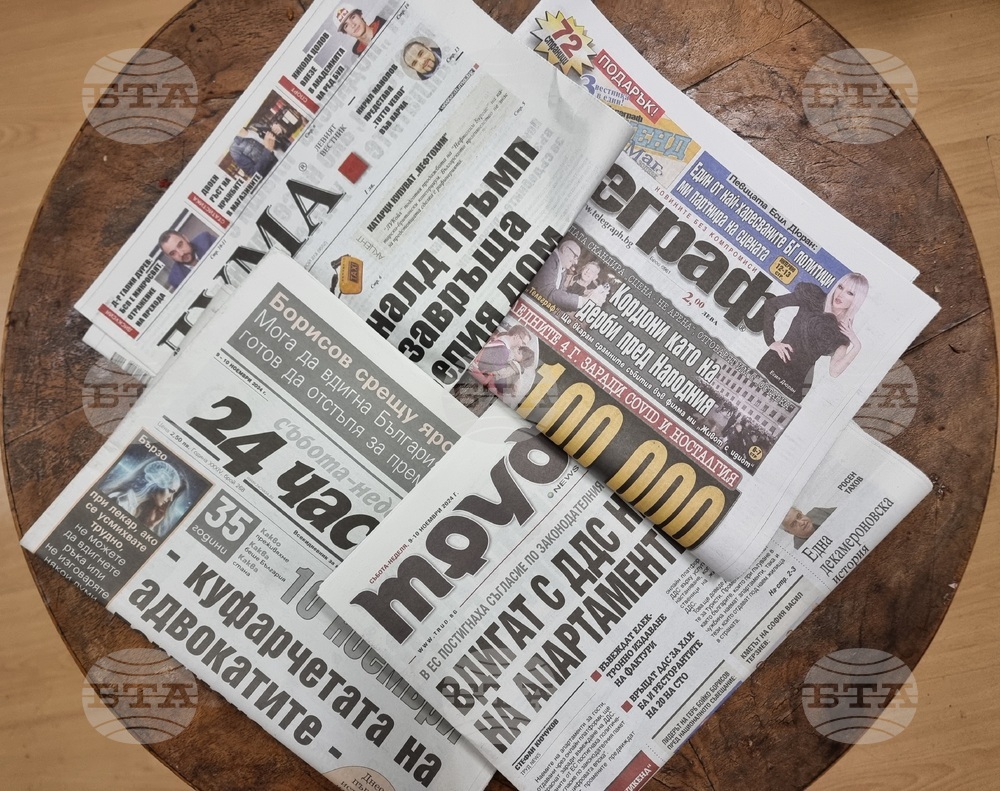
No single topic dominates Tuesday's news media.
POLITICS
On Bulgarian National Television's morning show, sociologist Boryana Dimitrova of Alpha Research and political scientist Dimitar Ganev of Trend discussed the role of initiative committees in the campaign for the presidential elections, as well the prospects of the leading candidates. According to Dimitrova, initiative committees are more of a tool for candidates to demonstrate broader public support than they are for actually nominating them; the deciding factor is the presidential candidate. Ganev underscored the importance of party support. According to him, over the past 35 years, the candidates who have reached the runoff have almost always been supported by the two major political forces. Dimitrova predicts a chance of over 50% that GERB will not field its own presidential candidate; both options that GERB leader Boyko Borissov has are bad: not participating, and participating but finishing third. According to Ganev, the outcome of the presidential elections could prove to be a serious test of GERB’s political standing. Dimitrova described the campaigns of Andrey Gurov and Georgi Kandev as more modern and geared toward younger voters - with a strong presence on social media. However, she pointed to Iliana Iotova’s high name recognition as a significant advantage. Ganev believes that Gurov and Kandev’s campaign will likely mobilize a significant portion of the democratic community, but the big question is whether it will succeed in attracting voters outside of it. According to the two analysts, the key question remains which of the candidates will be able to reach beyond their core party or political base and attract broader support.
On bTV’s morning show, political scientist Rumyana Kolarova commented that making predictions about the elections should be postponed until after Borissov announces whether GERB will have a presidential candidate or not. A lot depends on the first steps of Gurov and Kandev. Former MP Aleksandar Sidi commented that GERB running in the elections would make them more interesting, because the party has a chance given it came second in the parliamentary elections. He described as a mistake Borissov’s call on right-wing parties - Continue the Change and Democratic Bulgaria - for a joint candidate, as his voters would not like that given how Continue the Change were created to remove him from power.
***
On Nova TV’s morning show, analysts commented on the election victory of the far-right Alternative for Germany (AfD) party in Germany's eastern state of Saxony-Anhalt. According to Ivaylo Ivanov, member of the Managing Board of the Association of the Officers in the Reserve Atlantic (AORA), and Ruslan Trad, analyst with the Atlantic Council of Bulgaria, Russia is increasingly resorting to sabotage, disinformation, and other hybrid actions against countries that support Ukraine. According to Trad, the war has long since ceased to be fought solely on the front lines in Ukraine. In his view, hybrid operations are now part of the actual confrontation between Russia and the West, and the series of incidents involving critical infrastructure in Germany is a sign of a growing threat. He noted that such actions aim not only to cause material damage but also to instill fear and mistrust in societies. Ivanov also predicted that such operations will continue and are likely to intensify. In his view, Moscow is compensating for the lack of significant progress on the battlefield by applying pressure outside Ukraine - including through sabotage, subversion, and information campaigns in European countries. The analyst also noted that upcoming elections in a number of countries could become an additional target for attempts to exert influence.
***
Segabg.com reports that two more administrative structures have recently announced layoffs in response to the Government's directive to cut personnel costs by 10%. Unlike the planned changes to the healthcare system and the structures within the Ministry of Environment and Water, these cuts primarily involve eliminating unfilled positions, and no major disruptions are expected, the article reads. The Ministry of Labour and Social Policy has put to public debate proposed changes to the organizational regulations of the General Labour Inspectorate, whose regional offices are among the most important in the social sector, as they monitor compliance with labour laws. Fifty positions will be eliminated at the Inspectorate, reducing the staffing level from 650 to 600. This will be achieved through an internal reorganization of the specialized administration and the elimination of permanently unfilled positions. The Public Procurement Agency is also proposing changes to its organizational regulations. There, the reduction amounts to just five positions, with the position of financial controller being eliminated. Its functions will be assumed by existing staff at the Finance, Human Resources, and Administrative Activities Directorate, with the aim of reducing administrative and personnel costs. With the proposed changes, the number of administrative staff will be reduced from 102 to 97 positions, representing a 4.9% reduction, according to the reasoning accompanying the draft.
ECONOMY
Capital.bg reports that Bulgaria is abandoning some of its national rules for controlling the budget deficit and debt levels and will rely solely on the new EU rules for fiscal surveillance and economic governance, which call for a more flexible and tailored approach to each country. This is evident from the draft amendments to the Public Finance Act and the Fiscal Council Act, published for public consultation on Strategy.bg. Bulgaria is required to implement the new EU supervisory framework, which will take effect in 2025. Under this framework, the requirements for a deficit below 3% of GDP and debt not exceeding 60% of GDP remain in place. However, when adjustments to fiscal policy are needed, they will be more gradual and tailored to each country’s economy. The new EU rules do not prevent countries from having their own national legislative safeguards against excessive loosening of budgetary discipline. With the draft revisions to the Public Finance Act, however, the Government proposes to eliminate some of the currently in-force safeguards. This means that from now on, should public finances become lax, the mechanisms for addressing this will depend solely on the judgment of EU authorities. Even until now, the provisions in fiscal laws could be stretched and circumvented, but they served primarily as a public anchor. Without it, the public, economic analysts, and the opposition will have fewer grounds for criticism, the article reads.
***
Trud reports on its front page that the average amount of pensions paid out by private universal pension funds is EUR 56, according to data from the Financial Supervision Commission. Only one in five people who are already receiving their pension have accumulated enough money to receive a lifetime pension. The rest receive their money over a period of 1 to 3 years and then rely solely on the state pension, which is reduced due to their contributions to the private fund. This is the result of 24 years of operation of universal pension funds in Bulgaria. They were created with the aim of providing additional income to pensioners, but it turns out that most people who retire do not receive a second lifetime pension at all. And the pensions of those who have accumulated enough money in their personal accounts to qualify for a lifetime pension are, more often than not, very low relative to prices in the country, the article reads.
***
24 Chasa has an interview with the President of the Confederation of Independent Trade Unions in Bulgaria (CITUB), Plamen Dimitrov. He comments on the Government’s plans for pensions, minimum wages, and social assistance. CITUB calls for a pension reform that guarantees adequacy, financial sustainability, and a clear link between people’s contributions and their entitlements. A reform in the medical commissions assessing one’s disability is urgent but cannot be reduced to simply cutting disability pensions, he argues. In his words, 100,000 Bulgarians could return from Ukraine and Moldova to halt the demographic crisis, rather than relying on the import of workers from Nepal. CITUB supports the Government’s idea to replace the model of cheap labour but wants to see how the change would benefit working people’s wallets. Dimitrov also argues that rising food prices can be curbed through higher fines imposed by the Commission for Protection of Competition.
***
Trud has an interview with Union of International Hauliers Executive Director Yordan Arabadzhiev, who comments on draft changes to the Road Hauliers Act transposing the so-called EU Mobility Package I. The bill has been awaiting adoption since 2024, but now the Government has tabled it because Bulgaria faces an ongoing infringement procedure over the delay. Arabadzhiev explains what rules changes under the bill both for hauliers and drivers, noting that the revisions are not news to them because they transpose existing EU legislation. He describes the state aid for road transport companies amid rising toll taxes and fuel prices as a breath of fresh air, but warns that the aid is for hauliers operating on the Bulgarian market; those on the international market face serious competition from local hauliers, who are supported by their governments in one way or another. He thus calls for mechanisms to support Bulgarian hauliers operating mainly on the European market.
***
24 Chasa’s front-page story reads that the European Commission is trying to make EU citizens invest more of their savings into assets, security bonds, investment funds, and additional pensions as some EUR 10 trillion are sitting idle in bank deposits instead of going into the economy. To this end, Brussels offers tax reductions and special investment accounts – these are among the main measures in the Savings and Investments Union under development. This European Union initiative aims to get part of households’ huge financial resources to European companies in need of capital so these would develop new tech, broaden their production, and stay in Europe.
***
Mediapool.bg has an article about Bulgarian companies’ cyber security, warning that security increases but cyberattacks are getting smarter. The article cites Information Services data, according to which Bulgaria recorded 1,513 cyber incidents in 2025 caused by DDoS attacks (denial-of-service attacks), phishing emails and those that create fake identities, or the infection of users’ workstations for the purpose of stealing credentials and bank account information. However, the extent of the damage caused by these incidents has not been reported. The Cyber Security Directorate of the General Directorate for Combating Organized Crime (GDCOC) receives between 100 and 150 reports per day based solely on data regarding compromised business emails and scams involving altered IBANs. Among the most frequently targeted are organizations in the technology sector and financial companies, as well as those in the consulting, healthcare, retail, manufacturing, real estate, energy, and hospitality sectors, and state and municipal organizations. Yet, 31.28% of business organizations use more than five cybersecurity solutions, while the average percentage of companies in the European Union that do so is 56.85%, according to data from the Digital Economy and Society Indicators report for Bulgaria.
HOME AFFAIRS
On Bulgarian National Radio, former deputy interior minister Filip Gunev called for depoliticization of the Interior Ministry. "Unlike the Government’s agenda in many other areas, the changes in the Ministry of Interior and the Internal Security sector are very modest and minimal. We have no idea if any reforms will actually take place. At the same time, the Chair of the parliamentary Committee on Internal Security made a stronger statement suggesting that plans are being considered and work is underway in this direction, including changes to the way leaders are appointed or promoted within the Ministry. But we have yet to hear a clear concept of how this depoliticization will take place, or how we will put an end to the police being easily assigned political tasks," Gunev commented. He also commented on the draft amendments to the State Agency for National Security (SANS) Act: "Overall, the law is aimed at facilitating the work of the SANS, but this raises quite a few questions about whether we have the means to oversee their work. The first thing they are allowed to do is for the chairperson themselves to decide whether to close departments, directorates, etc., and to organize the Agency’s structure on their own, which raises the question of who oversees this.”
***
Telegraph has an interview with Colonel Lazar Lazarov, who left active duty last week as 16th Air Base Vrazhdebna Commander and Class 1 military pilot with over 1,440 hours in the air. He talks about his 30 years of service, including about the time when Bulgarian servicepersons participated in NATO-led missions in Afghanistan, facing enemy fire.
***
The main topic of Bulgarian National Television’s morning show on Tuesday was the fight with wildfires and human irresponsibility. Director of the General Directorate for Fire Safety and Civil Protection Aleksandar Dzhartov commented that this year has seen a significant number of fires caused by lightning, particularly in the Rila and Pirin regions. However, the majority of fires continue to be linked to human activity and negligence. The last two days have seen a record number of fires. On September 6, a total of 226 fires were reported - the highest number of the year during the fire season. Over the next 24 hours, another 186 fires were reported.
***
Telegraph’s front-page article reads that 300 cyclists have been caught drunk riding since the start of 2026. They have been fined just EUR 25. The article also provides information on electric scooter drivers caught violating the traffic rules.
/DS/
news.modal.header
news.modal.text