site.btaMedia Review: August 4
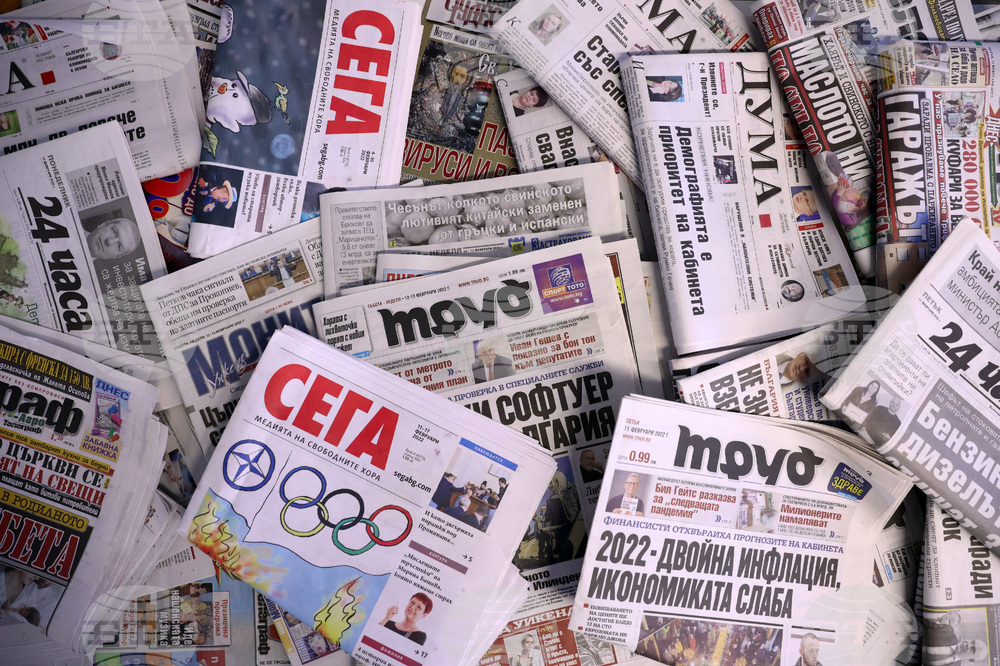
The ongoing energy crisis in Europe, the upcoming presidential election in Bulgaria and the judicial reform in this country dominate Tuesday's news media.
POLITICS
In a review of the first session of the 52nd National Assembly, the 24 Chasa daily analyzes the intensity of parliamentary oversight, summarizing that ministers spent a total of 37 hours and 56 minutes answering questions from MPs. During the first three months of the legislature, the cabinet faced a total of 765 questions, of which 546 received answers (two-thirds in writing and the remainder orally). According to the publication, Regional Development Minister Ivan Shishkov was the primary target of parliamentary interest, answering 49 questions from the parliamentary rostrum. He is followed by Culture Minister Evtim Miloshev with 21 questions and Interior Minister Ivan Demerdzhiev with 18. In contrast, some members of the government faced no scrutiny at all. 24 Chasa points out that Deputy Prime Minister Atanas Pekanov and Minister of Transport and Communications Georgi Peev did not receive a single question from the rostrum during the period. The article says that Prime Minister Rumen Radev answered three specific questions during regular Question Time: regarding a gift received from Turkish President Erdogan, water supply issues to Greece, and the government's refugee policy. The daily also provided a summary of the legislative output of the 52nd National Assembly's first session. The Parliament adopted 28 laws and 89 resolutions out of 163 bills introduced (114 of which were sponsored by MPs) in a total of 39 plenary sittings.
***
On Nova TV's morning programme, the Chair of the newfound Independent Association of Bulgarian Prosecutors (IABP), Georgi Balkov, declared that the primary goal of the association is to end the "monopoly" on the representation of prosecutors. Balkov stressed a fundamental change in direction: "We are, first and foremost, representatives of the profession before the authorities, rather than representatives of the authorities before the profession," he said. According to Balkov, the IABP will focus on strengthening the independence of individual prosecutors and restoring public confidence in the judicial system. A key long-term objective is to establish the Bulgarian prosecutorial community as a reliable partner in European and international criminal justice. The Chair highlighted the upcoming election of a new Supreme Judicial Council as a "key moment" for the system’s credibility. The association plans to advocate for a transparent and fair election process to ensure the integrity of the judiciary's governing body. Addressing the internal climate of the prosecution, Balkov said that the members of the new association are professionals who want to see the disappearance of "power centres". He asserted that the Bulgarian prosecuting magistracy must be guided strictly by the law.
***
Political analysts Maria Pirgova, Milen Lyubenov, and Lyubomir Stefanov shared their perspectives on the upcoming presidential elections in a discussion on Nova TV's morning programme. The analysts identified President Iliana Iotova as the frontrunner with a strong starting position, suggesting that the main question lies in who will emerge as her opponent in a potential run-off. Pirgova predicted a near-certain victory for Iotova, noting that parties will use the campaign primarily to mobilize their structures. She raised the possibility of Vazrazhdane leader Kostadin Kostadinov entering the race, which could mirror the 2006 scenario when nationalist Volen Siderov reached the second round against Georgi Parvanov. Lyubenov criticized the delay in the potential candidacy of Andrey Gurov, calling it a "serious political mistake" that could determine the election's outcome prematurely. He said that if GERB decides to run its own candidate, they risk falling to third or fourth place, potentially trailing behind Vazrazhdane. Stefanov warned against treating the election results as a foregone conclusion. Regarding Gyurov, he said that the likely strategy would be an initiative committee to avoid the candidacy becoming a political anchor. The analysts also discussed the potential for tension between the presidency and the executive branch following the vote. Pirgova suggested that Iotova could emerge as a critic of the government from the left, while Stefanov said that a president might attempt to follow an independent line in foreign policy, which could lead to friction with the Prime Minister and the Foreign Minister.
ENERGY
24 Chasa has an interview with Julian Popov, former minister of Environment and Water in the Andrey Gurov caretaker cabinet in which Bulgaria's energy future and the shifting habits of consumers are discussed. Popov points out that according to National Statistical Institute data, nearly 70% of Bulgarian households now use air conditioners. He says that for every unit of electricity consumed, a modern air conditioner produces 3 to 7 units of heat. He adds that air conditioners have become the cheapest form of heating in Bulgaria, second only to wood, but far more convenient and cleaner, a driven by both economic efficiency and the increasing need for cooling during summer heatwaves. Popov also says that Bulgaria is currently in a relatively strong position when it comes to EU's targets for electrification with 27% electrification of final energy consumption, surpassing the EU average of 23%. The expert also highlights that the real growth in the Bulgarian energy sector is currently driven by solar power and battery storage. He explains that in the last two years, batteries have transformed the market, allowing for the balancing of the system and the storage of cheap electricity for use during peak hours. Popov concludes that Bulgaria has the potential to become a genuine energy hub for the Balkans. By integrating with the markets of Greece, Romania, and the Western Balkans, Bulgaria can act as a provider of "storage services" - importing cheap excess energy from neighbors during the day and exporting it at a higher price in the evening thanks to its developing battery infrastructure. He stresses that the government should support these market trends rather than clinging to "engineering concepts from 30 years ago".
***
Boyan Rashev, energy expert and founder of the Mind Your Future Platform writes in a commentary for Trud that a "perfect storm" of ten converging factors is set to hit Europe this August, potentially leading to price shocks and supply instability. He is quick to highlight that Bulgaria is a regional "island of stability" capable of supporting its neighbours through the crisis. Rashev identifies a combination of climatic, geopolitical, and economic pressures. Extreme heat and drought are reducing hydropower output across the Alps and Carpathians. Low water levels on the Rhine and Danube are halting coal and fuel barges while forcing nuclear power plants in Hungary and Romania to reduce capacity or shut down due to cooling issues. Norway, often called "Europe's battery", is seeing record-low reservoir levels. Meanwhile, EU gas storage remains at a low 55%, and LNG prices stay high due to tensions in the Persian Gulf. European power grids face significant bottlenecks. Additionally, carbon quota prices exceeding EUR 80/ton make it expensive for coal plants to compensate for the energy deficit. Despite the broader European struggle, Rashev said that Bulgaria is well-positioned to act as a net exporter. Unlike regional competitors, Bulgaria’s Kozloduy nuclear plant was designed to withstand low Danube levels and is expected to remain fully operational. Furthermore, significant investments in solar power and battery systems are helping balance the grid during peak evening hours. Bulgarian dams also remain relatively full, and the Maritsa East thermal power plants are actively exporting electricity to help stabilize Romania and Hungary.
WORLD
Mediapool.bg carries an article examining the judicial reform currently underway in Moldova, highlighting it as a potential model for other countries in the region, including Bulgaria. The article, titled "How Moldova is Cleaning its Judicial System," details the uncompromising vetting process initiated by President Maia Sandu’s administration to root out corruption and restore public trust. This process involves two distinct stages: Pre-Vetting (evaluating candidates for the supreme judicial and prosecutorial councils) and Vetting (evaluating sitting judges in key positions, starting with the Supreme Court of Justice). The evaluation is conducted by commissions composed of both national and international experts (from countries such as the US, Germany, and the Netherlands). The focus is not just on legal competence but on ethical and financial integrity. The article says that the commissions scrutinize the assets of magistrates and their families over the past 15 years, looking for discrepancies between declared income and lifestyle.
The publication points out that the reform has met with fierce resistance from within the system. When the vetting of the Supreme Court of Justice began, 20 out of 25 judges resigned almost simultaneously. According to Mediapool, this "systemic sabotage" led to a temporary paralysis of the highest court. However, the Moldovan government responded with legislative changes to allow the court to continue functioning with a reduced quorum and by bringing in temporary judges who had already passed the integrity checks. The judicial reform is the cornerstone of Moldova's EU integration path. The European Commission has made it a key condition for the commencement of accession negotiations.
***
In a commentary reflecting on the recent commemorations of the Ilinden-Preobrazhenie Uprising (August 2), Trud examine the political and ideological divisions within North Macedonia. The daily highlights that for North Macedonia, August 2 represents two distinct historical events: the 1903 Uprising against the Ottoman Empire (the "First Ilinden") and the 1944 ASNOM (Anti-fascist Assembly for the National Liberation of Macedonia) meeting, which laid the foundations for Macedonia as a republic within Yugoslavia (the "Second Ilinden"). The publication points out that these two events serve as ideological anchors for the country’s two main political camps. The "First Ilinden" at the village of Mechkin Kamen is traditionally the domain of the right-wing VMRO-DPMNE and those identifying as "patriots". Conversely, the "Second Ilinden", celebrated at the Pelince museum complex near the Prohor Pcinjski monastery, is favored by the social-democratic SDSM and those nostalgic for the Yugoslav era. The article underscores a shift in the celebrations in 2026. For the first time in years, representatives of the ruling VMRO-DPMNE dominated all three major commemorative sites (Mechkin Kamen, Pelince, and Skopje). This was partly due to the absence of the Parliament Speaker, Afrim Gashi, who was on a family vacation during the national holiday. This allowed VMRO-DPMNE’s Antonio Milososki to deliver the keynote speech at Mechkin Kamen. The publication also draws attention to the diplomatic optics of the holiday. President Gordana Siljanovska-Davkova met with Serbian Prime Minister Đuro Macut in Ohrid, describing their meeting as a high-level "academic conversation" between professors. Trud suggests that while Skopje finds common ground and investment projects with Belgrade with ease, the relationship with Sofia remains fraught.
***
On bTV's morning programme Tihomir Bezlov, an expert from the Center for the Study of Democracy (CSD) discussed the causes and the potential implications for Bulgaria of the massive migration breach in the Spanish enclave of Ceuta that happened in late July. According to Bezlov, the crisis in Ceuta is the result of a "coincidence of multiple factors" rather than a single cause. He notes that the left-wing government of Pedro Sanchez in Spain has increasingly diverged from the general political trend in Western Europe. "Spain differs significantly from the general rightward shift seen elsewhere in Europe. Sanchez maintains a very open policy based on the ideology that Spain must accept migrants to support its economy," Bezlov explained. He pointed out that this stance has turned Sanchez into a "problem for Europe," drawing sharp criticism from countries like Italy and Denmark, which have moved toward stricter border controls. Bezlov stated that the immediate risk for Bulgaria is not a mass border breach, but rather the administrative return of migrants from Western Europe. "Our big risk is that these people could start being returned to us," Bezlov warned, referring to the Dublin Regulation obligations that were a central point of contention during Bulgaria’s Schengen accession talks. He said, however, that so far there has been no "massive return" of migrants to Bulgarian territory. Currently, the migration pressure on Bulgaria remains significantly lower compared to previous years. Bezlov cited statistics showing a sharp decline: approximately 1,300 people have been registered so far, compared to 18,000 in a previous period. Of these 1,300, about 700 have already been returned.
ECONOMY
In an interview with Bulgarian National Radio (BNR), Stoyan Panchev from the Expert Club for Economics and Politics discussed the fiscal challenges facing Bulgaria, emphasizing that Budget 2027 will be a critical turning point for the country’s economic and structural reforms. Panchev identified the primary challenge for the 2027 budget as fiscal consolidation. He noted that the government must demonstrate "courage" in reducing the deficit, which currently stands at approximately 5.7%. While Budget 2026 is viewed as a "finishing" or transitional document, the expert expects Budget 2027 to finally introduce long-delayed structural reforms and "reformist actions." The economist offered a grim assessment of Bulgaria’s current economic trajectory, stating that the post-1997 economic model has reached its limit. "This model is now exhausted and is creating problems," Panchev explained. According to the analyst, Bulgaria's growth is increasingly driven by consumption rather than investment. Panchev also pointed to signs of distress in the labour market, specifically the mass replacement of local workers with foreign labour at lower pay scales in certain sectors. Furthermore, he highlighted systemic issues in the business environment, noting that companies often face payment delays of three to six months, particularly when public funds are involved. Commenting on the previous budget cycles, Panchev stated that the most positive aspect of Budget 2026 was the exposure of "hidden problems" regarding the deficit. He alleged that deficits, exceeding 3% in 2024 and projected to surpass 5% in 2025, had been previously masked through "manipulations" to create the illusion that Bulgaria was meeting the criteria for Eurozone entry.
/KK/
news.modal.header
news.modal.text