site.btaSecond Bulgaria–North Macedonia Protocol Still Viewed in Skopje as Obstacle Four Years after Signing
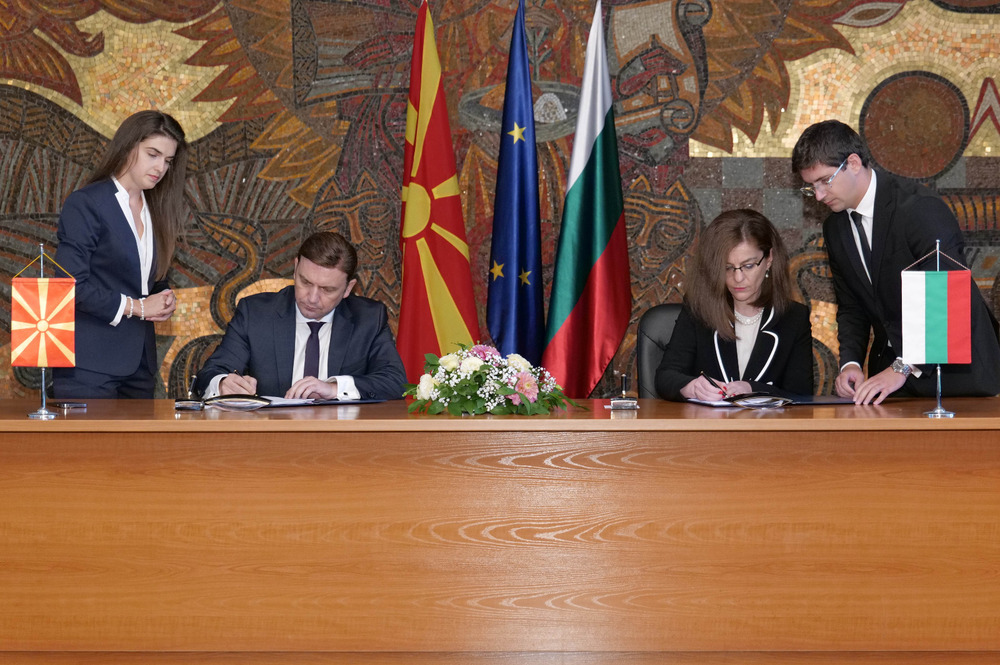
On July 17, 2022, the second meeting of the Joint Intergovernmental Commission between Bulgaria and North Macedonia was held at the Foreign Ministry in Sofia. A protocol signed after the meeting has in recent months been cited in Skopje as the main obstacle to the effective opening of the country’s EU accession negotiations.
Under Article 12 of the Treaty of Friendship, Good Neighbourliness and Cooperation between the two countries, signed in 2017, the Joint Intergovernmental Commission is required to meet regularly, once a year, to review the Treaty’s effective implementation, adopt measures to improve bilateral cooperation and resolve issues arising in the course of its implementation.
During the five years following the signing of the Treaty, however, this was only the second protocol signed by the countries’ foreign ministers. The first, dated June 10, 2019, was signed by then Bulgarian Deputy Prime Minister and Foreign Minister Ekaterina Zaharieva and North Macedonia’s then Foreign Minister Nikola Dimitrov.
On July 17, 2022, immediately after the Parliament in Skopje approved North Macedonia’s EU Negotiating Framework, the second protocol was signed in Sofia by then foreign ministers of Bulgaria and North Macedonia, Teodora Genchovska and Bujar Osmani.
The document, which became a key part of Skopje’s European path and, according to North Macedonia’s governing authorities, the “main obstacle” to the country’s EU integration, provides for the inclusion of Bulgarians in North Macedonia’s Constitution as a condition for the effective opening of EU accession negotiations.
It also contains measures to combat hate speech and discrimination. The two foreign ministries are designated as contact institutions responsible for informing the competent authorities when such cases are jointly identified.
The Protocol states that "the two sides will take effective measures to prevent malicious propaganda by institutions and agencies and will discourage activities by private entities aimed at inciting violence, hatred or other similar acts that could harm their relations".
It also says that "the Republic of North Macedonia will take measures to ensure effective access to equal rights, protection against discrimination and the preservation of the culture and identity of the Bulgarian community in the Republic of North Macedonia".
The document further provides for opening the archives of the communist secret services of the former Yugoslavia, of which present-day North Macedonia was a part until 1992, and encourages the Joint Historical Commission to "achieve clear results in accordance with Article 8, paragraph 2 of the 2017 Treaty".
The two governments reaffirm their support for the Commission and undertake to create a favourable environment for its work, to encourage it to improve its effectiveness and achieve concrete results based on strictly scientific debate, with the aim of presenting facts and events from the shared history connecting the two countries and their peoples in the educational systems of both countries.
"In its work, the Commission should adhere to the provisions of Article 8, paragraph 2 of the Treaty, namely to contribute to an objective and scientific interpretation of historical events based on authentic and evidence-based historical sources. In accordance with the applicable provisions of the 2017 Treaty, the work of the Commission may not be terminated unilaterally," the second protocol between the two countries says.
Genchovska described the July 17, 2022 meeting in Sofia as "extremely useful".
According to Genchovska, the meeting reviewed "the progress made in all five sectoral working groups" between the two countries. “What must be done from now on is to put the agreements and arrangements reached into practice, which is an extremely serious commitment for both countries,” she said.
Osmani, said his country was counting on Bulgaria’s support and expressed hope that a new chapter was being opened in relations between the two countries.
Meanwhile, in early July 2022, the then opposition VMRO-DPMNE launched a series of protests against the Negotiating Framework, accusing the government in Skopje of accepting it. The party, which was in opposition at the time, described it as a “Bulgarian dictate” and a document intended to bring about the country’s "Bulgarisation".
Four years later, VMRO-DPMNE is the governing party in North Macedonia, while the constitutional amendments have not been adopted.
Without the votes of Hristijan Mickoski’s party, North Macedonia’s Parliament does not have the required two-thirds majority to amend the country’s basic law.
After it became clear that the Negotiating Framework would not be changed, Mickoski’s government began seeking European guarantees that Bulgaria would not make any new demands of North Macedonia during the negotiations. The second protocol became the main argument supporting this position.
In 2025, an application was submitted to the Constitutional Court in Skopje asking it to assess whether the document was unconstitutional.
"The Second Protocol requires the Bulgarisation of the Macedonians and our removal as a people and a state with our own identity, continuity and history. Bulgarisation is supposed to begin with the seemingly harmless inclusion of Bulgarians in the Constitution and the harmonisation of all applicable legislation with the amendments," claimed former MP Liljana Popovska, who submitted the application concerning the second protocol to the Constitutional Court.
In 2026, European Parliament rapporteur for North Macedonia Thomas Waitz tabled an amendment to the latest report on the country’s progress, calling on “the Council Legal Service to urgently clarify all ambiguities concerning the legal status of the second bilateral protocol to the Treaty of Good Neighbourliness and Friendship between the two countries in relation to North Macedonia’s accession process”.
The European Parliament’s Committee on Foreign Affairs did not adopt the amendment, and it was not included in the European Parliament’s final resolution.
During the South-East European Cooperation Process Summit in Sofia, North Macedonia’s President Gordana Siljanovska-Davkova said after meeting Bulgarian President Iliana Iotova that it had become clear that Bulgaria had new demands of her country.
Prime Minister Mickoski, for his part, said there were no new demands and that the issues concerned were those included in the second protocol signed in 2022.
"Let us be precise. These are demands from 2022, which we saw, and that is why we said we were against them. We merely waited three years for the rest of the world to see these demands as well. These are not new demands; they are the same demands. In other words, the work of the Historical Commission is not a formality but a substantive matter. This is not the first time we have heard this," Mickoski said.
"For them, meaning Bulgaria, the work of the Historical Commission - the Joint Multidisciplinary Expert Commission on Historical and Educational Issues between Bulgaria and the Republic of North Macedonia, is substantive,"
The media in North Macedonia even began debating how the wording in the Protocol concerning the work of the Joint Historical Commission should be interpreted and whether encouraging the Commission’s work meant "obliging" or "motivating" it.
The debate was also revived between former foreign minister Nikola Dimitrov, who signed the first protocol, and Bujar Osmani, who signed the second, over which of the two documents was less favourable to North Macedonia.
Osmani recalled that the first protocol could not even be found in the archives of the Foreign Ministry in Skopje and that he had had to obtain it from Bulgaria.
During EU Commissioner for Enlargement Marta Kos’s visit to Skopje on July 8, 2026,, the country’s government was once again told that the commitments it had undertaken must be fulfilled before North Macedonia’s accession negotiations with the EU could effectively begin.
/NF/
news.modal.header
news.modal.text