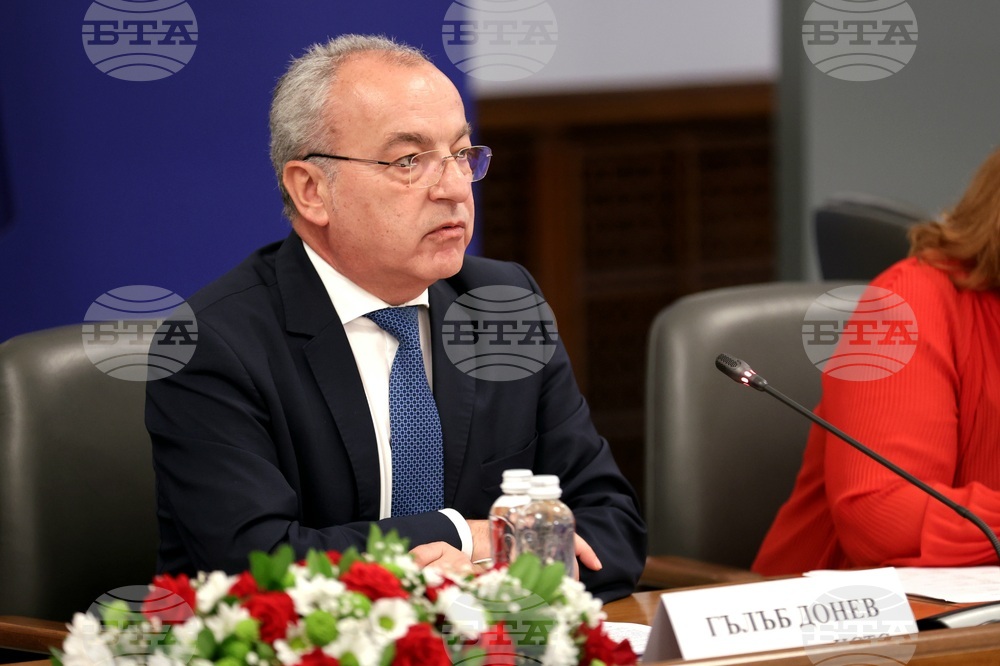
The National Council for Tripartite Cooperation failed to reach unanimity on the draft State Budget Act, Deputy Prime Minister and Minister of Finance Galab Donev said on Monday. The meeting also discussed the 2026 draft budgets of State Social Insurance and the National Health Insurance Fund.
The Consolidated Fiscal Programme (CFP) balance as a share of gross domestic product (GDP) over the 2026–2028 forecast period is projected at a deficit of 5.7% of GDP in 2026, 3.8% in 2027 and 3.0% in 2028. Keeping the CFP deficit at this level at this stage ensures a return to the limits by the end of the period, Donev said. Under these deficit levels, CFP revenue, grants and donations are projected at EUR 49,615.3 million in 2026, EUR 50,272.0 million in 2027 and EUR 53,394.9 million in 2028. The increase from the preliminary reported 2025 figure of EUR 44,014.7 million reflects several factors.
Total CFP expenditure is projected at EUR 56,807.2 million in 2026, EUR 55,350.8 million in 2027 and EUR 57,687.0 million in 2028.
Short-term revenue measures for fiscal consolidation in 2026 include raising the maximum social security income to EUR 2,300 from August 1, 2026; increasing minimum social security thresholds for certain economic activities and occupations above the minimum wage, also from August 1, 2026; increasing toll system revenue and raising vignette fees by 30% from August 1, 2026; improving collection of social security contributions and tax revenue; and increasing gambling revenue, among other measures.
Short-term expenditure measures for fiscal consolidation in 2026 do not envisage an increase in personnel costs, including for elected positions. The draft 2026 budget provides for a 10% cut in wage and remuneration costs for personnel employed under employment or service relationships, with certain exceptions set out in the draft State Budget Act, from September 1, 2026 until the end of the year and throughout 2027–2028. It also includes removing the COVID supplement from newly granted pensions after July 1, 2026; reducing the state subsidy for religious denominations from October 1, 2026; reducing the state subsidy per valid vote received under Article 26(1) of the Political Parties Act; revising the minimum wage-setting mechanism; and gradually introducing an obligation for civil servants under the Civil Servants Act and persons employed under the Judicial System Act to pay personal social security contributions, among other measures.
The Bulgarian Industrial Capital Association (BICA) abstained from supporting the bill, BICA member Rumen Radev said. BICA estimates that if current dynamics continue until the new budget takes effect, the accumulated deficit will reach EUR 4.8 billion, Radev said. A realistic approach means acknowledging that imbalances have built up, and explaining what caused them, he added. If policies remain unchanged on a cash basis, the deficit this year is heading for 7.4% of GDP, not counting commitments already undertaken. The proposed draft budget does not provide fiscal consolidation that is fast or deep enough, he said. Society and the real economy expect public finances to return to normal. The lack of reforms and rising expenditure caused public tension at the end of last year. BICA believes this year’s budget should not be a budget of postponed reforms, Radev said.
BICA believes tax rates should not be raised, additional revenue should be sought through better collection and by curbing the grey economy, vacant staff positions should be closed, the issue of working pensioners should be reconsidered, structures with overlapping functions should be merged, automatic mechanisms for indexing public-sector pay should be scrapped, the COVID supplement should be removed from all pensions, the Territorial Expert Medical Commissions (TEMCs) and the National Expert Medical Commission (NEMC) should be comprehensively reformed, and mechanisms to compensate businesses for high electricity prices should be preserved and targeted at enterprises exposed to price risk.
The Bulgarian Industrial Association (BIA) gives conditional support to the draft budget, its representative Dobri Mitrev said. “We insist that, during the budget procedure, the increase in the maximum social security income be postponed and efforts be made to reduce the projected deficit,” Mitrev said. The association is concerned about the deficit planned for this year and next. It is unfortunate for Bulgaria to face an excessive government deficit procedure in the first months of its eurozone membership, Mitrev said.
Tsvetan Simeonov of the Bulgarian Chamber of Commerce and Industry (BCCI) said the Chamber supports the draft budget. Simeonov said higher excise duties and a higher gambling tax could make these activities attractive to illegal operators.
Boyan Mitrakiev also declared support for the draft budget on behalf of the Confederation of Employers and Industrialists in Bulgaria (KRIB). “Inflation exists because we filled the state with loans, and you have to solve this problem,” Mitrakiev told government representatives.
The Confederation of Independent Trade Unions in Bulgaria (CITUB) will support the budget if certain conditions are met: preserving the current minimum wage-setting mechanism, repealing the automatic mechanism for wage changes in the budget sector, and postponing the planned 10% cut in personnel costs, CITUB President Plamen Dimitrov said.
“We cannot give firm support to the draft budget for the remaining months of the year,” Podkrepa Confederation of Labour Vice President Ioannis Parteniotis said. He said that although the draft budget covers only a few months, it does not help tackle the demographic crisis, reduce income inequality, combat poverty and social exclusion, or solve the issue of adequate pay. The expenditure side clearly freezes everything affecting people’s lives and work, Parteniotis said, expressing hope this would be reconsidered for 2027. He urged that the budget not impose an income freeze for the next five months. A strong state economy is achieved through higher productivity, real investment and real protection of the public interest, Parteniotis said.
The budget package is on a compressed timetable. The extraordinary meeting followed Donev’s presentation of the State budget parameters on June 24, 2026, and the draft is due to go to Parliament on July 1, 2026. The package covers the 2026 State Budget Act, the State Social Insurance Budget Act and the National Health Insurance Fund Budget Act. Donev said the draft reflects the current fiscal position, while wider policy changes are being left for the 2027 budget.
Talks are taking place amid social tension and EU fiscal pressure. CITUB and Podkrepa protested outside the Council of Ministers against proposed cuts in personnel spending and the requirement for civil servants to pay personal social security contributions. The debate is also shaped by the excessive deficit procedure, under which Bulgaria is expected to bring its deficit below the 3% of GDP threshold by 2029.