site.btaMedia Review: June 22
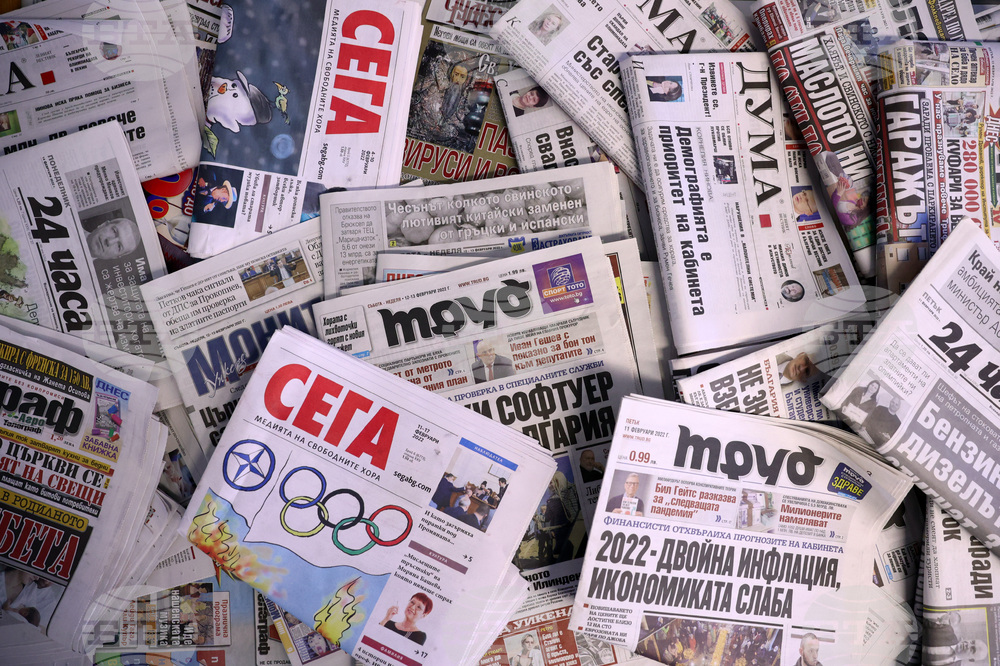
Not a single topic dominates Monday’s news media. The coverage focuses on the presidential race, with parties weighing possible candidates before the autumn 2026 election, Bulgaria’s position on the EU’s planned new sanctions package against Russia, and the pressure on public finances. Other major topics include possible higher property taxes, Recovery and Resilience Plan payments, rising rents in Sofia, tourism prices on the Black Sea coast and coastal pollution.
PRESIDENTIAL RACE
Telegraph writes that “at least three or four surprises may emerge” in the presidential elections in the autumn 2026. Sociologist Elena Darieva says no political formation has yet officially named a candidate for the position, although an initiative committee is expected to nominate former caretaker prime minister Andrey Gurov, with Continue the Change and Democratic Bulgaria likely to support him. “I expect surprises, but not necessarily in the form of an unexpected winner. The surprises are more likely to be in the candidacies and the coalitions behind them,” Darieva said. She added that presidential elections traditionally allow the rise of figures who are not narrowly party-based nominees. “I would not be surprised if a candidate from academia, diplomacy, the army or local government appears at the last moment,” she said. Telegraph notes that another surprise could come from unexpected second-round support between formally different camps. Darieva said the biggest uncertainty may not be who wins, but who reaches the runoff. The daily also quotes GERB’s Vladislav Goranov, who said that the party has not yet chosen its candidate and is looking for the strongest centre-right nomination.
Bulgarian National Radio (BNR) interviewed political analyst Stoycho Stoychev, who said nothing is certain in the presidential race. He noted that it remains unclear whether Prime Minister Rumen Radev will support President Iliana Iotova, what backing Gurov will gather, and what GERB will do. “By late autumn 2026, we will hardly know what the global factors will be, so that we can predict an election result now. Many things can change by then. We do not know what GERB will do,” Stoychev said.
SANCTIONS AGAINST RUSSIA
Commenting on BNR on Rumen Radev’s position against sanctioning Russian Patriarch Kirill, Stoycho Stoychev described it as mainly symbolic. He said the Russian Patriarch is not a decisive factor for either side and that the dispute is strong enough to fuel sharp political controversy, but not to produce real policy change. Stoychev argued that Radev and President Iliana Iotova often address issues with strong public impact but limited practical consequences. “I have not seen real steps or real actions on any of the things being talked about so intensely,” Stoychev said.
Speaking on Nova TV’s morning programme, former defence minister Todor Tagarev and journalist Valeri Todorov disputed over Bulgaria’s position on the EU’s planned 21st sanctions package against Russia. The discussion followed Bulgaria’s reservations about including Russian Patriarch and businessman Vagit Alekperov, linked to Lukoil, on the sanctions list. Tagarev said the arguments in defence of Alekperov are troubling and create the impression that foreign policy decisions may be influenced by economic considerations. He added that Bulgaria has so far supported all EU sanctions packages against Russia, but that the public messages from the authorities often differ from the country’s behaviour in EU institutions. “What we see at the moment is not a defence of Bulgaria’s national interest, but a defence of Russian interests,” Tagarev said. Todorov said Sofia’s position should not automatically be read as Russian pressure. He argued that Alekperov still has major influence in international energy business and that sanctions could complicate the future of Lukoil and its assets. “When a step may harm Bulgaria, we have the right to say no, or at least to request further discussion,” Todorov said.
Speaking on bTV’s morning programme, political analysts Rumyana Kolarova and Maria Pirgova debated whether Bulgaria is defending Orthodoxy or moving closer to Moscow’s position. Kolarova said the Russian Orthodox Church and Russian Patriarch have not shown respect for Bulgaria and rejected identity-based arguments in his defence. “For me, there is no logic here, because neither as an institution, nor especially as a person, has the Russian Patriarch shown respect for Bulgaria,” Kolarova said. She added that invoking Orthodoxy in this case amounts to “wild populism” and asked why the same emotional argument is not applied to Ukraine, whose people are also Orthodox. “Politically, this is humiliation. From every point of view - personal humiliation, institutional humiliation and national humiliation,” she said. Pirgova took the opposite view, saying the EU’s decision to sanction Patriarch Kirill is political and that Bulgaria’s response is also political. “The church performs a very important diplomatic function,” Pirgova said. She added that the request to remove Patriarch Kirill and Alekperov from the sanctions list has both political and economic meaning. “We cannot continue with these frozen relations with Russia. We are losing a lot. We are on track to lose the Lukoil case as well,” Pirgova said.
ECONOMY
Speaking on Bulgarian National Television’s (BNT) morning programme, Deputy Prime Minister Atanas Pekanov described the European Commission’s approval of Bulgaria’s fourth Recovery and Resilience Plan payment as both a budget relief and a warning that the country must speed up reforms. The payment is worth almost EUR 1 billion and comes after key conditions were met, including the creation of an independent anti-corruption commission. “European rules and deadlines are not optional - full mobilization is expected from us,” Pekanov said. He described the payment as “a breath of fresh air for the budget,” but said Brussels expects sustainable implementation of the anti-corruption framework, reform of the Prosecutor General’s status, energy-sector restructuring and demonopolization in rail transport. BNT adds that Bulgaria has about 50 days to report 56 remaining milestones for the fifth payment, with August 31 as the final deadline. Pekanov also noted that the European Commission has placed Bulgaria under an excessive deficit procedure. He said Bulgaria’s fiscal trajectory has been unsustainable for years, but warned that sharp spending cuts could suffocate the economy. A gradual consolidation, spending optimization, possible closure of agencies and stronger coordination with municipalities are expected.
***
In an interview with BNR, economist Kuzman Iliev, leader of Bulgaria Can party warned that repairing the 2026 budget will not be painless. “There should never be panic, but we must also be realistic. It will not be painless to do what is needed to heal the patient,” Iliev said. He called on Radev to launch an internal investigation into how data from the National Statistical Institute are prepared and passed to the Ministry of Finance, the Ministry of Economy and European statistical authorities. He claimed that there has been “huge manipulation of data” and warned that the deficit could rise sharply. He also said the eurozone is becoming too politicized and that Bulgaria’s entry allows Brussels greater control through the excessive deficit procedure. According to Iliev, there is no serious spending-control measures and considers tax increases the most dangerous option. He criticized planned defence spending, saying: “I do not see why this modernization should mean pouring in EUR 19 billion and 5% of GDP. We are preparing for something. I cannot understand what the current threat is that requires this.” He also warned that VMZ Sopot may soon need a rescue loan of EUR 60 million to EUR 70 million from the Bulgarian Development Bank.
***
24 Chasa writes in an analysis that the idea of higher taxation for people with more than one property may have limited fiscal effect. The daily notes that Bulgaria already has a form of differentiated taxation: primary homes receive a 50% tax reduction. In a country where 86% of people own their home, the paper says, this is one of the most important tax privileges. The analysis adds that mayors are unlikely to rush into higher local taxes, especially with local elections coming next year. Current law allows municipalities to set property-tax rates between 0.1 and 4.5 per mille, but most keep them near the middle of the range. The daily says this shows they already have the power to raise taxes, but prefer not to do so. 24 Chasa notes that only 9% of households have a second property. Property-related taxation brings in about EUR 550 million annually, including taxes on homes, cars, property transactions and tourist tax. If around EUR 70 million comes from second and subsequent homes, a 30% rate increase would add only about EUR 25 million to the treasury, or 3.7% more revenue under this item. The paper says the only more meaningful fiscal effect could come from updating tax valuations, which could bring around EUR 120 million, though the impact would vary by city and region.
Speaking on Nova TV, economist Dimitar Sabev and financial journalist Petar Iliev discussed the same idea of higher taxes on second and third homes. Iliev said Bulgaria already has progressive treatment of property because the first home receives a 50% reduction. “The first property is taxed with a 50% reduction, meaning we pay half the tax. Of course, the amount also depends on the location of the property,” Iliev said. He added that there is no clarity on how a new tax would be applied or what criteria would be used. “This is only a proposal. The municipal authorities in Sofia do not even know the total size of the properties on which tax should be charged,” Iliev said. Sabev said property tax provides less than 2% of Bulgaria’s tax revenue, compared with around 5% on average in Europe. “The tax system is a set of taxes that fill our treasury,” Sabev said. He argued that taxation should not be seen only as a budget tool, but also as a way to influence macroeconomic processes. “Some people hold five or six apartments only as an investment, while young families cannot buy a home,” he said. At the same time, he warned that the tax could easily be avoided by transferring properties to children.
***
24 Chasa writes that Sofia ranks second among 60 countries and cities tracked by Global Property Guide for annual rent growth, with a nominal increase of 12.32%. Only Montenegro is ahead with 14.43%. The daily says landlords in Sofia have become more confident even 11 months before Eurovision and before the exact date of the event is known. The paper notes that a small 68 sq m one-bedroom apartment in a modern building in Krastova Vada is advertised for BGN 1,650 per month. One-bedroom apartments, which are most often rented long-term, are seeing average offers of around EUR 634, while even the cheapest listings in fast-developing districts such as Krastova Vada, Manastirski Livadi, Vitosha, Malinova Dolina, Mladost and Nadezhda rarely fall below EUR 500 per month. The daily adds that demand comes from both long-term and short-term tenants, mostly young people working in the capital. 24 Chasa links the rise to the property-market distortion of recent years, the eurozone effect, and landlords’ attempts to earn more from newly purchased investment homes. It also notes that new EU short-term rental rules, in force from May 20, have sharply reduced supply. Airbnb listings in Bulgaria fell from 10,200 to 5,500, while Booking listings fell from 15,100 to 8,000 after platforms started verifying property registration numbers.
BLACK SEA TOURISM
Trud leads with fuel oil pollution on beaches from Tsarevo to Kamchia Resort, Bulgaria’s southern Black Sea coast, writing that the contamination most likely comes from an old spill outside Bulgarian waters. The daily notes that Black Sea currents probably carried the oil products to the coast, while the search for the source continues. Twenty-one alerts were filed on Friday about fuel oil on beaches between Sozopol and Tsarevo, followed by signals farther North in the Kamchia area. Trud adds that the Black Sea Basin Directorate inspected Romantika Beach in northern Kamchia and found sticky fuel-oil pellets mixed with seaweed. Samples were taken to establish the concentration of oil products in the water, and the Maritime Administration Executive Agency is checking whether a vessel caused the pollution. “The fuel oil pollution did not happen in our waters. It is expected to be made public on Monday where exactly it came from,” a source from the Regional Inspectorate of Environment and Water in Burgas told the daily. The daily also reports that bathing has been temporarily banned at Varna Officer’s Beach because of fecal contamination. Tests showed excessive levels of Escherichia coli and intestinal enterococci, and health authorities ordered warning signs to be placed at two neighbouring beaches. Trud notes that the area has been chronically affected by pollution from the nearby Shokarov Canal, especially after heavy rain.
***
BNT reported that restaurant prices on the Bulgarian Black Sea coast are again a focus of public attention. Tourists and residents are posting receipts on social media and saying prices are noticeably higher, while the sector says the average increase compared with last summer is 15% to 20%. Businesses cite the return of the standard VAT rate, more expensive raw materials, and a serious shortage of labour that pushes up wages and costs. BNT says a check on the southern Black Sea coast showed major price differences even within the same resort, from a doner kebab for EUR 8 to cherries for EUR 9 per kg. Some tourists describe prices as shocking, while business representatives say the increase is limited to around 10%.
Speaking on BNT’s morning show, Marin Sotirov of the Varna Restaurant Association, who said there is speculation in every sector, but control is the State’s responsibility. “Without foreign workers, the season literally cannot happen,” Sotirov said. BNT added that Bulgaria is no longer a cheap destination and that the tourism product should move toward higher quality. Despite price fluctuations, 2025 was a record year for Bulgarian tourism after 2019, while this year is expected to bring a slight slowdown, but no dramatic decline.
SOCIETY AND CONSUMER AFFAIRS
Trud writes that every tenth teenager in Bulgaria shows signs of pathological attachment to screens and behavioural change. The daily cites a seven-year study and says the phenomenon affects between 10% and 12% of teenagers, while three quarters of children show signs that could develop into something more serious. Trud notes that nearly 40% of underage patients seeking help at the addiction treatment centre in Bankya are addicted to the screen of a phone or computer. The youngest patient treated there was 12 years old, and there are cases of children spending 10 to 12 hours a day in front of screens. The daily adds that 9 in 10 Bulgarians under 19 have social media profiles, while 75% create such profiles before turning 12. The paper reports that 92% of children and pupils use mobile devices for an average of nearly three hours a day. The average age at which children start using a smartphone is 8. Trud also lists European restrictions on mobile phones in schools, noting that France bans phones for pupils under 15, Spain bans them in classrooms, Italy applies a ban for pupils under 14, and the Netherlands allows phones only for medical reasons or disability-related needs.
***
24 Chasa leads with the news that consumers will receive one extra year of warranty if they repair a faulty appliance instead of throwing it away and replacing it with a new one. The daily writes that draft amendments to the Act on the Supply of Digital Content and Digital Services and the Sale of Goods transpose EU rules aimed at promoting a circular and sustainable economy. The idea is to make repairs cheaper and easier, extend the life of household appliances, reduce electronic waste and carbon emissions, and limit the production of new devices. The daily adds that the new rules will apply to washing machines, dryers, dishwashers, refrigerators and other household appliances produced after July 31, 2026. Producers and traders will have to offer repairs at a reasonable price, maintain spare parts and software, and inform consumers where and how repairs can be ordered. During the repair, the seller may provide a temporary replacement product free of charge or offer a refurbished product if repair is impossible. Bulgaria will not build a separate national repair platform, but will use the common EU platform, which will have a Bulgarian-language section. The Consumer Protection Commission will act as the national contact point. 24 Chasa notes that consumers will also be able to use a European repair information form, listing the nature of the defect, price, deadline and any additional costs, such as transport. The terms in the form, including the price, cannot be changed for at least 30 days, so consumers can compare offers. The Association of Home Appliance Manufacturers in Bulgaria, APPLIA, supports the directive and says its members have long offered after-sales service even after warranties expire.
/MR/
news.modal.header
news.modal.text