site.btaMedia Review: June 9
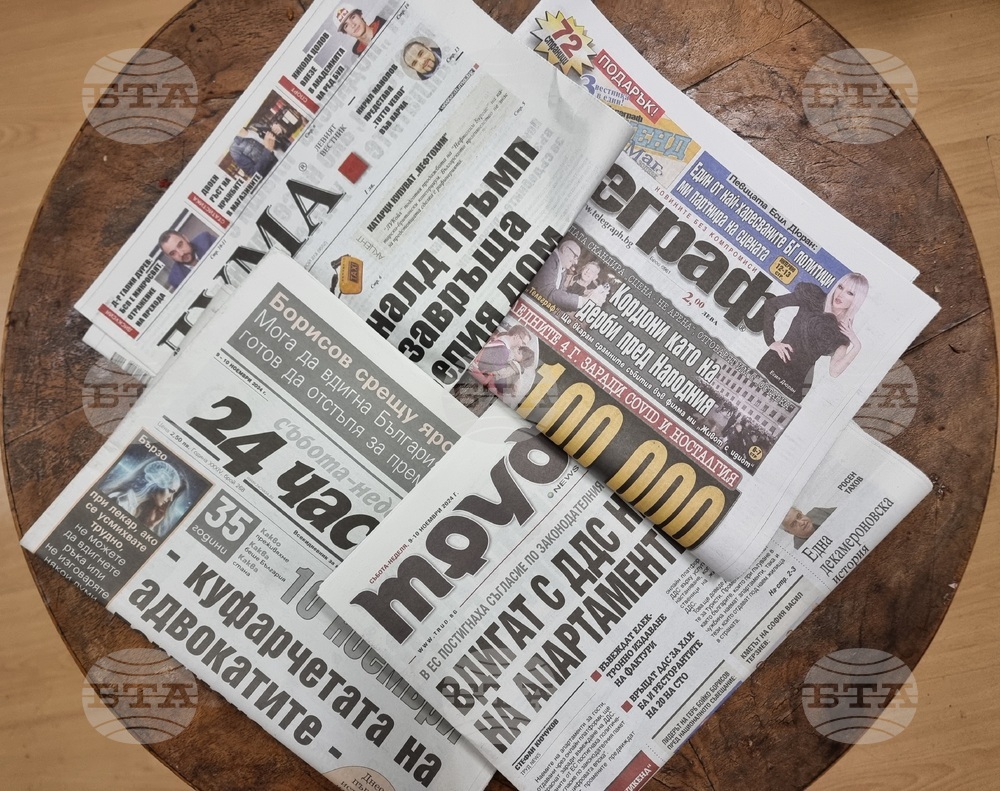
The news media cover extensively Monday's top domestic events: the surprise resignation of acting Interior Ministry Secretary General Georgi Kandev and supermarket chains pledging price cuts for staple foods for six months.
KANDEV'S RESIGNATION
Kandev's move is open to speculation since he did not give clear motives for it. Mediapool.bg says the most senior professional at the Interior Ministry suggested that he had been used as a "facade" for decisions made by others and that "there is no decree that can command the people's trust" - an apparent reference to the ambiguity surrounding his status. He was never formally appointed to the post and served only in an acting capacity, although both Interior Minister Ivan Demerdzhiev and Prime Minister Rumen Radev praised his performance. Under the law, the secretary general is appointed by presidential decree upon the government's nomination.
Emil Dechev, who was interior minister of the Gurov caretaker Cabinet under which Kandev was appointed acting Interior Ministry Secretary General in late February, told Nova TV that when they worked together, he gave Kandev full operational freedom, without restricting media appearances or social media activity. Dechev argued that this allowed Kandev to fully develop his professional potential and achieve good results.
Former interior minister Emanuil Yordanov commented on bTV that a ministry cannot function with "two media stars", arguing that roles must be clearly separated and that the minister is the undisputed head of the institution under the Interior Ministry Act. He added that problems arise when officials fail to accept the hierarchy, stressing that employees who do not agree with their leadership should leave rather than challenge it.
Interviewed by BNT, former deputy interior minister Filip Gunev commented on the timing of the resignation ahead of a potential election campaign, noting that Kandev had gained public visibility and a strong image but had limited time to implement structural reforms in the Interior Ministry. Kandev's main contribution was linked to election management. Gunev said the Interior Ministry is increasingly becoming a "breeding ground for political figures".
***
24 Chasa looks at several versions for Kandev's resignation. Unofficial Interior Ministry accounts suggested he had clashed with two of Minister Ivan Demerdzhiev's deputies rather than with the minister himself, who was reportedly surprised by the resignation and had not intended to seek it. Separate, unconfirmed claims pointed to Kandev's alleged lack of action over the Varna illegal construction case, reportedly involving the Ukrainian ambassador and Mayor Blagomir Kotsev. Andrey Gurov and Georgi Kandev could emerge not only as a presidential ticket but also as the public faces of a new political force, according to unofficial sources within Continue the Change and Democratic Bulgaria who said they too had been caught off guard by the emotional Facebook post in which Kandev announced his resignation.
Speculation intensified after former caretaker prime minister Andrey Gurov publicly backed Kandev shortly after he resigned and shared a photo of the two, fuelling suggestions of a coordinated move into politics. Kandev, who enjoyed Gurov's confidence under the caretaker government and is a family friend, rose to prominence as acting secretary general during a crackdown that saw record numbers of vote-buying suspects detained and cash seized ahead of elections.
Interior Ministry sources floated another explanation for Kandev's departure, citing his alleged inaction over illegal construction in Varna's Baba Alino area, although no details were provided about his role in the case. Demerdzhiev has previously alleged that Ukrainian Ambassador Olesya Ilashchuk intervened to overturn an expulsion order against Ukrainian entrepreneur and real-estate developer Oleg Nevzorov. However, no details have emerged regarding any role or inaction by Kandev in the case, 24 Chasa says.
***
Interviewed by Bulgarian National Radio, political analyst Prof. Evgenii Dainov said Kandev's resignation is a very serious warning. He evidently does not want to serve as a cover for things that are about to happen. This is an extremely serious signal and the most severe reputational damage to date.
Ivaylo Mirchev, co-chairman and MP of Democratic Bulgaria, said on bTV on Monday that there had been no discussions about Kandev and former caretaker prime minister Andrey Gurov becoming a future presidential ticket. The party's other co-chair, Bozhidar Bozhanov, told BNT that suggestions of a political career for Kandev were speculative, describing him as "a Bulgarian officer who places great value on his duty to the Interior Ministry and to maintaining public order". Bozhanov added that it remained to be seen whether Kandev would enter politics and potentially join Gurov on a presidential ticket backed by the democratic community.
In dnevnik.bg, Velislava Popova comments that the Interior Minister's wishes for success in Kandev's "political career" further fuelled speculation about his political ambitions. While the vice-presidency is largely ceremonial, it can serve as a springboard to the presidency, as in the case of Iliana Iotova following Rumen Radev's departure.
FOOD PRICES
Experts comment on major retail chains' pledge to implement 15% price cuts on basic food products. Eight supermarket chains agreed with the government to cut prices on staple foods by at least 15% for a minimum of six months under the Care Basket initiative, with some discounts expected to exceed 30%. Participation is voluntary, with retailers deciding which products to include, primarily focusing on Bulgarian food products.
24 Chasa and Trud frontpage stories on the initiative. 24 Chasa lists some of the discounted goods: meatballs, Dobrudzha-type bread, eggs and stewed fruits. Trud reports that labels for products included in the Care Basket initiative do not show old and new prices, making it difficult for consumers to assess the actual discount.
Capital.bg offers an overview of measures against price rises in recent years. Governments have repeatedly tried to curb food price increases with mixed results. In 2022-2023, Galab Donev's caretaker government included intensive inspections, price monitoring across the supply chain and proposals for greater transparency, but no actual price caps were introduced, while inflation eased mainly due to broader EU trends. Subsequent proposals ranged from legal limits on retail margins and supply-chain regulation to voluntary supermarket initiatives and state-backed "people's stores", but most either stalled or were criticized for distorting the market. Overall, successive governments have converged on the idea of making basic foods more affordable by influencing retail chains, while differing only in the tools used.
On BNT, Yavor Gechev, Chair of the parliamentary Agriculture Committee, said measures to lower food prices are based on voluntary commitments and a "call for social responsibility" from retail chains, rather than formal agreements. He stressed that discounts in the small consumer basket are not meant to come at the expense of either producers or consumers. He attributed the rise in prices to a lack of regulatory control in recent years.
Bogomil Nikolov, Executive Director of the Active Consumers Association, told BNT that agreements between the government and major supermarket chains to lower prices on staple foods may provide short-term relief but will not address the underlying causes of inflation. He argued that the focus should instead be on improving market functioning by tackling weak competition, intermediaries and unfair practices. The consumer advocate also questioned the quality of some heavily discounted products, citing concerns that very cheap cheese may have a high water content, and warned that aggressive price campaigns by large retailers could squeeze smaller shops and ultimately reduce competition.
Financial expert Nikola Filipov told Nova TV he does not expect the measure to significantly affect prices, arguing that the only sustainable way to reduce inflation is to limit pro-inflationary public spending. He also noted that producers were not directly involved in the talks and warned that part of the burden could be shifted onto them through reduced profit margins.
On bTV, former agriculture minister Kiril Vatev said the key issue is who will bear the cost of retail discounts, stressing that price cuts should not come at the expense of producers. He warned that beyond consumer prices, the deeper problem lies in unequal bargaining power between farmers and retail chains.
Economist Assoc. Prof. Ognyan Boyukliev commented on Bulgarian National Radio that cheap bread is not a mark of social policy; what is needed is high-quality Bulgarian bread. The same applies to milk and meat, and change should start with the Food Act. What is also needed is tax reform and an active agricultural policy. Pensions need to be increased, and there should be a functioning social policy, but not one pursued at the expense of Bulgarian producers. He is also in favour of progressive taxation as a means of increasing revenues, rather than taking out new loans.
GOVERNANCE ISSUES
Telegraph quotes political analyst Prof. Alexander Marinov as saying that overly categorical statements are a risk feature of the new government. Commenting on Rumen Radev's pre-election commitments, Marinov told Radio Focus it is still early days to assess delivery versus promises, but argued that real reforms have not started so far since there is no clear reform plan grounded in analysis.
Also in Telegraph, political analyst Prof. Milena Stefanova notes a discrepancy between the signals sent by the Cabinet and Parliament, which she describes as lack of coordination. She says the government has not yet presented a clear direction or programme, with governance appearing chaotic and unprepared. The key problem is weak dialogue both within the ruling majority and with the opposition, alongside the Prime Minister's military-style conduct.
***
In 24 Chasa, Georgi Angelov, Senior Economist at the Open Society Institute, analyzes the causes of inflation in Bulgaria. Its higher inflation compared to the euro area is explained less by external shocks and more by stronger domestic pressures, according to BNB Governor Dimitar Radev, who pointed to fiscal policy, credit growth, economic structure and competition as key drivers. While external factors set the initial inflation impulse, rapid growth in consumer credit and the fiscal deficit significantly amplify price pressures by increasing money supply faster than output. Angelov concludes that loose fiscal and credit conditions, rather than wage growth, are the main internal drivers of inflation. Tax hikes, the option chosen by the Bolojan government in Romania, which was ousted in May, risk worsening inflation and leading to poorer consumers and recession, without solving the deficit problem. The economist suggests that to reduce inflation, the underlying drivers need to be addressed by cooling consumer credit growth and tightening the budget deficit.
***
In a Trud interview, Yordan Arabadzhiev, Executive Director of the Union of International Hauliers, said transport operators were prepared to protest but would prefer dialogue with the government. He cited a combination of soaring fuel prices, delays in promised toll-fee compensation, the absence of financial support measures, a sharp rise in compulsory insurance costs and higher toll charges for older vehicles, warning that these pressures were fuelling inflation and threatening the sector's viability.
A front-page story in Trud quotes a survey by the Education Trade Union of the Podkrepa Confederation of Labour which found that the start of the school year is at risk of being disrupted by strike action. Without dialogue with the Finance Ministry, discontent may escalate into strikes. 96% of respondents said the salaries of teachers and employees in secondary education do not reflect the volume and responsibility of their work.
SOCIETY
In a bTV interview, Emanuil Yordanov, defence lawyer of former Bulgarian Development Bank (BDB) chief executive Stoyan Mavrodiev, said that when he was arrested in Belgrade on June 3, he already had a ticket for a flight to Sofia and would have returned to Bulgaria three days later. He added that they had agreed Mavrodiev should come back and participate in the ongoing criminal proceedings, warning that his absence fuels speculation he is unable to address.
Mavrodiev is wanted by the Bulgarian authorities for a loan of BGN 150 million (EUR 77 million) extended by the BDB. A European arrest warrant was issued against him after he was placed on a national wanted list in August 2024.
***
Bulgarian National Television Director General Milena Milotinova said the selection process for the Eurovision 2027 host city has officially begun, with Sofia, Plovdiv, Varna and Burgas confirming interest. BNT is seeking not just a venue but a committed organizational partner, with candidates required to meet strict EBU technical standards, while a decision on the host city is expected by the end of July. "This is a major marketing opportunity. The benefits for Bulgaria are incalculable," she said.
***
Dnevnik.bg looks at the case of Anastasia Rogacheva, who moved to Bulgaria in 2011. She renounced her Russian citizenship after being conditionally approved for Bulgarian nationality, only to have her application later rejected on unspecified national security grounds. The mother of two says she has received no explanation from the authorities and has been unable to find a solution despite seeking help from institutions and lawyers. Convinced she had broken no rules, Rogacheva sought an explanation from the State Agency for National Security (SANS) as to why she was deemed a national security risk but received no response. The Justice Ministry said opinions from SANS or the Interior Ministry related to national security are recorded without reasoning under existing regulations and confirmed that such citizenship refusals cannot be appealed.
***
24 Chasa has interviewed Assoc. Prof. Nikolay Dimitrov, a social psychologist, in the wake of the latest crash which left four dead and 17 injured. It was apparently caused by an illegal street race between two cars travelling at more than 150 km/h, according to investigators and prosecutors. The psychologist argued that the tragedy was not merely the result of reckless drivers but reflected a broader failure of social and institutional safeguards. He said repeated rule-breaking without consequences can erode moral self-restraint, normalize risk-taking and foster a sense that laws apply only to others. Social media amplify this by glamorizing wealth, speed and defiance of rules as markers of success. He said that a sense of impunity emerges when the perceived risk of punishment is outweighed by the expected benefit or emotional reward of the behaviour. Dimitrov warned the greater danger is not the aggressive driver himself but a society that stops being shocked by such behaviour and mistakes online outrage for meaningful civic action.
VIBER TO INTEGRATE ChatGPT IN BULGARIA
Viber users in Bulgaria will soon be able to access ChatGPT directly within the app, without switching between platforms, following a new partnership between Rakuten Viber and OpenAI. The feature is expected to roll out in the coming weeks, according to Viber CEO Ofir Eyal, who announced the development on bTV.
ARMENIA AFTER ELECTIONS
In Trud, Veselin Kirov analyses the paths open to Armenia after the June 7 parliamentary elections. The analyst argues that Armenia's future has become part of the broader geopolitical rivalry between Russia and the EU, warning that a rapid pivot towards the West could leave the country exposed. He advocates a multi-vector foreign policy that balances ties with Moscow, Brussels and regional powers, describing neutrality as the most pragmatic and "pro-Armenian" option. Any decision on closer integration with the EU should be endorsed by voters in a referendum rather than driven solely by the ruling elite.
/DD/
news.modal.header
news.modal.text