Regional security conference
![President Iotova Opposes Viewing Black Sea Solely as Militarized Zone]()
![President Iotova Opposes Viewing Black Sea Solely as Militarized Zone]() President Iliana Iotova and EIRI Executive Director Veselin Valchev, Sofia June 8, 2026 (BTA Photo/Minko Chernev)
President Iliana Iotova and EIRI Executive Director Veselin Valchev, Sofia June 8, 2026 (BTA Photo/Minko Chernev)
site.btaPresident Iotova Opposes Viewing Black Sea Solely as Militarized Zone
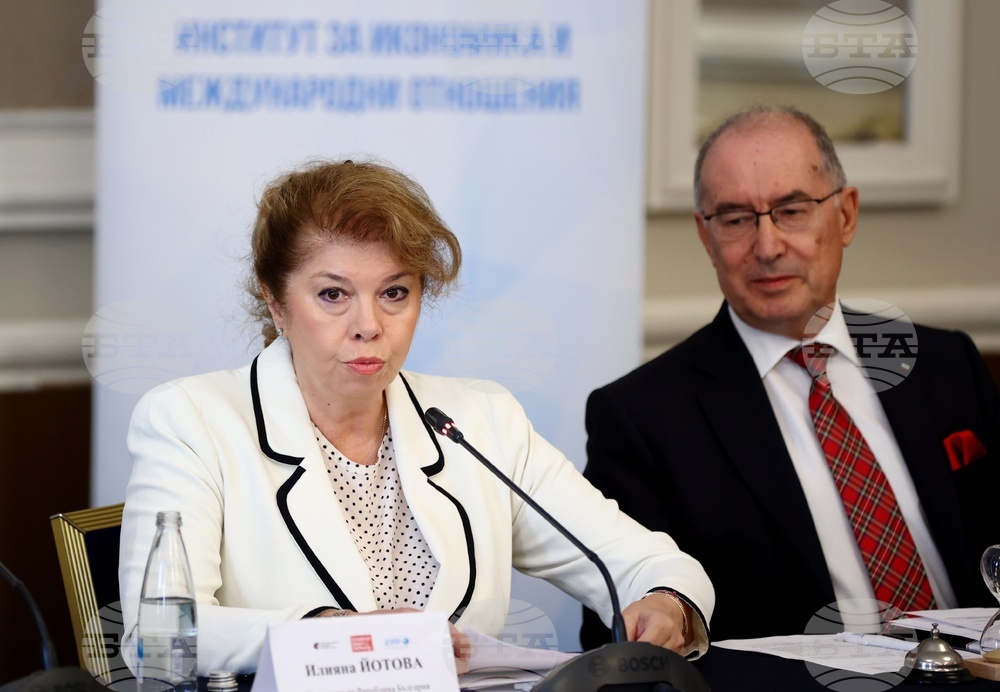
Bulgarian President Iliana Iotova said Monday that she firmly opposes viewing the Black Sea region solely as a militarizing area, stressing that the sea is a major geographical and natural asset for Bulgaria.
Addressing the conference "Towards Shared Regional Security for Peace, Stability and Cooperation in the Balkans and the Black Sea", organized in Sofia by the Friedrich Ebert Foundation and the Economics and International Relations Institute (EIRI), Iotova said developments in the region must be monitored carefully to avoid undermining tourism and the emerging industries along the Black Sea coast that provide livelihoods and income for local communities.
The event is being held in connection with Bulgaria’s Chairmanship of the South-East European Cooperation Process (SEECP). On June 10, Iotova will host the SEECP Summit marking the initiative’s 30th anniversary.
The President said the international security architecture is undergoing unprecedented challenges, noting that the geopolitical fault line currently runs through Bulgaria, the Balkans and Southeastern Europe. Security can no longer be guaranteed by any single country, she argued, emphasizing the importance of cooperation within the European Union and NATO.
Iotova said Bulgaria should contribute its own perspectives to regional security debates rather than relying solely on common framework positions. According to her, the changing geopolitical environment has increased the strategic importance of the Balkans for Europe’s security, stability and prosperity.
She called for closer attention to developments in Serbia, Kosovo, Bosnia and Herzegovina and North Macedonia, warning that regional realities are changing faster than national policies.
The President noted that Russia’s war against Ukraine has returned security to the centre of the European agenda and transformed energy into a strategic instrument. Competitiveness, she said, is now directly linked to sovereignty, employment, social stability and citizens’ well-being.
Iotova stressed that the Black Sea has become one of the most important regions on the global security map and can no longer be regarded as a peripheral area of European security.
As a NATO member and Black Sea country, Bulgaria considers maritime security a strategic priority, she said. Together with Romania and in cooperation with European institutions, Bulgaria is developing a concept for a Black Sea Maritime Security Hub. The proposed civilian network structure would focus on situational awareness, protection of maritime infrastructure, countering hybrid threats, and responding to disasters and environmental crises.
She added that recent drone incidents in a Romanian port have highlighted the need for such a hub.
Iotova also said Bulgaria, Romania and Turkiye continue joint efforts within the Mine Countermeasures Task Group Black Sea (MCM Black Sea) to ensure safe and secure maritime routes.
She argued that the European Union's SAFE (Security Action for Europe) and ReArm Europe Plan/Readiness 2030 initiatives should be expanded through joint procurement mechanisms. According to Iotova, Bulgaria's participation in SAFE has so far not sufficiently involved the country's defence industry, although expectations remain that Bulgarian companies will have broader opportunities under a future SAFE+ framework.
The President stressed that military modernization should be a systematic process based on realistic goals and clear deadlines. She expressed confidence that the new government would address economic challenges and establish priorities for defence-related investments.
Iotova said Bulgaria’s defence industry has the potential to become a technological hub within the EU’s evolving security policy.
She also highlighted the importance of regional connectivity, noting that stronger transport and energy links are essential for trade, tourism, military mobility and broader cooperation.
The President underlined the strategic importance of accelerating the construction of Corridor VIII and improving North-South transport and energy connections through cooperation between Bulgaria, Greece and Romania.
She also pointed to the importance of the tunnel under Mt Shipka project and called for progress on a third bridge over the Danube between Ruse and Giurgiu. Iotova noted that the European Climate, Infrastructure and Environment Executive Agency has approved EUR 6.9 million for a feasibility study of the project.
She also emphasized the strategic significance of the Vertical Gas Corridor for Bulgaria.
Concluding her remarks, Iotova said genuine security is built not only through military capabilities and defence strategies, but also through trust, connectivity and a willingness to seek common solutions to shared challenges.
/IV, VE/
news.modal.header
news.modal.text