Wrap-up
![Caretaker Cabinet Hands Over Executive Power to New Regular Government]()
![Caretaker Cabinet Hands Over Executive Power to New Regular Government]() Prime Minister Rumen Radev (left) and outgoing caretaker prime minister Andrey Gurov at a changing of the guard ceremony at the Council of Ministers, May 8, 2026 (BTA Photo/Milena Stoykova)
Prime Minister Rumen Radev (left) and outgoing caretaker prime minister Andrey Gurov at a changing of the guard ceremony at the Council of Ministers, May 8, 2026 (BTA Photo/Milena Stoykova)
site.btaCaretaker Cabinet Hands Over Executive Power to New Regular Government
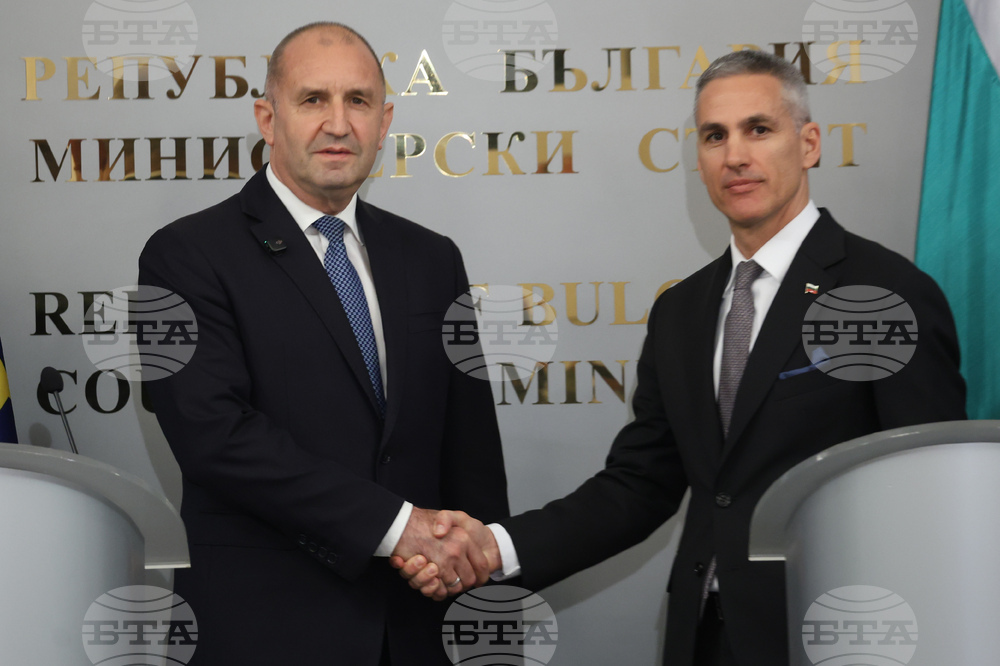
Changing-of-the-guard ceremonies took place Friday after the Rumen Radev Cabinet was approved by Parliament earlier in the day. The members of the caretaker government handed over executive power to the new ministers.
Newly elected Prime Minister Rumen Radev said that he believed that “our government is the first step toward establishing stable, strategically oriented governance in Bulgaria, with a single goal, namely the modern development of Bulgaria as a contemporary European nation.” He also thanked the caretaker cabinet for its work in ”organizing normal and fair elections and ensuring institutional continuity.” Radev expressed appreciation for the detailed handover report on the state of the executive branch. He noted that Andrey Gurov had been selected to serve as caretaker prime minister as a result of what he described as “unfortunate constitutional amendments that led Bulgaria into a dead end.” “I know it was not easy for you,” he added.
Outgoing prime minister Andrey Gurov said that the caretaker government is leaving behind "an upright state and an upright society." He noted that in only a few months the caretaker government managed to show that "the state can have a backbone, that it is possible to speak with names and that power can be exercised with integrity" and through work, not as a slogan. Addressing his successor Rumen Radev, Gurov said: "It is now entirely normal for society to have very high expectations of your government, especially against the backdrop of this unprecedented support it enjoys in both the parliament and the presidency." The outgoing prime minister said that the caretaker government faced many attacks, acts of sabotage and outright fury from "people who viewed the state as an instrument for personal gain and personal interest". “Do not betray the citizens and hand power back to those people; do not allow the law to be moved by the telephone and do not fear the truth – fear the people who keep silent about it," Gurov told the new government.
The changing of the guard by ministries:
Interior Ministry
Ivan Demerdzhiev took over the post from caretaker minister Emil Dechev. Demerdzhiev said that the main priorities of the Interior Ministry in the new Government are the fight against corruption, the restoration of justice, and the dismantling of the "Peevski–Borissov corruption model" [named after GERB-UDF Floor Leader Boyko Borissov and Movement for Rights and Freedoms Floor Leader Delyan Peevski]. Demerdzhiev thanked Dechev for the fair elections and for “cleansing” the Interior Ministry of "Peevski’s proteges". "We are aware of citizens’ expectations, consider them justified, and are ready to take responsibility," Demerdzhiev said.
Dechev said that the main priority of the caretaker government was to conduct fair elections. "We gave our best and achieved a good result. In a very short time, the leadership of the Interior Ministry managed to convince both employees and citizens that we want the police to work according to the law," he added.
Foreign Ministry
Velislava Petrova took over the post from caretaker minister Nadezhda Neynsky, who also presented a report on the work accomplished by the ministry during the caretaker government’s term. “I believe we will have the necessary stability so that Bulgaria’s foreign policy has a clear direction and represents Bulgaria in the most adequate way possible within the alliances in which it participates and on the broader international stage,” Petrova said. She acknowledged the work of her predecessor Neynsky. “I have always looked at you as a role model, not only for diplomats but also for women in diplomacy, so I will continue to rely on your wisdom from now on as well,” Petrova added.
For her part, Neynsky said: “Diplomacy is tasked with defending the national interest through much less visible, but often far more successful means, which requires a high level of professionalism and dedication, and I have no doubt that you will devote yourselves to this.” As an achievement of the caretaker government, she highlighted the successful organization of the parliamentary elections abroad despite the limited number of polling stations. “We went through the difficult task of evacuating Bulgarian citizens during the Gulf War, and we faced complex decisions in defending our national security,” she noted. “Being European is not just an empty word, but a requirement in terms of morality, justice, honesty, and legality,” Neynski stressed.
Finance Ministry
Galab Donev took over the post from caretaker minister Georgi Klisurski. Donev said that the Government will submit the draft 2026 State Budget Act within a month. He added that the real budget deficit is higher than officially reported because of what he described as numerous hidden expenditures and vowed to disclose all unpaid or unaccounted-for liabilities so that the Bulgarian public can see the actual state of the country’s finances. Donev highlighted controlling the deficit and ensuring prudent management of public finances as key priorities of the Government, with the aim of keeping the budget shortfall within reasonable limits.
Klisurski said that five financial inspections of public procurement contracts at the Customs Agency had been assigned and that a report had been submitted to the Banking Supervision Department of the Bulgarian National Bank regarding the granting of potentially bad loans by the Bulgarian Development Bank. “I hope that the new Minister and the new leadership of the ministry will bring these financial inspections to completion,” he stressed. The outgoing minister pointed out that, with regard to transparency, a technical option had been prepared that would allow the publication of the annual financial statements of all primary budget spending units in the state administration, which the new Government could make use of if it chooses to do so. Klisurski said that during his two and a half months as caretaker finance minister he had fulfilled the three main priorities announced upon taking office, namely securing EUR 65 million for the holding of the elections, extending the so-called budget extension act, and disbursing the funds for the municipalities.
Energy Ministry
Iva Petrova took over the post from caretaker minister Traicho Traikov. She emphasized that the Ministry's future efforts will be directed towards developing a stable, sustainable and competitive energy sector in the interests of Bulgarian citizens and businesses. "Decisions on nuclear energy, renewables and coal capacities, storage systems, and gas and electricity infrastructure all play a key role in ensuring energy security and independence," Petrova stressed. She highlighted that establishing effective protective mechanisms for consumers during periods of significant volatility in energy prices is of leading importance for maintaining the affordability of energy supplies.
Traikov outlined the main aspects of his team's work over the past months: "We tried to organize the energy sector, in which for a long time interests had taken precedence over State priorities." In his words, the current development of the energy sector includes prospects that the regular government can implement and build upon. "I wish you success and the will to endure," he told Petrova.
Economy Ministry
Under the structure of the new government, the Ministry of Economy is among the ministries, together with the ministries of innovation and e-government, that are being restructured into two institutions. Formerly known as ministry of economy and industry, it is now called Ministry of Economy, Investment and Industry.
Alexander Poulev took over the post from caretaker minister Irina Shtonova. As his main priorities, he outlined combating inflation in essential food products, measures against rising fuel prices, and a review of the activities of public enterprises, structures and agencies. According to Poulev, “the most important issue today” is inflation in essential food products. He said that on Monday his team and members of Parliament would put forward very tangible legislative initiatives.
Shtonova said that over the past months their main goal had been to make the ministry work more practically and in closer cooperation with business. "Bulgarian business and the economy need sustainability, predictability and a functioning dialogue with the state. Therefore, the election of a regular government with the potential for a full term is the best news for us," she said. "The most important task we set ourselves was for the Ministry to be an open and functioning point of contact for business, an administration that hears the problems, seeks solutions and communicates clearly and in a timely manner," Shtonova said, expressing confidence that this direction should continue and be further developed.
Defence Ministry
Dimitar Stoyanov took over the post from caretaker minister Atanas Zapryanov. He outliend care for defence personnel, modernization of the Bulgarian Armed Forces and the improvement of infrastructure as his main priorities. "We have a governance and legislative programme under which we will begin work without delay. We will propose amendments to the Defence and Armed Forces Act, and to the Reserve of the Armed Forces Act," Stoyanov added.
Zapryanov highlighted the efforts made during the caretaker government to increase military capabilities, address personnel shortages and upgrade the Armed Forces. Wishing Stoyanov a successful term, the outgoing caretaker minister traditionally presented him with an icon of Saint George.
Justice Ministry
Nikolay Naydenov took over the post from caretaker minister Andrey Yankulov. Naydenov said he supports proposals for lasting measures to limit the ability of the Supreme Judicial Council (SJC), after the expiry of its mandate, to take decisions that could affect the independence of the judiciary. He said that restrictions or postponement of decisions by the current composition of the SJC that could influence the future development of the judicial system are urgently needed. “On Monday you will see the legislative proposal prepared by the Progressive Bulgaria parliamentary group,” he added.
Yankulov said that Naydenov is assuming office at a very difficult moment because expectations towards him and the Government are high. “He will have my full support in matters concerning justice that are aimed at improving the system,” Yankulov said, adding that he remained available to help.
Labour Ministry
Nataliya Efremova took over the post from caretaker minister Hasan Ademov. “There is no greater challenge than Dr. Ademov raising the bar for me and me trying to jump over it,” Minister Efremova said with tears in her eyes. Turning to the employees of the Ministry of Labor and Social Policy, she added: “I will certainly be able to make the jump only with you, I will not succeed alone. You are the best.” As a new element in the work of the ministry, Efremova said she would introduce what she called an “inclusive policy.” She explained: “Recently, I was given the book “Why Nations Fail” as a gift. The summary said that when there is no inclusive policy that engages the interests of all stakeholders, nations cannot prosper.”
Ademov handed Efremova a folder containing nine tasks and proposals for continuing and expanding social policies. He noted that the Ministry had undertaken the task of helping in the effort to ensure fair, transparent, and just elections. “The second task we set for ourselves was to use the opportunities provided by European solidarity to support the most vulnerable citizens,” the outgoing minister said. According to him, the expectations of Bulgarian citizens are high, but in the social system things cannot always happen quickly. Ademov stressed that Efremova has the necessary expertise to take on the position of minister and wished her success.
Regional Development Ministry
Ivan Shishkov took over the post from caretaker minister Nikolay Naydenov. He said that among his first tasks will be addressing the poor condition of regional roads, the lack of prepared projects for key motorway sections, and a landslide affecting the Smolyan-Pamporovo road. Shishkov argued that the current state of transport infrastructure is the result of significant public spending that has been unevenly distributed across the country’s regions. “We have a clear programme for how to resolve these issues and confidence that we can turn ideas into reality,” Shishkov said, adding that he would ensure transparency in the Ministry’s work.
Nikolay Naydenov said he had handed over a file containing information on the most important achievements by sector, pending tasks, and future ideas. He voiced satisfaction with the work carried out during the caretaker government’s term and noted alignment with the new minister on the Ministry’s policies and operational approach. Naydenov also advised Shishkov to launch public procurement procedures as quickly as possible, given that resources under more than half of the contracts for current road maintenance and repair are being exhausted.
Innovation Ministry
Under the structure of the new government, the Ministry of Innovation is among the ministries, together with the ministries of economy and e-government, that are being restructured into two institutions. The former ministries of innovation and growth, and e-governance, are now united into the Ministry of Innovation and Digital Transformation.
Ivan Vasilev took over the post from caretaker innovation and growth minister Irena Mladenova and caretaker e-governance minister George Sharkov. Vasilev said that the two leading priorities over the next four years are to make Bulgaria an attractive place for high-tech business, and the digital transformation of the economy and society. The centralization of innovation technology policy is the premise behind the merger of the Ministry of E-Governance with the Ministry of Innovation and Growth into the new Ministry of Innovation and Digital Transformation. "So that there can be a unified policy on innovative technologies, the technology of the future, artificial intelligence, robotics, cybersecurity. To have them in one place, to have the policies and messages for the transformation of our economy first and foremost, and then of the state administration, through digital services," he explained.
Education Ministry
Georgi Valchev took over the post from caretaker minister Sergei Ignatov. “There must be continuity in education policies. There must also be political consensus on the vision for the future of education,” Valchev said in his address. He added that there could be no modern future without modern education and stressed that the Education Ministry plays a key role in shaping policies to improve the sector.
Ignatov emphasized that he is leaving behind a well-organized Ministry that has worked responsibly on the important tasks ahead related to exams. He expressed his gratitude to the experts for their efforts and professionalism.
Health Ministry
Katya Ivkova took over the post from caretaker minister Michail Okoliyski. She said that the most important thing in the field of public health is to shift the focus from hospital treatment to health promotion and disease prevention. "There must be control over spending in healthcare, and there must be a focus on maternal and child healthcare, a topic on which Assoc. Prof. Okoliyski and his team worked extensively," she added.
Okoliyski said: "We are leaving a predictable legacy with clear priorities and a report on what we have achieved. We rely on and expect continuity in all the meaningful work we have done."
Culture Ministry
Evtim Miloshev took over the post from caretaker minister Nayden Todorov. He said that over the past 15 years he has approached the Ministry from the opposite side, not from the side of power but from the side of non-governmental organizations. Stressing the importance of continuity in the Ministry's policies, Miloshev said: "Of course, I am not coming as a magician, but I am coming with morality, ambition and tasks facing our long-suffering sector. I am coming with the ambition to ensure visibility, dialogue and better days for Bulgarian culture at a time when the economic, domestic political and especially geopolitical situation suggest far more complex solutions."
Todorov said he feels very reassured as he hands over the culture minister's post to Miloshev. He recalled that Miloshev has been in a position of government before. Between April 2024 and January 2025, Miloshev served as caretaker Minister of Tourism. Todorov said his legacy to Miloshev includes two legislative bills: one is for the Bulgarian National Radio – to save the broadcaster's performing companies – and the other is to amend the delegated budget in the performing arts, "so that we can bring some normality to it".
Sports Ministry
Encho Keryazov took over the post from caretaker minister Dimitar Iliev. He stressed that he is taking on the position with an awareness of the responsibility toward the future of Bulgarian sports and young people. Keryazov said that he will work for the development of prevention programmes among children and young people, as well as for active partnership with state institutions and local authorities in the name of sports and youth policy.
Iliev said: “It is a real pleasure for me to hand over the position to Mr Encho Keryazov. I know Encho as a person who cares about sports and about the children of Bulgaria. Good luck! Make us proud.”
Tourism Ministry
Ilin Dimitrov took over the post from caretaker minister Irena Georgieva. He said his first step would be to conduct an analysis of the Ministry’s work and that a press conference would likely be held within a week to outline the Ministry’s priorities.
Georgieva said the she was leaving office with the summer tourism season well prepared. “I hope we are setting the stage for a well-prepared summer season, even though it will be a challenging one. As we said during our recent meetings with businesses along the Black Sea coast, we are cautiously optimistic about the results,” she noted.
Transport Ministry
Georgi Peev took over the post from caretaker minister Korman Ismailov. He highlighted transport safety as the highest priority ahead of him. Among his other priorities, the new Minister also highlighted connectivity, intermodality, digital solutions and the use of artificial intelligence systems, as well as the development of green transport. Peev added that a team is to be formed within the Ministry, which will include competent specialists in it.
Ismailov said that he is leaving the new leadership information about completed activities, ongoing projects, priorities, and problems in the sector.
Environment Ministry
Rositsa Karamfilova-Blagova took over the post from caretaker minister Julian Popov. She said the ministry faces “complex and difficult tasks” and noted that the government enters office with high expectations and a clear sense of responsibility following the election results. Karamfilova-Blagova added that it is time for reforms - specifically those requiring determination and courage - and expressed hope for a working environment where honest exchange of views prevail.
Popov said he was leaving the Ministry in good hands and wished his successor success in strengthening its role. He also thanked the ministry team for their hard work and late-night efforts.
Agriculture Ministry
Plamen Abrovski took over the post from caretaker minister Ivan Hristanov. He said: "When I started working in the system of the Ministry of Agriculture in 2004, I could never have imagined that more than 20 years later I would be so warmly welcomed by the team in my role as Minister." He thanked Hristanov for the work carried out over the past months.
Hristanov introduced the new Agriculture Minister, saying that he is well known in the sector and that it is an honour for him to welcome him to the institution.
/MR/
news.modal.header
news.modal.text