site.btaSova Harris Poll: Six Political Forces to Enter Next Parliament
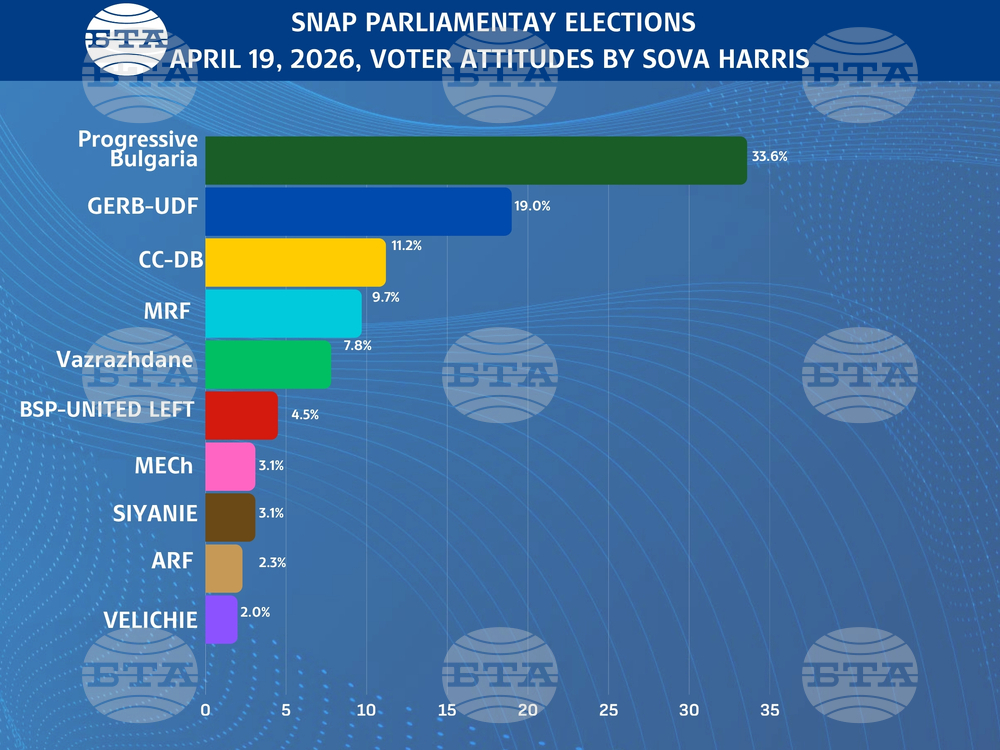
Six formations are certain to enter the next parliament, according to a nationally representative poll conducted by Sova Harris. It was taken between April 2 and 6, 2026, among 800 adult Bulgarian citizens using standardized face-to-face interviews at respondents’ homes. The survey was commissioned by Trud daily.
According to the findings, Progressive Bulgaria ranks first with 33.6%. GERB-UDF comes second with 19% support. Third is Continue the Change–Democratic Bulgaria (CC-DB) with 11.2%. The Movement for Rights and Freedoms (MRF) ranks fourth with 9.7%. Vazrazhdane is fifth with 7.8%, and BSP–United Left comes sixth with 4.5%.
Below the 4% threshold for parliamentary representation are Morality, Unity and Honour (MECh) and the Siyanie (Radiance) coalition with 3.1% each, the Alliance for Rights and Freedoms with 2.3%, and Velichie with 2%. A total of 3.7% of respondents picked "Another party/none of the above".
Sova Harris reports a rise in support for Progressive Bulgaria, which, according to the agency, indicates that the coalition’s campaign is yielding positive results with potential for further growth. Support for GERB-UDF remains stable, suggesting a serious contest in the final stage of the campaign. The upcoming vote is shaping a new bipolar political model in Bulgaria.
A key issue will be whether not only a government can be formed, but also a qualified majority capable of amending the Constitution and appointing new leaderships of regulators.
The results indicate that CC-DB is emerging as the third political force and could play a decisive role in forming a reform-oriented bloc.
MRF is expected to be the fourth political force, with potential to influence a qualified majority and judicial reforms if it joins a coalition. However, its leverage would decrease if a sixth party enters parliament, highlighting the importance of the presence of BSP–United Left. Vazrazhdane, whose parliamentary presence appears certain, is seen as a corrective opposition force capable of influencing key decisions.
The survey suggests voter turnout could reach 3,000,000 people. The Interior Ministry’s campaign against vote-buying is also a factor. Sova Harris notes that a similar operation during Boyko Rashkov’s tenure as interior minister led to turnout being about 200,000 votes lower than expected, due to a segment of voters who know only selling their vote.
If turnout does reach around 3,000,000 voters, this would mark a significant increase in public engagement in the electoral process. With ten days remaining until the elections, typically the most decisive period of any campaign, unexpected developments could still influence the outcome. A sharp rise in fuel prices could have such an effect. The caretaker Government’s signing of a 10-year security agreement with Ukraine is also identified as a factor that could alter voter behaviour.
The survey shows that high prices and inflation have become the central issue of the campaign, cited as the top concern by more than half of voters. A total of 69.8% of adult Bulgarians fear that the crisis could worsen their financial situation to the point where they struggle to make ends meet, while only about a quarter believe this will not happen. This indicates that a majority feel economically vulnerable and are seeking security and change.
There is clear public disapproval of the caretaker Government’s agreement with Ukraine. Negative assessments dominate, while a high share of undecided respondents suggests limited awareness or the complexity of the issue. This reflects a perceived lack of legitimacy in foreign policy decisions taken by a caretaker administration. The public favours a moderate and balanced foreign policy approach to the conflicts in Ukraine and Iran, with most respondents supporting diplomacy that considers all sides.
Support for full alignment with the European Commission (EC) remains limited, indicating a preference for a more autonomous national position. The significant share of undecided respondents reflects uncertainty amid the complex international environment.
There is also strong distrust in the consistency of the EC, with most voters believing that different standards are applied to the conflicts in Ukraine and Iran. This perception may fuel Euroscepticism and a sense of double standards.
Skepticism prevails regarding the ability of the elections to produce a stable government. Negative assessments outweigh positive ones, and the large number of undecided respondents indicates low trust in the political system overall -an indicator of chronic political instability.
Public attitudes are also critical of the caretaker Government’s ability to ensure fair elections. The high share of undecided respondents suggests that opinions on this issue are sensitive to current developments.
The assessment of Iliana Iotova’s performance as President is positive but not unequivocal. Positive ratings exceed negative ones, indicating a stable public image. Even voters who do not share her views acknowledge her role as an arbiter and balancer in the political system as useful and respectable, Sova Harris concludes.
/NZ/
news.modal.header
news.modal.text