site.btaNearly 80% of Roma Live in Overcrowded Housing Against 34% of Total Bulgarian Population
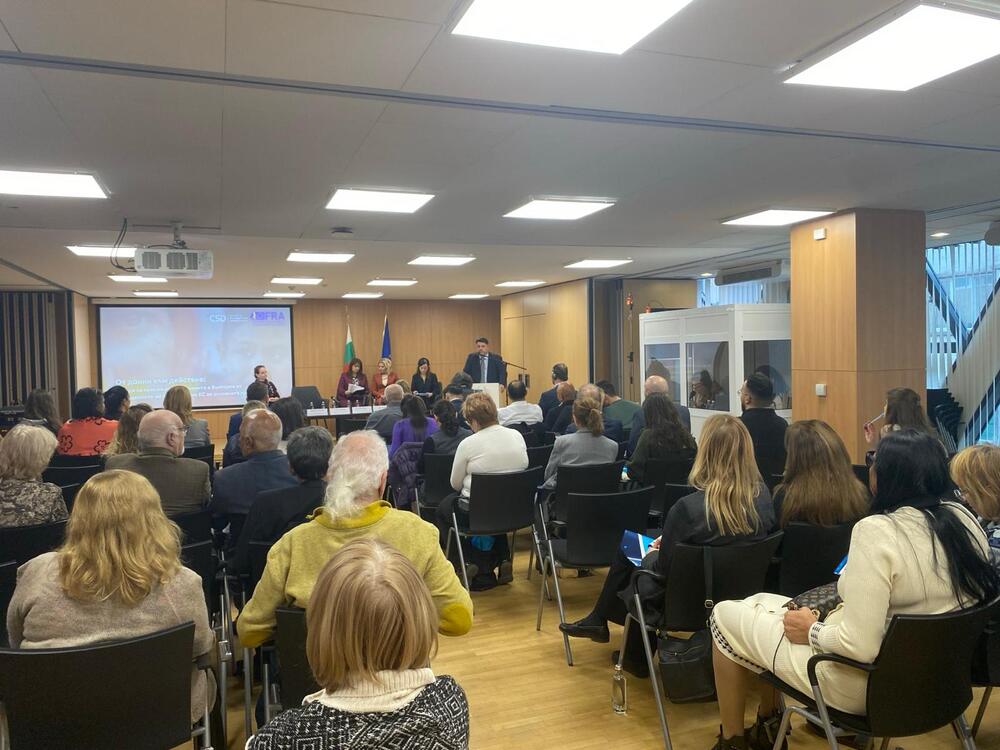
Seventy-nine percent of Roma live in overcrowded housing compared to 34% of the total Bulgarian population, experts said on Monday at a national roundtable dedicated to the findings on the situation of Roma in Bulgaria from the EU Agency for Fundamental Rights Study. The event was organized by the Center for the Study of Democracy and the EU Agency for Fundamental Rights (FRA).
During the discussion, the latest survey on Roma conducted by the EU Agency for Fundamental Rights in 2024 was presented, providing up-to-date data on fundamental rights and living conditions of Roma communities in ten EU member states.
According to the study, Bulgaria can achieve the 2030 targets in three areas- poverty and social exclusion, education, and employment. The country’s data shows positive development in some indicators. Although 53% of Roma in Bulgaria are still at risk of poverty, this represents a decrease compared to 86% in 2016. Forty-two percent of young Roma have completed at least upper secondary education, compared to 28% in 2016. Another 62% are employed in paid work, up from 49% in 2016.
However, experts noted that other challenges remain unresolved. Key issues include the living conditions of Roma in overcrowded housing (79%), with 57% living in poor housing conditions compared to 16% of the general population. Among Roma children, 70% attend segregated schools, where all or most students are Roma. Additionally, 19% of Roma reported experiencing discrimination in the past year, an increase compared to 2016, when 14% reported such experiences. Only 7% said they encountered such problems, representing a decrease from 24% in 2016.
“Our main task is in the protective function, in the proceedings initiated to prevent discrimination. There have been numerous cases in which the Commission for Protection against Discrimination has acted on its own initiative on socially significant issues, particularly when there is unequal treatment of citizens of Roma origin,” said Elka Bozhova, Chair of the Commission.
“Roma continue to face discrimination and challenges in the areas of education, healthcare, and employment,” said Yordanka Chobanova, Head of the European Commission Representation in Bulgaria. According to her, there are three key elements - equality, inclusion, and participation -for integrating Roma.
Professor of sociology Ilona Tomova addressed the topic of education. “Regarding education, some steps have been taken, such as making preschool preparation mandatory and free from the age of four, but at the same time, ‘on the ground,’ segregation in the education system is increasing,” she said. According to her, there is also “increased segregation in the labor market,” with Roma being left with either low-paid jobs or employment in undesirable sectors.
“We continue to be objects of policies rather than subjects of policies,” said Maria Metodieva, Director of Institutional Partnerships at the Trust for Social Alternative. According to her, political parties do not want to expand their platforms to include Roma. “If this does not change, there cannot be a higher level of Roma participation, nor can we guide the state on which direction to take,” she added.
During the roundtable, the topic of discrimination was mentioned several times. “Discrimination is a social phenomenon, it is prejudice. When you are affected by prejudice, it is impossible to create meaningful policies to combat discrimination,” said Radoslav Stoyanov, co-chair of the Bulgarian Helsinki Committee.
“The media do not reflect the reality in which different Roma communities live in a qualitative way,” said Mihail Mishev, editor-in-chief and founder of the platform Romalo. According to him, journalists do not understand the Roma community and are unaware of their difficulties and concerns. “What we see is that the successes of young Roma are presented, but through a lens of detachment from their community,” he said.
In the first part of the discussion, Deputy Prime Minister Atanas Zafirov reported that the share of young Roma with secondary education has increased from 28% in 2016 to 41% today.
Ombudsman Velislava Delcheva drew attention to the fact that the most visible problem concerning Roma citizens is forced evictions from their homes. “The main emphasis in recommendations to local authorities is to use all legal possibilities to take all measures to ensure alternative housing,” she said.
/RY/
news.modal.header
news.modal.text